

On this page
You spent a year preparing again for JEE or NEET, the result came good, and now a college's reporting list has a line you did not expect: "gap year affidavit". It is neither hard nor expensive. This guide shows what it contains, how the forms differ between colleges, and how to get one made before reporting day.
Is a gap certificate needed after a drop year?
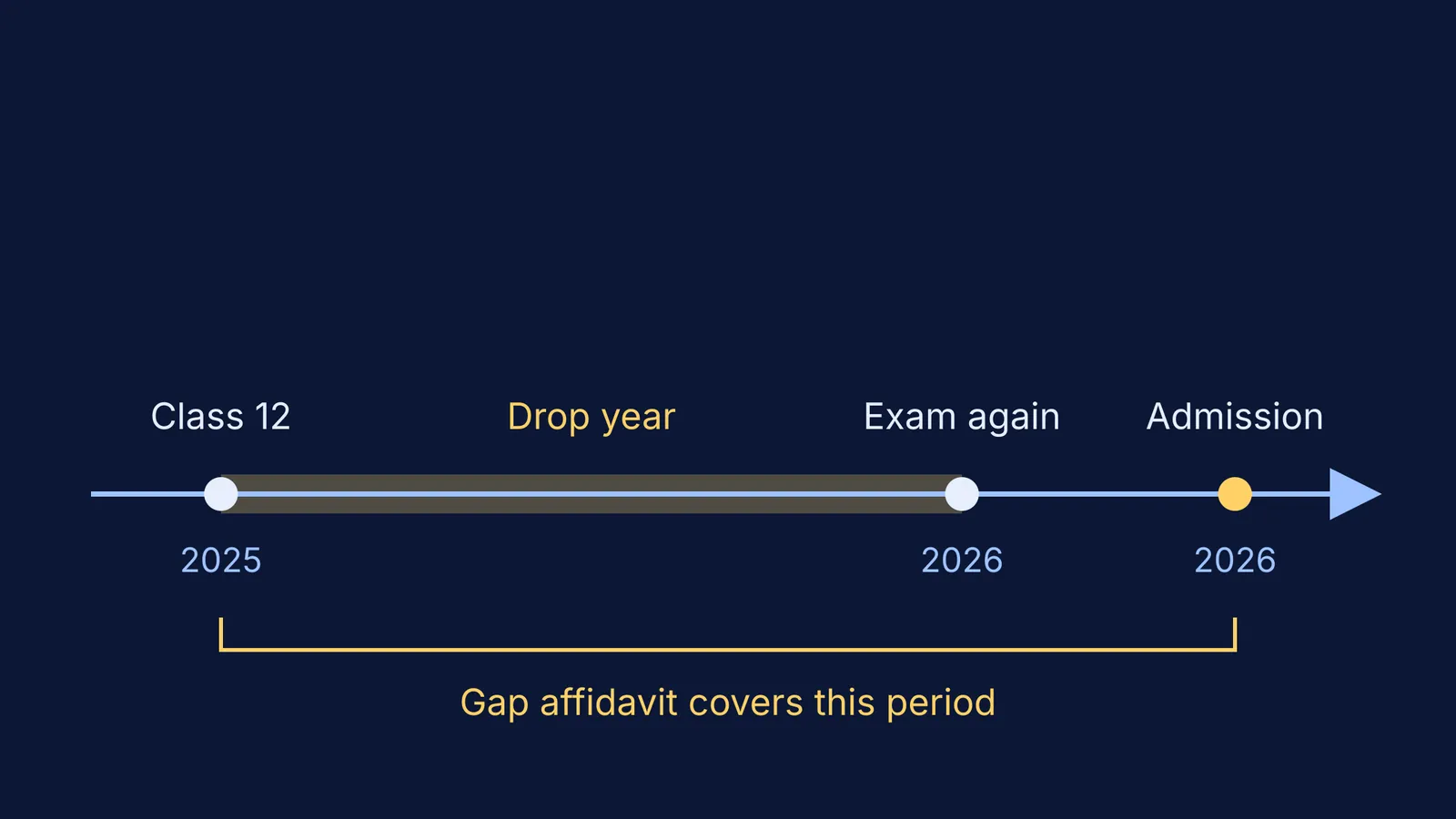
It depends on where you take admission, not on which exam you wrote. A gap certificate, also called a gap affidavit, is a short sworn statement, signed by you and attested by a notary (some forms also accept a magistrate), that explains what you did between passing Class 12 and joining college.
Some admission bodies ask every dropper for one. The JAC Chandigarh 2026 list of required documents says a Gap Year Affidavit "is required from the candidates who have appeared for the 12th exam earlier than the year 2026".
Others do not list one at all. The JoSAA 2026 certificate formats page lists no gap affidavit among its forms. Individual institutes can still add their own documents at reporting, so read the reporting list of the college that actually allotted you a seat.
For whether a drop year affects exam eligibility, see our explainer on who can sit JEE Main and the Class 12 year rules. The affidavit is paperwork, not a test.
What does a gap affidavit actually say?
We read three official formats from 2026 admissions. They are short and overlap a lot, though not every format has every point:
Who you are: your name, your parent's name and your address.
What you did during the gap. JAC Chandigarh's Annexure VII has the line "That I was engaged in ___ during the gap year".
That you were not involved in any offence or unlawful activity during the gap.
On IIIT Bhopal's format, also what you passed, the year and the school, the dates of the gap, and that no criminal case is pending against you.
On the JAC and PEC formats, a verification that the statement is correct and nothing has been concealed, signed by you as the "deponent".
The details differ. JAC Chandigarh asks for non-judicial stamp paper of ₹5 or above, attested by a Notary Public or First Class Magistrate (Annexure VII). Punjab Engineering College's gap year affidavit asks for ₹10 or above, attested by a Notary Public. IIIT Bhopal asks for a notarised affidavit on ₹100 stamp paper.
How do you get a gap affidavit made?
Do this as soon as you know which college you are reporting to, not on the morning of reporting.
Find the format in the information brochure or the certificate-formats page of the admission body. If the college asks for an affidavit but gives no format, ask its admission office which points it must cover before you buy anything.
Buy non-judicial stamp paper of at least the value printed on that format from a licensed stamp vendor.
Get the format typed or printed on the stamp paper with your details filled in. Your name, parent's name and Class 12 year should match your marksheet exactly.
Go to the notary (or the officer your format names) in person with your ID, and sign as the deponent there so the affidavit can be attested.
Keep the original flat in your document folder and make photocopies. JAC Chandigarh, for example, asks candidates to bring original documents "along with a set of duly self-attested photocopies" (JAC 2026 document list).
If you are going through JoSAA, our parents' guide to JoSAA counselling rounds, choices and documents covers the rest of the folder.
What should you write as the reason for the gap?
Write what you actually did, in plain words. For most droppers that is preparation for an entrance exam. A filled-in line on JAC's format might read:
"That I was engaged in full-time preparation for JEE Main and JEE Advanced 2026 during the gap year i.e. 2025-26."
A NEET-UG repeater swaps in the exam name. If you also worked part-time, took a short course or were unwell for some months, say so briefly and honestly.
What if the drop year is still ahead of you?
The paperwork is the easy part; the year itself is harder. Our guide to supporting your child through a JEE drop year is written for parents. If you are not sure where to restart, Fermi's AI tutor works out what you already know and builds a plan for the session, so each day starts with a clear next step.
If the pressure of a second attempt gets heavy, talk to someone you trust. The government's Tele MANAS helpline, a toll-free number (14416) set up across the country, offers 24x7 tele-mental health counselling (PIB release on the National Tele Mental Health Programme).


