

On this page
If you have just finished Class 10 and joined a JEE batch, the first few weeks can feel like a new subject. The subjects are the same, but the clock and the marking rules are different.
What changes when JEE coaching starts in Class 11?
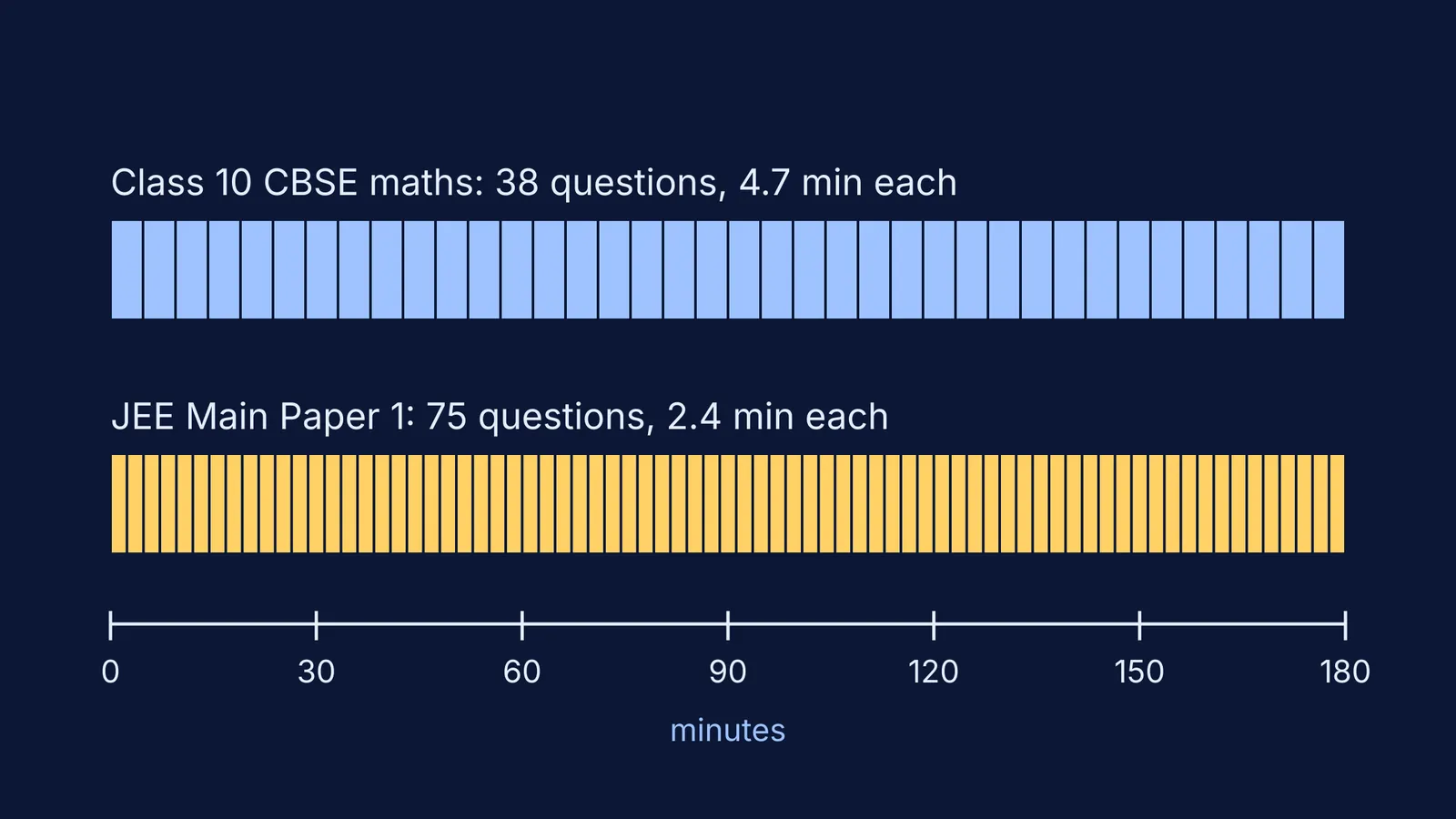
Pace. The JEE (Main) 2027 information bulletin from NTA sets Paper 1 (B.E./B.Tech.) at 75 questions in 3 hours, 25 each in physics, chemistry and mathematics. CBSE's Class 10 Mathematics Standard sample paper for 2025-26 has 38 questions in the same 3 hours. That is about 2.4 minutes per question in JEE Main against about 4.7 minutes in the board maths paper.
Marking. In JEE Main, both multiple-choice and numerical-value questions earn +4 if right, −1 if wrong and 0 if left blank, according to the NTA bulletin. Numerical answers are entered as a whole number, rounded to the nearest integer, and nobody reads your working. The board paper is different: the CBSE marking scheme splits a 3-mark answer into step marks such as 1½, 1 and ½.
Question style. CBSE's circular on assessment for 2024-25 set Class 10 papers at 50% competency-focused questions, 20% multiple-choice and 30% short and long answers, and the 2025-26 sample paper notes that the scheme continued. JEE Main has no written answers at all: you pick an option or type a number.
Coaching also brings frequent tests, often with a rank. A low early score can simply mean the format is new to you. Our 60-minute mock test review routine turns each test into a short list of fixes.
Which Class 10 habits are worth keeping?
Testing yourself. In Roediger and Karpicke's 2006 study, students who took recall tests on a passage remembered more after two days and after one week than students who restudied it, even though the restudiers felt more confident.
Spreading revision out. A 2013 review by Dunlosky and colleagues rated practice testing and distributed practice as the two high-utility techniques among the ten it examined.
Neat, complete working while practising. JEE gives no step marks, but clear working is how you find the exact line where a solution went wrong.
Which habits should you change?
Rereading and highlighting. The Dunlosky review rated both as low utility. Swap them for closing the book and writing what you remember.
Practising one chapter at a time. In a classroom study by Rohrer, Dedrick and Stershic, 126 seventh-graders worked the same maths problems over three months, arranged either mixed or one type at a time. On an unannounced test 30 days later, mixed practice produced higher scores (effect size d = 0.79). JEE papers mix topics, so your practice should too.
Answering strictly in order. At about 2.4 minutes a question in the JEE Main pattern, ten minutes stuck on one problem costs you the time for about four others. Mark it, move on and come back.
What should your first month look like?
Week 1: find the gaps. Class 11 builds on Class 10 algebra, trigonometric ratios and graphs. Try five board-level questions on each. If an idea turns out to be shaky, the Fermi Concept Library has a lesson for each concept in physics, chemistry and mathematics, so you can fix that one idea without redoing a whole chapter.
Week 2: recall after every class. Spend ten minutes writing down, from memory, the formulas and one worked example from that day. Then check your notes.
Week 3: practise at JEE pace. Take ten mixed questions from chapters you have finished and give yourself 25 minutes.
Week 4: review your first test. Sort every lost mark into one of three kinds: concept gap, wrong method, or time and care. Where you chose the wrong method, the Fermi Problem Library has worked problems with a step-by-step solver that explains the reasoning rather than printing an answer.
If chapters start to pile up, this triage plan for a JEE backlog helps you choose what to catch up first.
What can parents say after the first test?
Try: "This format is new to most of your batch. Which three questions would you fix first, and what do you need for that?" Our month-by-month guide to the first year of JEE preparation covers what else to expect.
If low mood, poor sleep or worry lasts for weeks, talk to a school counsellor or a doctor. Tele MANAS, the government's tele-mental health service, runs 24/7 on the toll-free number 14416 in every state and union territory, according to the Ministry of Health and Family Welfare.
Give the switch a few weeks. Keep the habits that make you think, drop the ones that only feel productive, and judge yourself on your fourth test, not your first.


