

On this page
For science graduates in India, the Indian Forest Service (IFoS) offers one of the most prestigious and field-oriented careers in government. As one of the three All India Services (alongside the IAS and IPS), it places officers in charge of the country's ecological wealth.
If you are studying for a B.Sc. in a pure science or a B.Tech., you are already meeting the specific academic requirements that set this exam apart from the wider Civil Services Examination.
What do forest officers do?
An IFoS officer works under the Ministry of Environment, Forest and Climate Change (MoEFCC) or state forest departments. Their primary role is to manage and protect India's forests and wildlife.
In the field, officers oversee national parks, tiger reserves and wildlife sanctuaries. They are responsible for enforcing critical environmental laws, such as the Wildlife (Protection) Act, 1972 and the Forest (Conservation) Act, 1980 (MoEFCC mandate). Beyond conservation and anti-poaching operations, they work closely with forest-dwelling communities to promote sustainable livelihoods through social forestry.
Are you eligible for the Indian Forest Service?
Unlike the Civil Services Examination, which accepts any university degree, the IFoS requires a science or engineering background.
To be eligible, a candidate must hold a Bachelor's degree from a recognised university with at least one of the following subjects:
Animal Husbandry & Veterinary Science
Botany
Chemistry
Geology
Mathematics
Physics
Statistics
Zoology
Alternatively, a Bachelor's degree in Agriculture, Forestry, or Engineering of any discipline is also accepted (UPSC IFoS Eligibility).
The age limit is generally between 21 and 32 years as of August 1st of the examination year, with standard relaxations for reserved categories. General category candidates are permitted six attempts.
How does the examination process work?
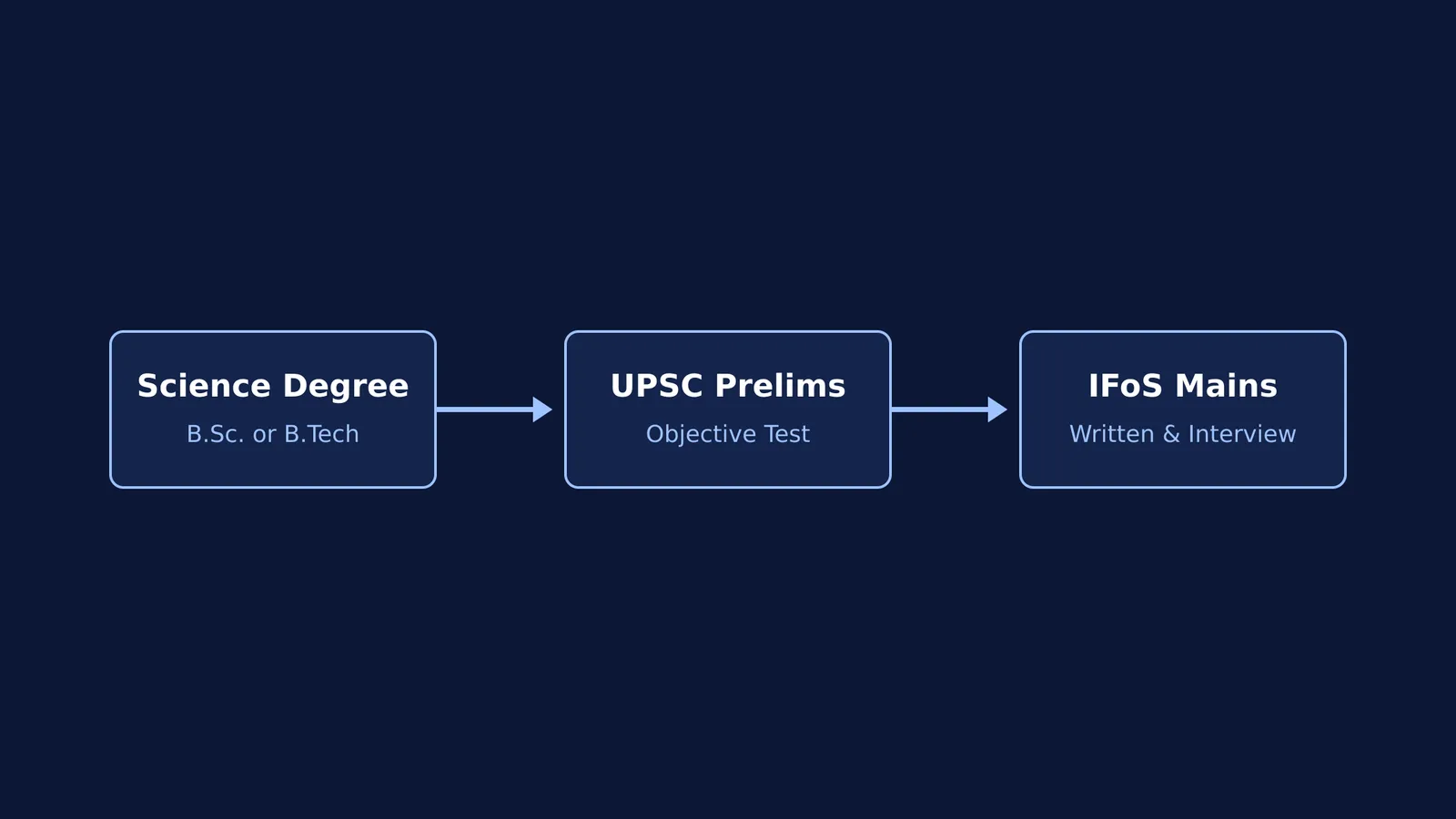
The selection process involves three stages, starting with a combined preliminary exam (UPSC rules).
Preliminary Examination: All IFoS candidates must appear for the Civil Services (Preliminary) Examination. While the paper is identical to the one taken by IAS aspirants, the cut-off marks for the Forest Service are typically higher because there are fewer vacancies.
Main Examination: This is a written, descriptive test. It includes papers on General English and General Knowledge, alongside papers for two optional subjects.
Personality Test: A 300-mark interview that assesses your suitability for a career in forest administration.
Choosing your two optional subjects
For the Main examination, you must select two optional subjects from the UPSC's approved list. This is where a science degree is a massive advantage: you can choose the subjects you have spent three or four years mastering at university.
For example, if you are studying Botany and Zoology, or Physics and Mathematics, you already have a solid foundation for the Mains.
However, the UPSC does not allow certain subject combinations. You cannot pair:
Mathematics and Statistics
Chemistry and Chemical Engineering
Agriculture and Forestry
Agriculture and Animal Husbandry & Veterinary Science
More than one Engineering subject
Preparing your science subjects
The depth of knowledge required for the IFoS Mains is equivalent to an honours degree. If you are aiming for this career while still in university, focus on building a rigorous understanding of your core subjects rather than just passing semester exams.
If you find yourself struggling with complex mechanisms in chemistry or mathematical proofs, Fermi's AI tutor can help you build that deep conceptual clarity. It works through university-level topics with you, noticing where you are stuck and explaining the reasoning step by step. When you are ready to test your knowledge against tough, descriptive questions, you can use the Fermi Problem Library to practise holding a line of reasoning across a full derivation or scientific argument. Preparing early allows you to absorb the core concepts at a steady pace, giving you a strong advantage when you eventually face the rigours of the competitive examination environment.


