On this page
If you are starting engineering or a BSc next to classmates who have coded since Class 8, your first programming lab can feel like everyone else got a head start. They did, a little. But you can close the gap if you practise in small daily pieces rather than in long sessions the night before the lab exam.
Is it normal to struggle with your first programming course?
Yes. A 2019 ACM working group that pooled course data found that pass rates in introductory programming courses appear to average about 75%, with some evidence that this is at the low end for introductory STEM courses. So about one student in four does not pass, and finding it hard says little about whether you can learn to code.
How a course is taught matters too. A 2014 systematic review by Vihavainen, Airaksinen and Watson compared 60 pass rates from before and after changes to teaching, across 13 approaches. On average, the changes raised pass rates by nearly one third compared with a traditional lecture-and-lab course. You can't redesign your course, but you can copy what works: frequent small exercises, quick feedback and working with others.
Which programming language should you learn first?
The one your college teaches this semester. Your first-year course may use C, Python or another language; check the syllabus and stay with that language until the end-semester exam. Hopping between languages splits your practice, and the basics (variables, conditions, loops, functions) carry over to every language you learn later.
If your course uses Python, keep the free official Python tutorial open next to your class notes.
How do you practise coding every day as a beginner?
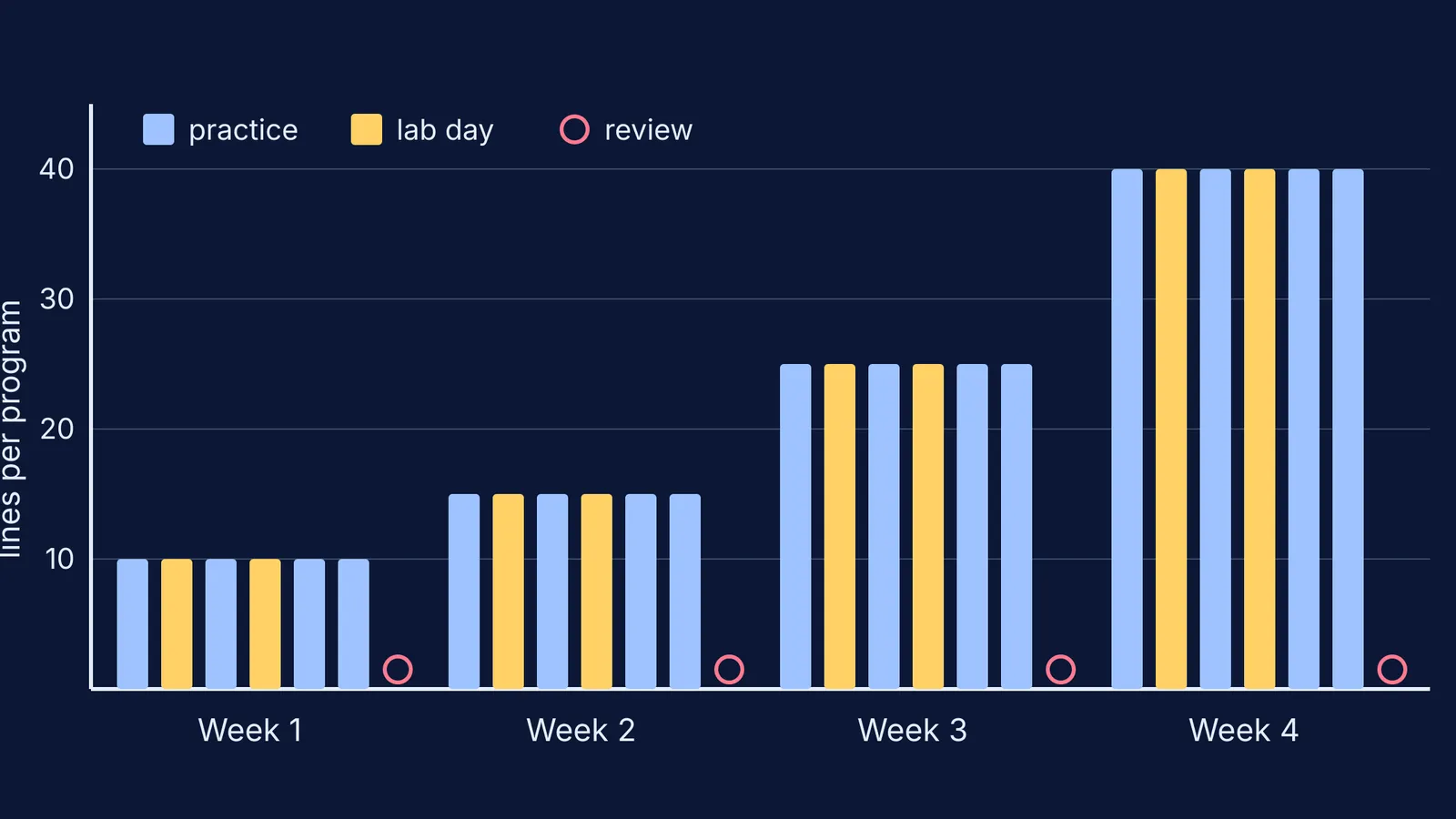
Write one small program a day, typed by you. Half an hour is enough. Here is a four-week plan:
Week 1, input and output: print your name, add two numbers, convert Celsius to Fahrenheit, split a canteen bill among friends. Up to 10 lines each.
Week 2, decisions: check whether a number is even, pass or fail from marks, the largest of three numbers, a grade calculator. Up to 15 lines.
Week 3, loops: a multiplication table, the sum of 1 to n, counting the digits in a number, a guess-the-number game. Up to 25 lines.
Week 4, functions and lists: a factorial function, the average and highest of a list of marks, a CGPA calculator for your own subjects. Up to 40 lines.
Each day, follow the same routine: write it, run it, change one thing and predict what will happen, then run it again. The prediction step is where most of the learning happens, and it is the same skill tested in predict-the-output Python questions. On Sunday, rewrite one program from the week without looking.
Errors are part of the plan; see why making mistakes helps you learn.
How do you make the most of lab sessions?
Lab is the one time in the week when a teaching assistant or faculty member can watch you code. Treat it as feedback time, not typing time.
Before: read the lab sheet the night before and write the logic in plain words or as a flowchart on paper.
During: get the simplest version running first, then add features. If you are stuck after trying two fixes, ask.
After: write two lines in a notebook: what broke, and what fixed it.
If your lab allows it, try working in pairs. In a study of 554 students at UC Santa Cruz, Charlie McDowell and colleagues had students pair-program: one types as the "driver" while the other reviews each line, and they swap roles at intervals. Students who paired were more likely to stay in the course through the final exam (90.8%) than students who worked alone (80.4%). Among those who sat the exam, which everyone took on their own, pass rates were about the same. Check your college's rules first, because graded work may have to be your own.
What if you fall behind?
Go back to the last week of the plan that felt easy and restart from there. Steady practice beats one panicked night before the lab exam. For the bigger picture of what changes after school, read about your first semester at science or engineering college.
If a word like variable, loop or function still feels vague, the Fermi Concept Library covers every concept in physics, chemistry, biology, mathematics and computing, each with its own lesson. If you don't know where to begin, Fermi's AI tutor can work out what you already know and build a plan for the session, so you sit down to a clear next step.
If worry about the course starts affecting your sleep or mood, talk to your college counsellor, or call Tele MANAS on 14416.
Tonight, write your first program: two lines that print your name and today's date.