

On this page
In school, your practical file followed a set pattern: aim, apparatus, procedure, observation table, result, precautions. In the CBSE physics curriculum for 2025-26, the Class XI practical record is worth 5 of the 30 practical marks. In college, the lab report is usually marked as scientific writing, in the format scientists use in journals.
What are the sections of a lab report?
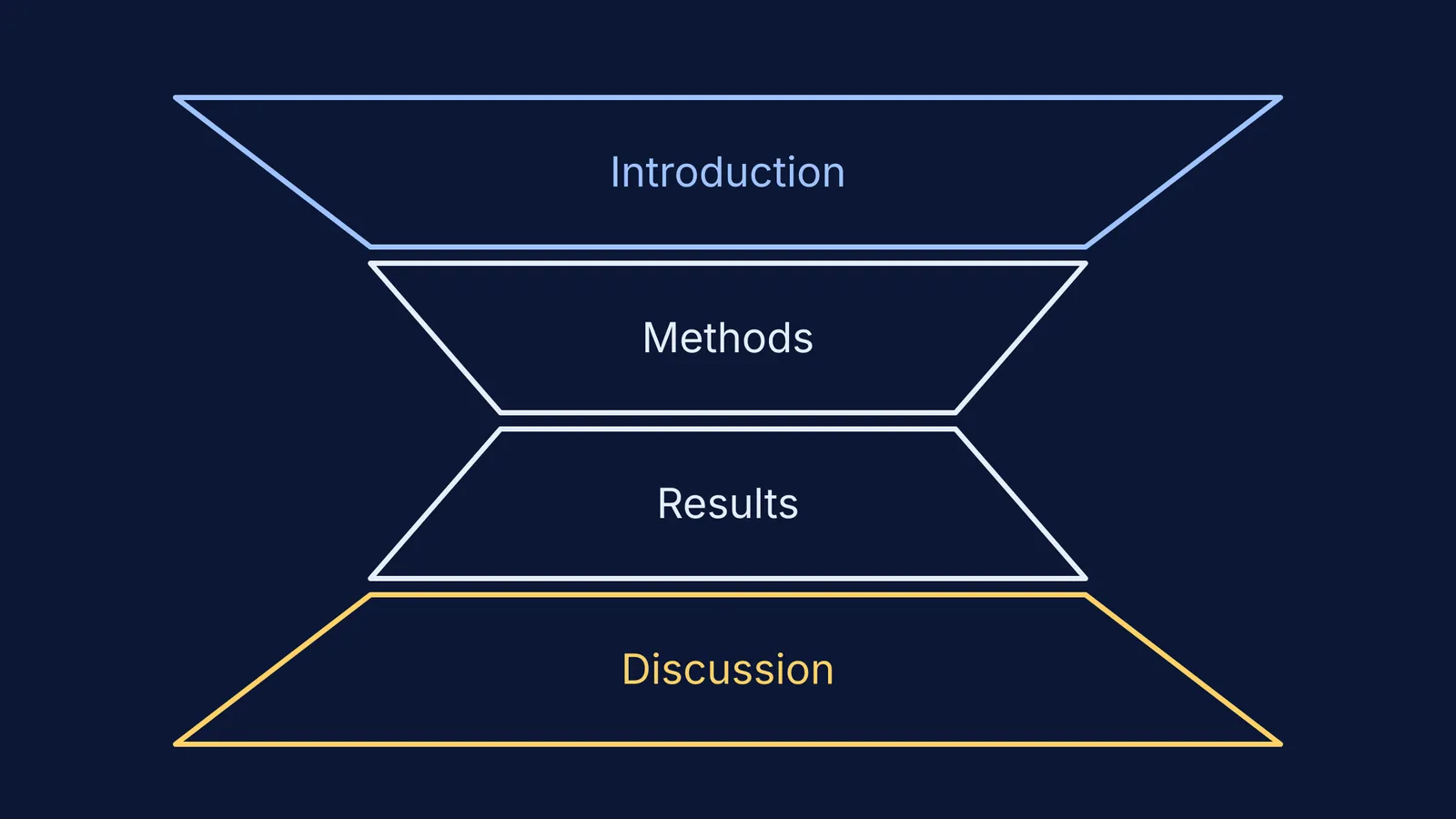
Many college lab reports follow IMRaD: Introduction, Methods, Results and Discussion. The UNC Writing Center guide to scientific reports is built around these four parts and notes that some instructors also ask for an abstract or a separate hypothesis section.
Introduction: the purpose, the background, your hypothesis and why it is reasonable.
Methods: what you actually did, in order, in the past tense, with enough detail to repeat it and reasons for your choices.
Results: your data as captioned tables and graphs with units, plus a few sentences on the trends. No interpretation yet.
Discussion: whether the data support your hypothesis, what the odd readings mean and how your results compare with earlier work.
This shape is not a classroom invention. A study by Sollaci and Pereira sampled articles from four leading internal medicine journals between 1935 and 1985. It found that IMRaD reached 80% in the 1970s and was the only pattern in original papers by the 1980s.
How is a lab report different from a school practical file?
The section names change, but the bigger shift is what each part does. A practical file records; a lab report argues.
Aim becomes Introduction. "To determine g using a simple pendulum" is an aim. An introduction says why the period should depend on length and what relationship you expect.
Procedure becomes Methods. Instead of copying steps from the lab manual, you write what you did, including changes made on the day, in your own words.
Observation table becomes Results. Tables get titles, columns get units, graphs get labelled axes, and you describe the trend in words.
Result line and memorised precautions become Discussion. Instead of one value and a stock list of errors, you explain which errors mattered in your setup and which way they pushed the answer.
One shared format becomes your own writing. You may share data with a lab partner if the course allows, but the words must be yours. Read your college's academic integrity rules in the first week.
What does a good Discussion look like?
Take the simple pendulum, which the CBSE syllabus lists among its Class XI practicals (our L–T² graph walkthrough covers the method). The school file ends with "Result: the value of g is found to be ..." and copied precautions. A college Discussion makes four moves:
Answer the question. Is your graph of T² against L a straight line through the origin, as theory predicts? Say so in the first sentence.
Compare. Put your value of g next to the accepted value and give the gap as a percentage.
Explain the gap with your own evidence. "Human error" is weak. "Timing many oscillations reduced the effect of reaction time, but the two longest lengths still sit above the line" is strong, because it points at your data.
Say what you would change. One or two concrete fixes, such as more lengths or a light gate.
If you cannot explain *why* T² should be proportional to L, the Discussion stays thin however well you write. That is a concept gap: the Fermi Concept Library gives each concept in physics, chemistry and biology its own lesson, so you can fix the idea before writing about it.
Checklist before you submit your lab report
The title says what you measured and how, not just "Experiment 3".
The Introduction ends with a hypothesis or an expected relationship.
Methods are in the past tense and describe what you actually did.
Every table and graph has a number, a caption, and units on every column and axis.
Values carry sensible significant figures (our guide to significant figures and units lists the common slips).
Results describe trends without interpreting them.
The Discussion's first sentence answers the experiment's question.
Every error you mention is tied to something in your own data.
Every source is referenced in the style your department asks for.
The writing is yours, and you have read it aloud once to catch missing words.
You followed your instructor's format sheet, which overrides any general guide, this one included.
Lab reports are one of several things that change in first year; our piece on your first semester at science or engineering college covers the rest.


