On this page
The answer key is out, your response sheet is downloaded, and your group chat already has a number. Here is how to get yours honestly: match carefully, count in buckets, and write the result as a range.
How do you estimate your score from the answer key?
Work from official documents only. For JEE (Main), NTA shows your recorded responses and question paper before the result, likely for only two to three days, so download your response sheet and keep a copy (JEE (Main) 2027 Information Bulletin, NTA). For the June 2026 NEET (UG) re-exam, a pen-and-paper test, NTA published keys for all four question paper sets and asked candidates to challenge only under the series code printed on the test booklet they took home (NTA public notice, 25 June 2026).
Then go question by question and put each one in a bucket:
Correct: your recorded answer matches the provisional key.
Wrong: you answered and it does not match.
Blank: unanswered, including “marked for review” with no answer.
Doubtful: you are not sure what you marked, or the key's answer looks wrong to you.
Count twice, ideally with someone reading out the key. The four counts must add up to the total number of questions; if they don't, you have skipped a row.
Which marking scheme should you use for NEET and JEE Main?
In NEET (UG) 2026, a correct answer earns +4, an incorrect answer −1 and an unanswered question 0, across 180 questions for 720 marks (NEET (UG) 2026 Information Bulletin, NTA).
The same bulletin says that if a question is dropped or no option is correct, every candidate who appeared gets +4 for it, attempted or not.
In JEE (Main) 2027 Paper 1, both multiple-choice and numerical-value questions carry +4 for correct and −1 for incorrect, with 75 questions for 300 marks (JEE (Main) 2027 Information Bulletin).
So for both exams: estimated raw score = 4 × correct − 1 × wrong. Check the bulletin for your own exam and year, since rules can change.
Worked example: turning a NEET answer key into a range
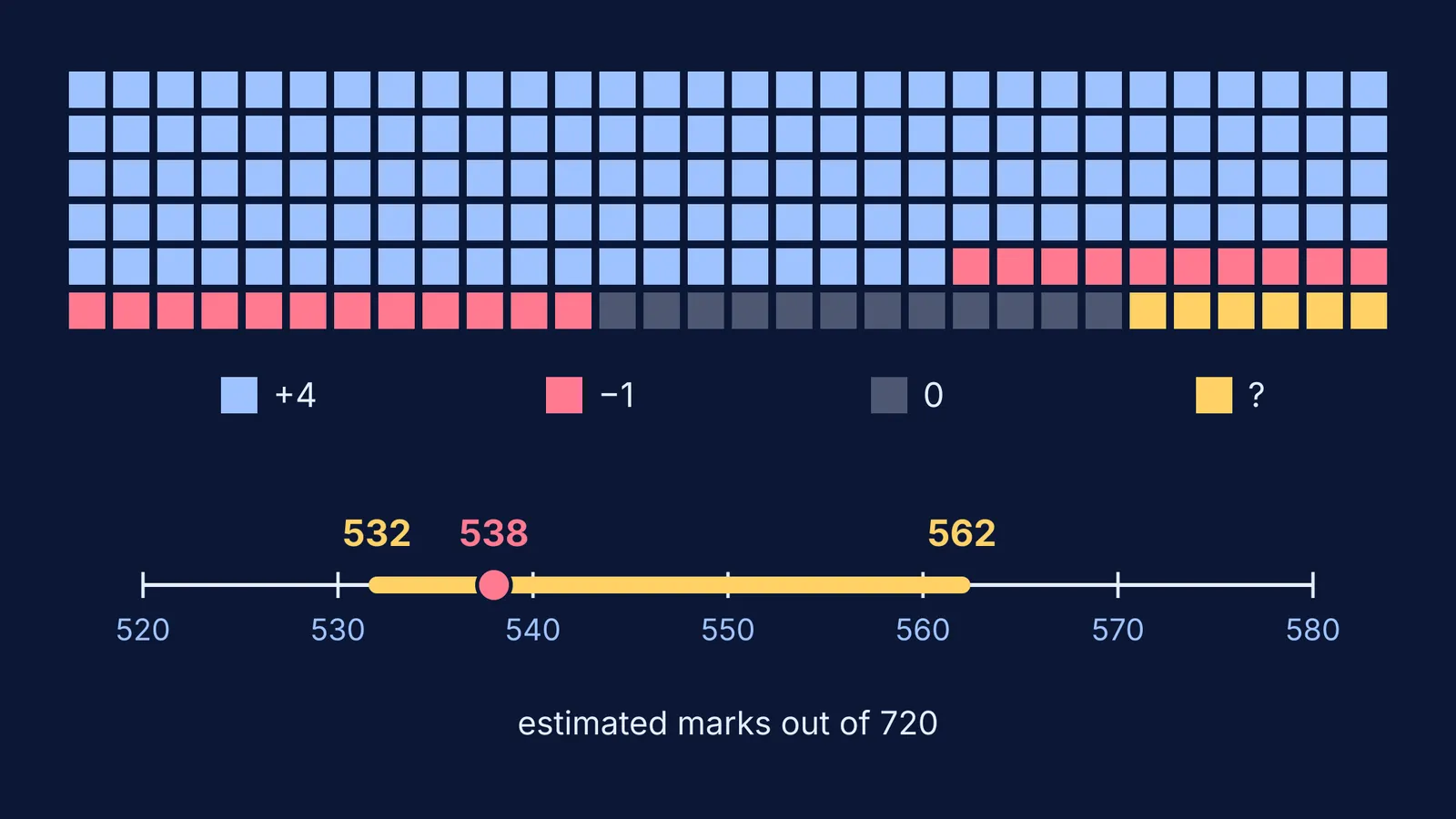
Using the NEET (UG) scheme of +4, −1 and 0 (NTA bulletin), imagine your counts are:
Correct: 140
Wrong: 22
Blank: 12
Doubtful: 6
Check: 140 + 22 + 12 + 6 = 180.
Sure score: 4 × 140 − 22 = 538.
Worst case, every doubtful question wrong: 538 − 6 = 532.
Best case, every doubtful question right: 538 + 24 = 562.
Your honest estimate is 532 to 562.
Why is your estimated score only rough?
The key can change. Subject experts examine the challenges, a final answer key is declared, and the result is compiled from that final key (JEE (Main) 2027 Information Bulletin). NTA does not tell candidates individually how their challenges were decided.
Your recorded response may differ from your memory. In the June 2026 NEET (UG) re-exam, the key challenge opened before scanned OMR sheets were available, and candidates got a separate chance later to compare their sheet with what the scanner recorded (NTA public notice, 13 July 2026). Until you see your scan, treat answers you recall from memory as doubtful.
Raw marks are not a rank. For JEE (Main), raw marks from different shifts are converted to NTA scores before merit is prepared, so the same raw score can mean different things in different shifts. Our explainer on how JEE Main percentile normalisation works shows why.
If you think a key answer is wrong, a challenge costs ₹200 per question. For the June 2026 NEET (UG) re-exam that fee was refunded for accepted challenges (NTA notice), while the JEE (Main) 2027 bulletin calls it non-refundable. Read how the NTA answer key challenge works before you pay.
What should you do with your estimated score?
Use the range to decide whether to prepare for the next session and whether a challenge is worth it. Don't use it to announce a rank to relatives.
Then use your wrong bucket. Next to each wrong answer write one word: concept, method, misread or guess. For method mistakes, the Fermi Problem Library has worked problems with a step-by-step solver that explains the reasoning rather than printing an answer, so you can see where your working went off. For concept gaps, the Fermi Concept Library gives each concept its own lesson.
Parents, one script is enough: “What range did you get? Which questions are you unsure about? Okay, we'll know properly when the final key is out.” Our guide to what to do while waiting for results has ideas for the days in between.
If the wait leaves you unable to sleep, eat or stop checking, talk to someone you trust, or call Tele MANAS, the government's free, 24/7 mental health helpline, on 14416 (PIB).
Count twice, write a range, and let the final key have the final word.