

On this page
When you fill out the application form for JEE Main or NEET, one of the first things you are asked for is a mobile number and an email address. It might seem convenient to use the email address of the cyber cafe filling out your form, a temporary school email, or a friend's phone number.
However, doing so can cut you off from your own exam results and college counselling.
The National Testing Agency (NTA) issues clear rules on this every year. If you lose access to the email and phone number you use on the day you register, you could lose access to your application entirely.
Which email and phone number to use in exam forms?
According to the official Information Bulletins for JEE and NEET published on nta.ac.in, the NTA sends all critical updates directly to the contact details provided in your application.
When you register, an OTP (One-Time Password) is sent to your mobile number and email ID to verify your identity. After that, your Application Number is generated and sent to those same details.
If you forget your password later in the year, the password reset link will only go to the registered email address. The NTA also sends a copy of your Confirmation Page to that email address, along with critical notifications when your Admit Card and final Scorecard are ready to download.
Can I use a cyber cafe email for NTA registration?
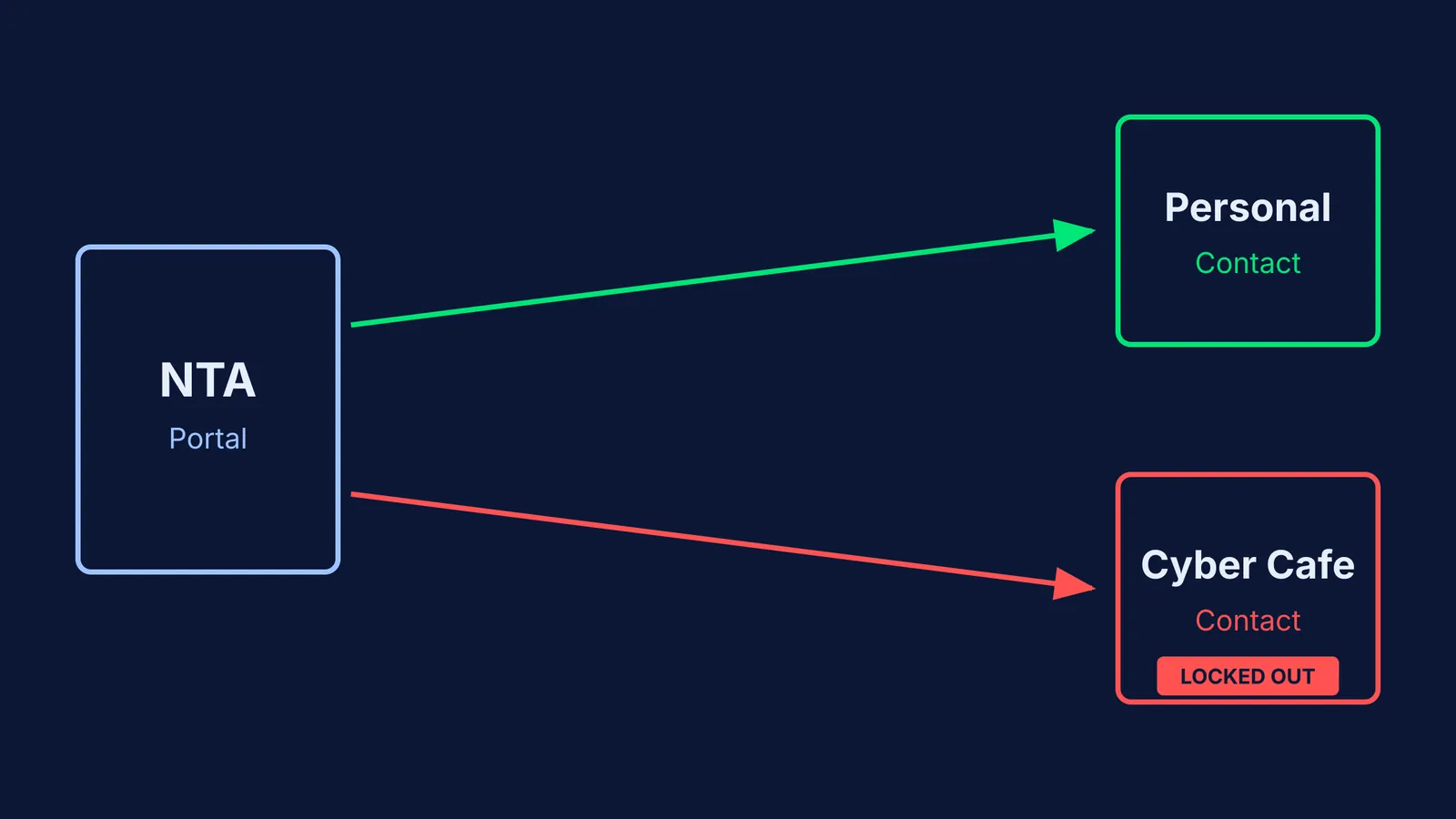
The NTA explicitly states that candidates must ensure the registered email and mobile number are their own or belong to their parents or guardians. They clearly warn against using a cyber cafe's email address or a coaching institute's contact details.
If a cyber cafe operator uses their own email to register you, they receive your application number and password reset links. You will have no way to recover your account on your own. Furthermore, if you are due any refund for application fees, the NTA automatically credits the refund back to the original payment source. If the cyber cafe paid using their card, they receive your refund.
If you mistakenly use contact details that are not yours, the NTA states it is not responsible for any non-communication or miscommunication.
Can I use my school email for JEE and NEET?
Many students are given an email address by their school (such as `student@schoolname.edu.in`). While this is your own address, it is often disabled or deleted shortly after you graduate from Class 12.
The exam and counselling process takes a long time. You will need access to your exam registration email during the JoSAA or state counselling rounds, which happen after you have left school. If your school deactivates your account, you will not be able to receive important counselling updates.
How should you set up your contact details for exams?
The most reliable approach is to set up contact details that you will control for the entire application cycle.
Create a professional email address: Set up a new email address specifically for exams, applications, and counselling.
Use a permanent mobile number: Use your own phone number or a parent's number that is unlikely to change.
Link to Aadhaar: Ensure the mobile number you use is the one linked to your Aadhaar card, as the NTA uses Aadhaar-based OTP authentication for identity verification.
Write it down: Write the exact email address, its password, and the registered mobile number in a physical notebook kept safely at home.
Once your registration is secure, the real work of studying begins. Whether you are wondering about coaching or self-study or trying to figure out why JEE aspirants plateau, knowing where to focus is half the battle. This is where Fermi's AI tutor can help. Rather than just giving you answers, Fermi builds a plan for the session, works out what you already know, and teaches through the concepts you are stuck on. If you are struggling with a specific type of question, you can use the Fermi Problem Library, a step-by-step solver that explains the reasoning.
Setting up the right email and phone number is a simple administrative task, but it ensures you stay in control of your application all the way through to college admission, laying the foundation for a study routine that lasts.


