

On this page
If you are applying to US colleges from India, the application form asks you to pick a round before you have written a single essay. That choice decides when you hear back, and whether a yes is a promise. Here is what each round means, what you sign, and how to decide.
What is the difference between early action, early decision and regular decision?
The definitions below come from the National Association for College Admission Counseling (NACAC), a US association of college admission officers and school counsellors.
Early decision (ED): you commit to a first-choice college where, if admitted, you definitely will enrol. Deadline and decision both come early. Binding.
Early action (EA): you apply early and get a decision well before the college's regular response date. It is not binding.
Restrictive early action (REA): you get an early, non-binding decision, but the college may stop you from applying ED, EA or REA to other colleges. If admitted, you have until May 1 to confirm.
Regular decision (RD): you apply by a set date and hear back within a stated period. It is not binding.
Under regular decision and early action, NACAC says you can apply elsewhere and have until May 1 to compare offers and confirm. Some colleges run a second binding round: Wesleyan University lists a November 15 deadline for ED I and January 1 for ED II. Dates differ, so check each college's own page.
What exactly do you sign for early decision?
On the Common App early decision agreement, three people sign: you, a parent or guardian, and your school counsellor. Your parent promises to "ensure the student abides by the early decision commitment".
If admitted, you must promptly withdraw other applications and make no new ones "to any other university in any country", which includes India. If you are seeking aid, you can keep other applications open until the ED college tells you about your aid. The college may also share your name and early commitment with other colleges.
A college may release you if the aid is not enough. Dartmouth's admissions office, for example, says students can be released "if the aid awarded will not be sufficient to make enrollment possible", after first trying to adjust the award.
Does applying early improve your chances?
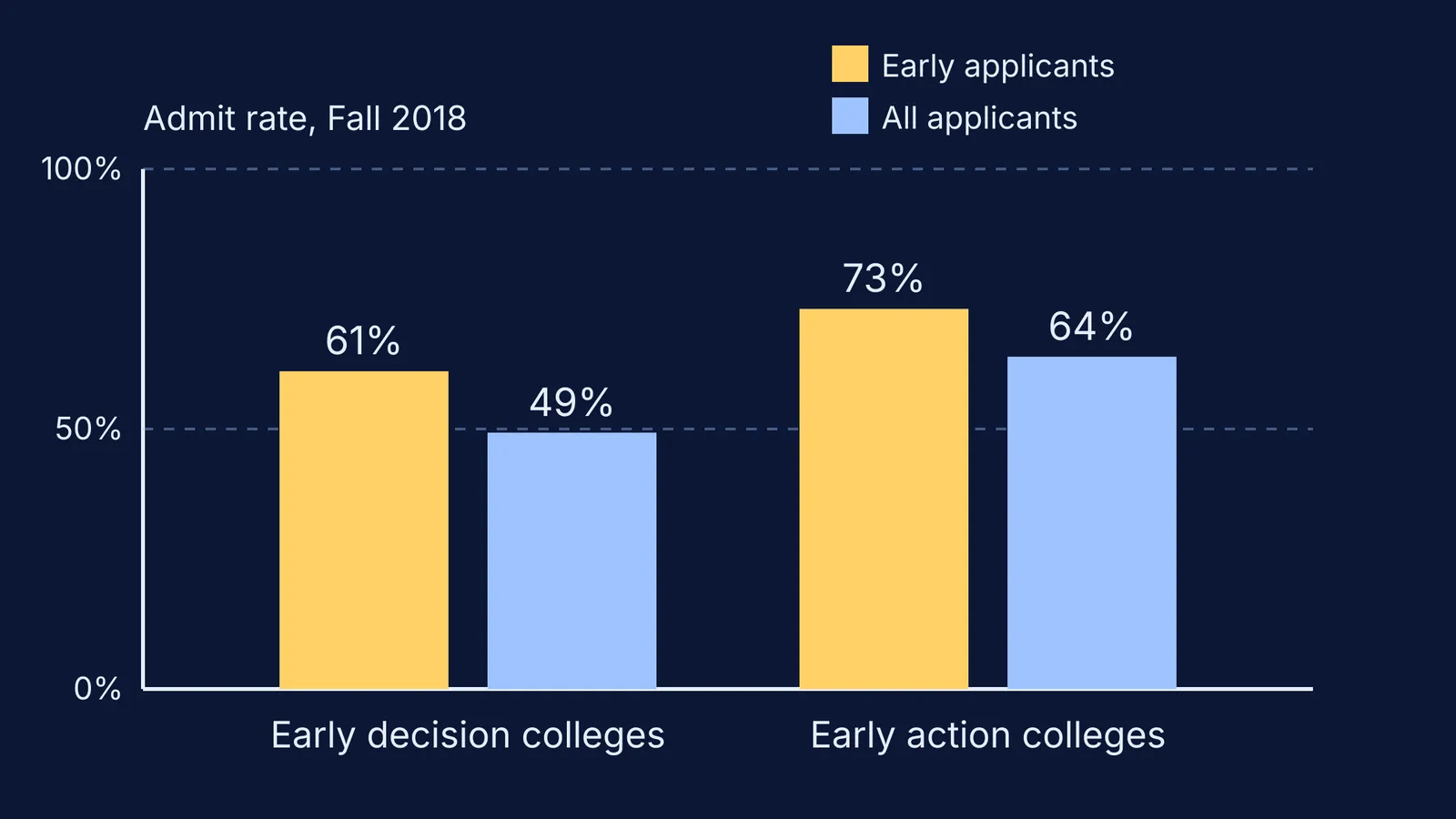
On average, early applicants are admitted at higher rates. NACAC's 2019 State of College Admission report covers Fall 2018 admissions.
25 percent of the colleges surveyed offered ED and 38 percent offered EA.
Colleges with ED admitted on average 61 percent of ED applicants, against 49 percent of all their applicants.
Colleges with EA admitted on average 73 percent of EA applicants, against 64 percent overall.
About 90 percent of ED admits enrolled, against 25 percent of all admits at those colleges.
Economists Christopher Avery and Jonathan Levin, writing on selective colleges in the American Economic Review in 2010, described an admissions advantage for early applicants. Their model rests on the idea that colleges want students keen to attend, and applying early lets students signal that.
These are averages across different applicant pools, not your personal odds.
How do you decide which round is right for you?
Answer three questions.
Is there one college you would choose over every other, after real research into its courses, costs and location?
Can your family commit without comparing aid offers? Use the college's own cost estimate. If the answer depends on aid, treat ED with caution.
Will your essays, test scores and recommendations be ready by the early deadline without hurting your Class 12 preparation?
Three yeses point to ED. If question 3 is your only yes, EA gives you an early answer with no promise. Otherwise, regular decision is a sound choice, not a fallback.
For example, Riya (a made-up student) is in Class 12 in Pune. She likes two US colleges equally, needs aid, and is writing JEE Main. Questions 1 and 2 are noes, so ED is out. Her essays are nearly done, so she applies EA where offered and RD elsewhere, keeps her Indian options open, and compares offers in April.
What to say at home:
Student: "If I get in through ED, I must go and withdraw everything else, even in India. Can we afford it without other offers?"
Parent: "Let's check the college's cost estimate tonight and decide by the weekend."
What should you do this week?
List every college with its rounds, deadlines and whether each is binding.
Block essay time around school and coaching with a weekly time-blocking plan.
If the essays keep slipping, read why procrastination is about feelings.
Marks remain central to admission. In the same NACAC report, 75 percent of colleges rated grades in all high school courses as considerably important in Fall 2018 decisions. If a Class 12 chapter is still shaky, the Fermi Concept Library has a lesson for every concept in physics, chemistry, biology, mathematics and computing.
Once the offers are in, you can start thinking about your first semester at college.


