

On this page
Many JEE and NEET aspirants in India spend most of the week at coaching or studying at home, and only nominally at school. People call this a dummy school. Before you build your day around it, know the rule that can undo it. CBSE's circular of 4 August 2025 says a minimum of 75% attendance is mandatory to appear for the Class 10 and 12 board exams. It also says that if a surprise inspection finds students absent without proper leave records, they may be treated as “non-attending/dummy candidates”, and CBSE will not allow them to sit the board exams.
The plan below gives your day the structure a school timetable used to, and keeps attendance, board subjects and practicals from costing you a year.
What does CBSE's attendance rule mean for JEE and NEET students?
Here is what the same CBSE attendance circular and its attached procedures say:
The board gives a 25% relaxation only for exigencies such as medical emergencies, national or international sports events and other serious reasons, backed by documents.
Leave must be requested in writing. Leave without a written request counts as unauthorised absence.
Attendance is counted up to 1 January of the session, and shortage cases must reach the regional office by 7 January. Once the school has sent them, attendance records cannot be changed.
Schools should write to parents, by registered or speed post or email, if a student often misses school.
Your practicals and internal assessment take place at your own school, according to CBSE's guidelines for practical examinations. For Class 12, the board appoints an external examiner. For the 2025 exams, regular-session schools had to hold them between 1 January and 14 February 2025. Rules are reissued yearly, so check the newest circular on cbse.gov.in. On another board, ask your school for its rule in writing.
How should you structure a study day without regular school?
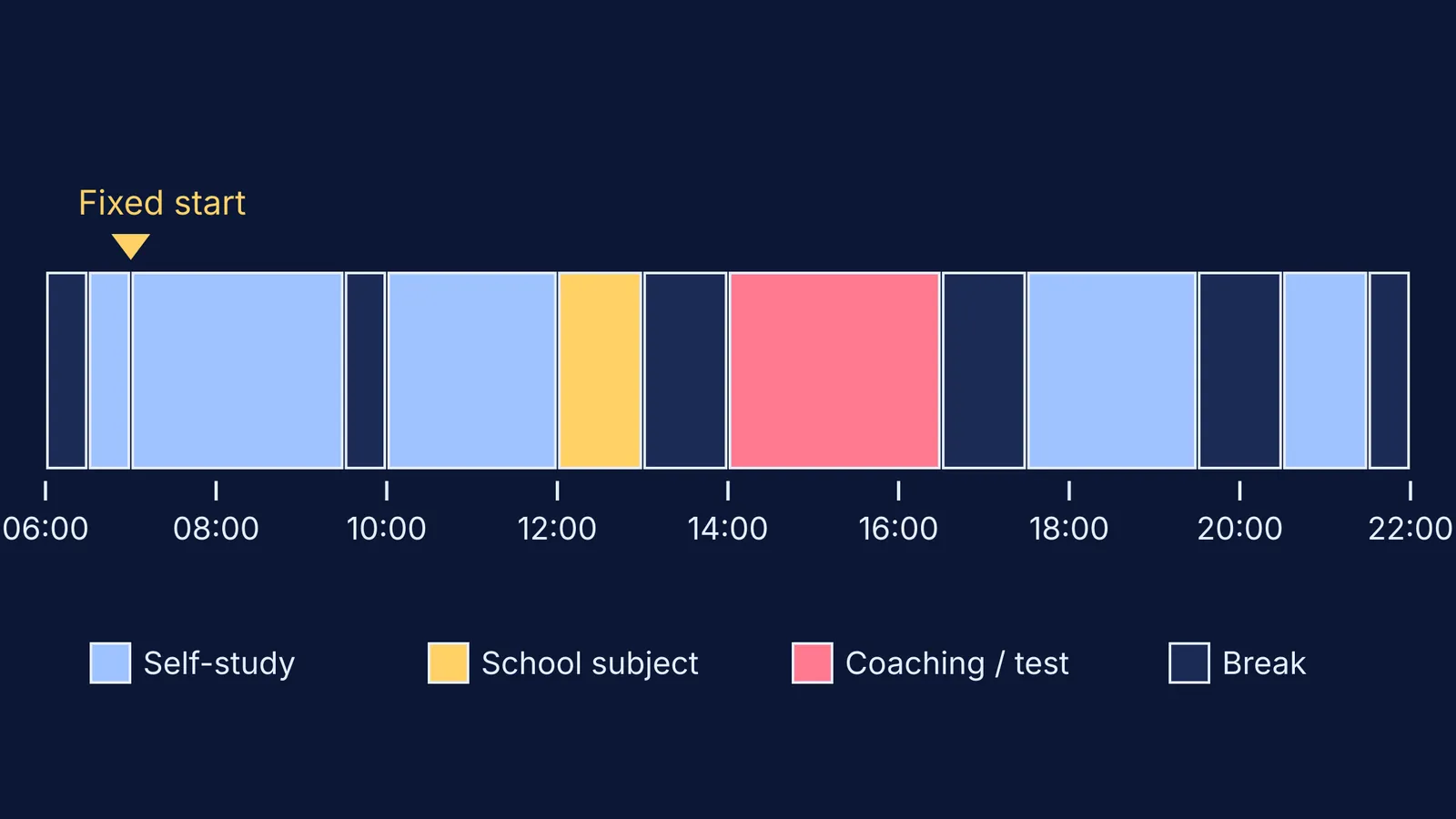
A school day gives you one thing that self-study doesn't: a bell. Pick a fixed start, say 07:00, and treat being late for it the way you would treat being late for class.
Work backwards from sleep. The American Academy of Sleep Medicine's consensus statement recommends that teenagers aged 13 to 18 sleep 8 to 10 hours per 24 hours. If you wake at 06:00, that means lights out by 22:00.
Here is a sample home-study day:
06:00–06:30: wake up, no phone.
06:30–07:00: redo two problems you got wrong yesterday.
07:00–09:30: Block 1, your weakest JEE or NEET subject, timed problems.
09:30–10:00: breakfast and a short walk.
10:00–12:00: Block 2, second subject: new theory, then questions.
12:00–13:00: school-subject slot.
13:00–14:00: lunch and rest.
14:00–16:30: coaching class or a timed test.
16:30–17:30: exercise or time outdoors.
17:30–19:30: Block 3, third subject, then your error log.
19:30–20:30: dinner with family.
20:30–21:30: NCERT reading and tomorrow's plan.
21:30–22:00: wind down, screens off.
On days you go to school, the school day replaces Blocks 1 and 2 and the school-subject slot. Keep the same start and finish times either way. To plan the whole week, see our guide to time blocking for students juggling school and coaching.
If you sit down for Block 1 and don't know where to begin, Fermi's AI tutor can work out what you already know and build a plan for the session, so the block starts with a clear next step.
Where do board subjects and practicals fit?
Give them the 12:00 slot every day, rotating through the week:
Monday and Wednesday: English and any subject that JEE or NEET does not test.
Tuesday and Thursday: practical file, observations and likely viva questions.
Friday: one section of a past board paper, written by hand.
Our guide to CBSE Class 12 physics practicals and the viva shows what to prepare. For how the two syllabuses overlap, read balancing Class 12 board exams with JEE preparation.
For an experiment you have only read about, the Fermi Simulation Lab has interactive simulations for ideas that are easier to see than to read. Use it before the real lab session, not instead of it.
How do you keep your attendance record safe?
Use this checklist every month:
Ask the school for your attendance percentage, and note it down.
For every absence, give a written leave application at the time. For illness, attach medical papers straight after.
Keep a copy or photo of every application.
Add practical and internal assessment dates to your calendar the day the school announces them.
Parents: open every letter or email from the school about attendance.
A leave note can be this short: “To the Principal. My child [name], Class [XII-B], Roll No. [ ], was absent on [dates] because [reason]. [Medical certificate attached.] Please record this as leave. [Parent's name, phone, date].”
If a timetable this full leaves you exhausted or anxious most days, talk to a parent, teacher or counsellor, or call Tele MANAS, the government's 24x7 tele-mental health service, on the toll-free number 14416.
Start tomorrow with one change: set the 07:00 start and keep it for a week.


