

On this page
For a University of Delhi seat, the list you save in the Common Seat Allocation System (CSAS) matters almost as much as your CUET-UG score. The rules below come from DU's official CSAS(UG)-2026 document. They can change each year, so read the new version on admission.uod.ac.in before you start.
How does CSAS preference filling work?
After NTA declares CUET results, DU opens Phase II, the preference-filling window, where you rank “Programme + College” combinations. Each combination, such as “B.A. (Hons.) Psychology at College X”, counts as a separate seat (CSAS(UG)-2026, chapter 5).
For 2026, DU listed 73 UG programmes and more than a hundred B.A. Programme combinations across 69 colleges, and you could choose as many as you liked, provided you met each programme's eligibility (CSAS(UG)-2026, chapter 4). Three rules from that chapter shape everything else:
Only saved preferences count, so save often.
The last saved order locks automatically at the Phase II deadline and is used for every allocation round.
After the deadline you cannot add, delete or reorder anything, with one exception.
That exception is a short window. Before the first round, DU declares “simulated ranks”, tentative ranks based on submitted scores and preferences, and you may revise your list then (CSAS(UG)-2026, section 4.4). Treat them as a reality check, not a promise.
Why does the order of your preference list matter so much?
In each round, CSAS gives you the highest preference on your list that your merit, category and the available seats allow. What happens next is where a weak list hurts (CSAS(UG)-2026, chapters 6 and 7):
If you are allocated a seat and do not accept it in time, you are out of all later regular rounds.
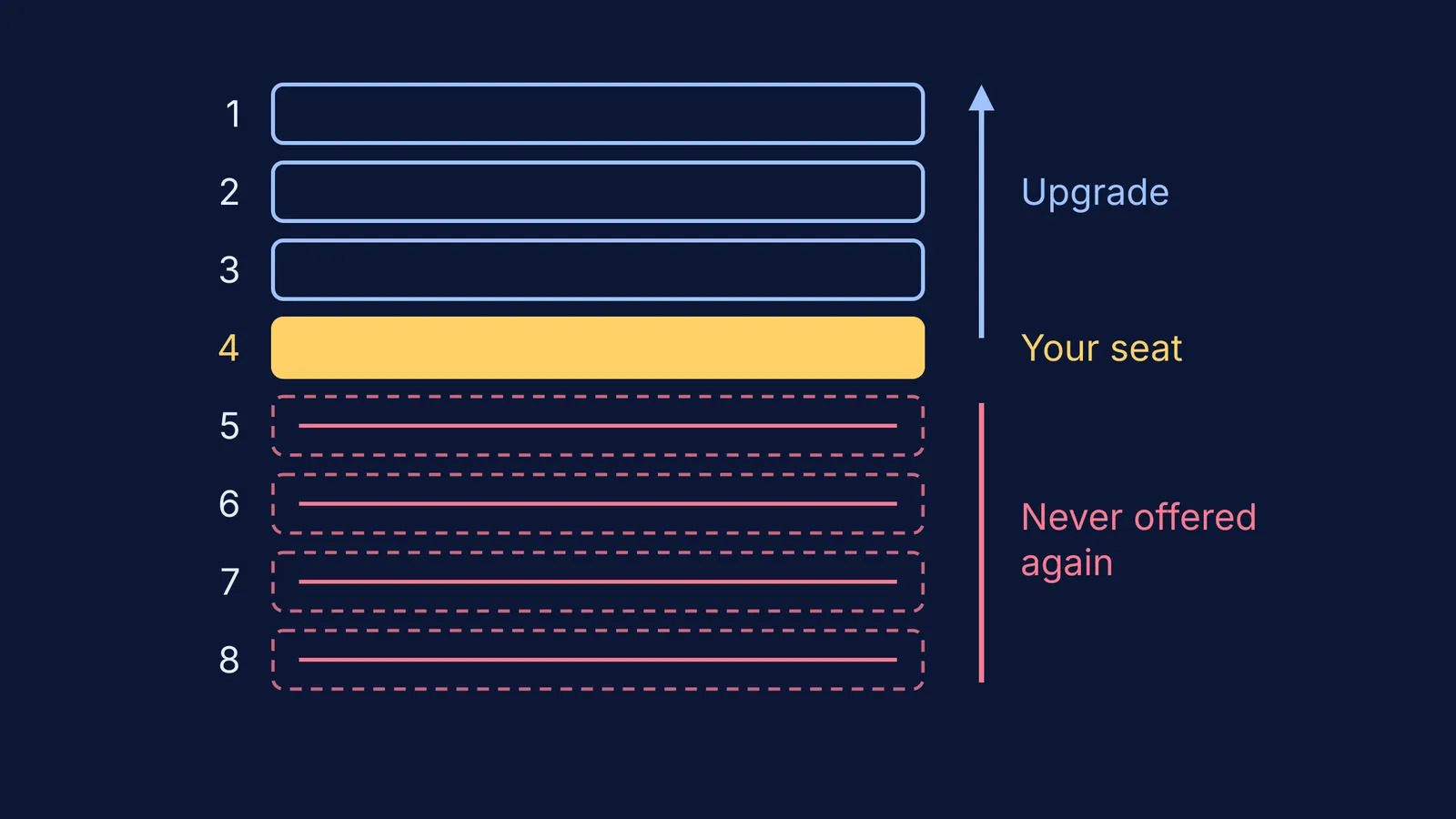
After paying the fee you choose “Upgrade” or “Freeze”. Upgrade keeps you in the running only for combinations ranked higher than your current seat. Everything ranked below it is never offered again.
If you get your first preference, there is no upgrade.
So if you would rather study at your ninth choice than your fifth, your order is wrong: once you take number five, number nine is gone.
How do you check eligibility for each course?
Before choosing programmes, you map your Class XII subjects to the CUET papers you took. DU calls correct mapping “an essential criterion for the selection of programmes” (CSAS(UG)-2026, section 4.1). The General Test is not mapped to any subject. If a Class XII subject has no CUET paper, you must have taken a closely related one, with at least 50% of the syllabus matching.
Colleges check again after you accept, and they can reject a seat for failing programme-specific eligibility or subject mapping (same document, section 6.2.2). For example, under section 4.2, B.A. (Programme) combinations with Mathematics, Statistics, Computer Applications or Computer Science as a core discipline require a pass in Class XII Mathematics. Read each programme's eligibility in DU's UG Bulletin of Information 2026-27 and tick it off before it goes on your list.
A worked example: one list, four tiers
Take a hypothetical science student who took Physics, Chemistry, Mathematics and English in CUET and wants physics above all. They build the list in four tiers:
Reach: B.Sc. (Hons.) Physics at the colleges they want most, where past minimum allocation scores were above their score.
Match: B.Sc. (Hons.) Physics where past scores were close to theirs, then B.Sc. (Prog.) Physical Science at colleges they like.
Wider: B.Sc. (Hons.) Mathematics or Electronics, only if they would be happy studying either.
Safety: combinations well within reach that they would still join, with travel and fees checked.
Inside each tier, they order by honest preference: is Physics at a far college better than Physical Science near home? Decide before the lock, not during a round. DU posts minimum allocation scores after each round on its admission website; they shift every year, so use them as a rough guide.
What should you check before the deadline locks your list?
Subject mapping matches your Class XII marksheet.
Every programme passes its eligibility in the Bulletin.
No combination you would refuse.
The order matches honest preference, especially where tiers meet.
Fees, location and hostel checked for each college, as the CSAS document advises.
List saved, and the “Selected Preferences” tab previewed.
A quick test for parents: ask your child to read the list aloud and say, line by line, whether they would go there. Any hesitation is a line to move or delete. Then, in the rounds, log in after every result, accept on time, and choose Upgrade only if a higher choice is still worth it.
If your list leans towards physics or maths, the waiting weeks are a good time to firm up basics with the Fermi Concept Library, which has a lesson for every concept in physics, chemistry, biology, mathematics and computing.
Still choosing papers? Read CUET for science students. The same rank-honestly logic applies to JoSAA counselling, and once a seat is yours, see our guide to your first semester at college.


