

On this page
You have a college offer and you want a year before you start, to work, travel, care for family or try a big exam again. Deferral exists for exactly this, but the rules differ by country and by university.
What does it mean to defer a college offer?
Deferral means you accept a place now and start the same course a year later. UCAS, the UK admissions service, puts it simply: "Deferring simply means delaying", and you can usually defer your entry by only one year (UCAS deferred entry guide).
Two things catch students out. First, it is the university's choice: UCAS says not all universities or colleges accept deferred entries, and it is up to each one whether to accept a deferral for your course. Second, your offer does not get easier. UCAS notes that the conditions of a deferred offer stay the same, so you still need the grades in the year you applied.
Which colleges allow you to defer admission?
There is no single list, so check each university's own page. Four examples:
Harvard lets admitted students defer by choosing "I defer" on their reply form, and considers two-year deferrals for military or religious service (Harvard College FAQ).
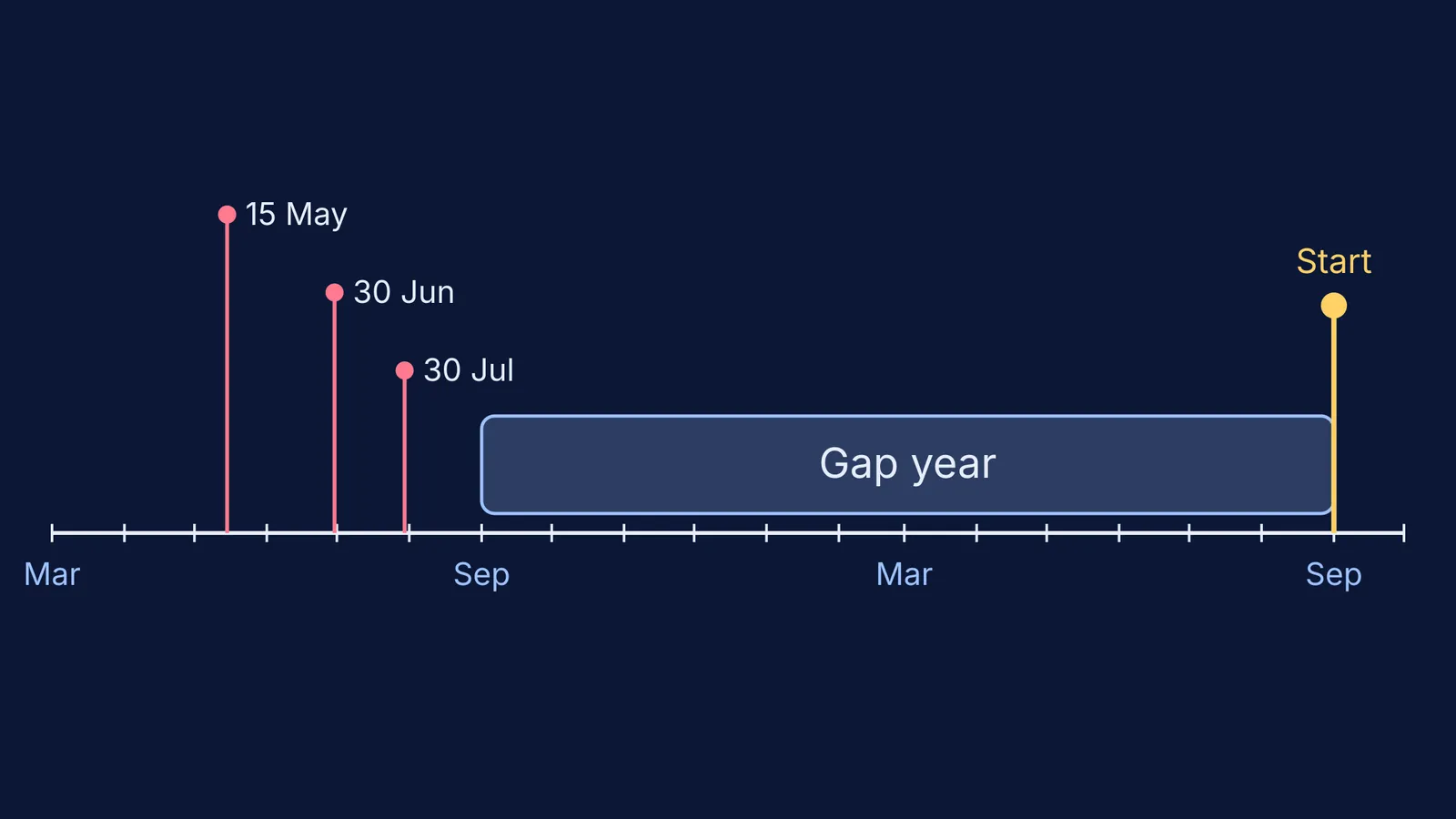
Princeton says students may request to defer for one year, that requests are not guaranteed, and recommends asking before 15 May (Princeton admission FAQs).
Brown reviews written deferral requests case by case and asks for them by 15 May (Brown admission).
LSE in London accepts one-year deferral requests from offer holders, does not grant two-year deferrals, and set 30 July 2027 as this cycle's deadline (LSE offer holders).
In India, engineering and medical seats are allotted through counselling rounds, which work differently from individual offers. If your seat came through JoSAA, read the current business rules on the official JoSAA site before deciding anything: withdrawing, not reporting and sitting an exam again each have their own rules.
What reasons do colleges accept for a gap year?
Universities rarely list approved reasons. They want a real plan. Harvard's gap-year page describes what its deferred students have done, from work, travel and research to music, sports, volunteering, political campaigns and military service (Harvard: considering a gap year). LSE asks you to set out your reasons and plans in writing.
Strong requests usually involve one of these:
a job, internship or apprenticeship with dates
a structured volunteering or service programme
family responsibilities, recovery from illness or compulsory military service
a specific project: research, a sport, an art form, a language
"I need a break" is fair; turn it into a plan before you write.
How do I ask to defer my admission?
Read the university's own deferral page and note the deadline. Dates differ: 15 May at Brown, the end of June at Harvard for students who have already committed.
Accept the offer first if the university asks you to. Princeton recommends asking only after you decide to enrol.
Write a short, specific request.
Keep every reply in writing, and ask what you must do to confirm your place.
Here is a script you can adapt:
"Dear Admissions Office, I have accepted my offer for [course], starting [month, year]. I would like to request a one-year deferral to [month, year]. During the year I plan to [specific plan, with dates and organisation]. I will not enrol in a degree programme elsewhere. Could you tell me how to confirm my place? Thank you, [name, applicant ID]."
What should I do in the gap year?
One study is encouraging. Andrew J. Martin of the University of Sydney, writing in the Journal of Educational Psychology, studied more than 2,800 high school and university students in Australia. Those who had taken a gap year reported higher motivation at university, such as planning and persistence, even though gap-year takers had tended to show lower motivation and performance at school (Education Week summary). It shows a link, not proof that the year caused it.
A simple plan for the year:
Months 1-3: start the main thing you named in your request, and keep every letter or certificate.
Months 4-9: keep one hour a week for the subject your course starts with, so the first semester is not a cold start.
Months 10-12: confirm your place, sort out housing and money, and read about settling into your first semester at college.
For that weekly hour, the Fermi Concept Library covers every concept in physics, chemistry, biology, mathematics and computing. If you are not sure where to begin, Fermi's AI tutor works out what you already know and builds a plan for the session.
If the year is for another attempt at an entrance exam, read our guide to supporting a drop year. Weighing a move? See moving cities or staying home.
If the year starts to feel heavy rather than useful, talk to someone early. In India, Tele MANAS is a free, 24x7 national helpline on 14416.


