

On this page
Choosing an academic path can feel like walking through fog. Whether you are deciding on a stream after Class 10, selecting a university degree, or weighing whether to take a drop year for entrance exams, the sheer number of variables can be overwhelming.
Most students lean on what everyone else is doing. According to a 2019 Mindler survey reported by India Today, 93% of Indian students aged 14 to 21 are aware of only seven career paths, including engineering, medicine, law, and management. But choosing a stream based solely on what is popular—or what your parents' friends suggest—often leads to mismatched skills, academic stress and deep regret later on.
You need a way to clear the fog and make a choice based on your actual strengths and priorities.
How do you make a big decision about studies?
When faced with multiple options and conflicting advice, the best approach is to make your thinking visible. A simple tool used by engineers and project managers to do exactly this is the weighted decision matrix.
Instead of keeping a messy pros-and-cons list in your head, a decision matrix forces you to write down your choices, define what matters most to you, and score them objectively. It turns a subjective feeling into clear numbers.
For instance, if you are reading our guide on Choosing a stream after Class 10: a guide for families, sitting down to draw a matrix together can help you move from an emotional argument to a calm, concrete decision.
Why do students regret their stream choice?
Regret often stems from unexamined assumptions. A student might choose the Science (PCM) stream purely because they scored well in Class 10 mathematics, only to realise that the daily effort required for competitive exams leaves no time for their real passion. Another might pick Commerce because their friends did, without researching the actual subjects involved.
By building a matrix, you assign specific weights to the factors that matter to *you*. If having time to pursue design, coding or sports is your top priority, you might assign "Free Time" a heavy weight of 5. If getting into a specific vocational career is non-negotiable, "Career Alignment" gets the highest weight.
When you write it out, you protect yourself from making a decision based entirely on a single criterion, like a recent test score, a sudden fear of missing out, or peer pressure.
How does a weighted decision matrix work?
To build your own matrix and map out your choices, follow these four steps:
List your options: Write your possible paths as columns across the top of a page. This could be Science (PCM), Science (PCB), Commerce, or Arts. It could also be "Join local college" vs "Take a drop year for JEE".
Choose your criteria and weight them: Write the factors that matter down the left side. Give each one a weight from 1 to 5 (where 5 is the most important). You might include Interest, Career Alignment, Past Grades, and Cost or Time.
Score each option: Go row by row and score how well each option meets the criterion, from 1 (poor) to 10 (excellent). Be brutally honest with yourself here.
Calculate the totals: Multiply your score by the weight for that row, then add them all up.
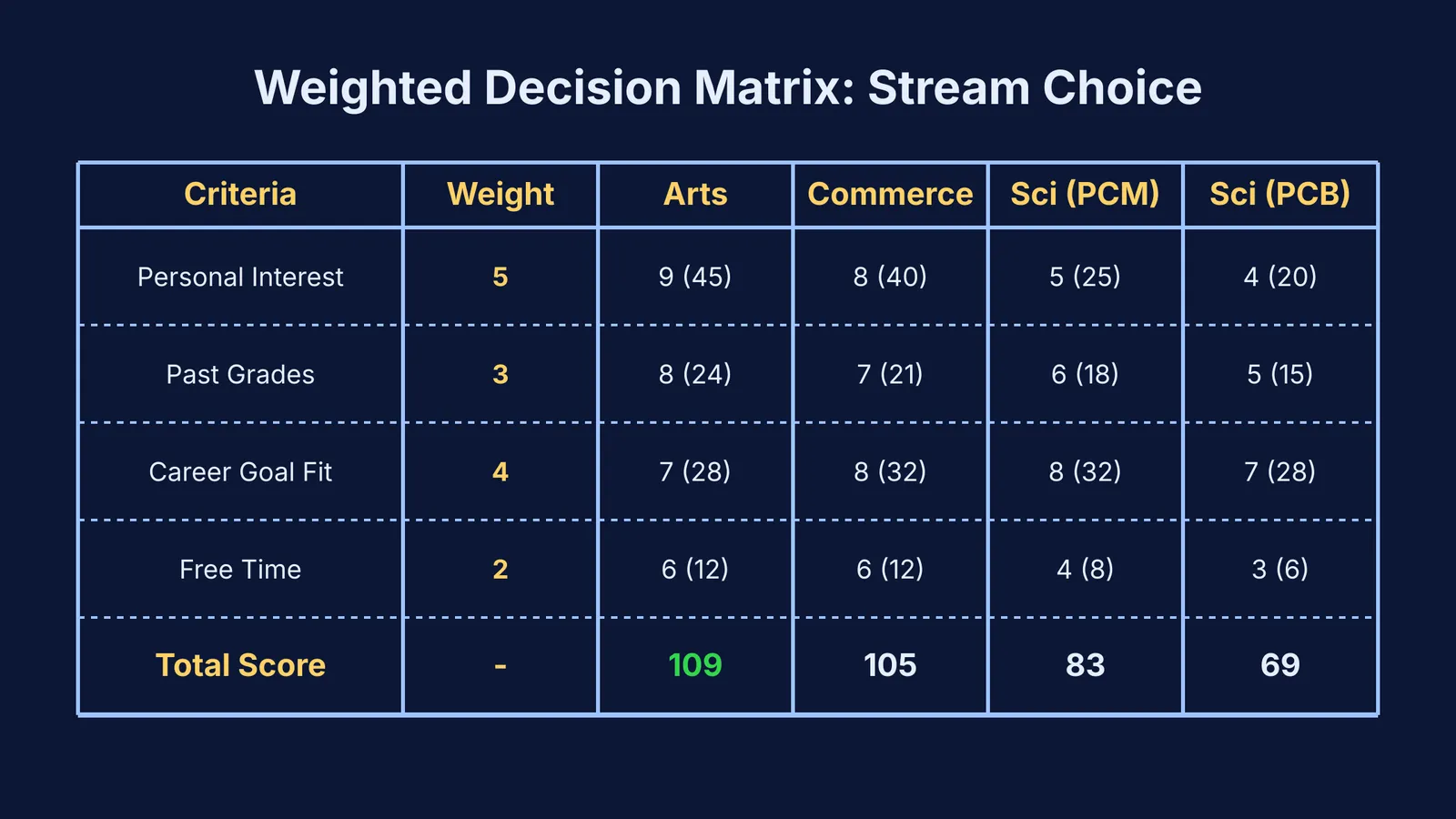
The option with the highest total is your logical winner based on the priorities you set. In our example diagram, the student highly valued their personal interest (weight 5) and past grades (weight 3) in subjects aligned with Arts and Commerce. As a result, Arts scored 109 and Commerce 105, easily beating the Science streams for this particular student.
What if you still feel stuck?
Sometimes the matrix gives an answer you do not like. That is also a highly useful result: it tells you that your assigned weights might not reflect your true feelings, or that you are missing crucial information about an option.
If your matrix points you toward taking up Science because it aligns with your career goals, but you are worried about the sudden jump in difficulty, remember that you are not alone. When you sit down with your new textbooks and feel lost, Fermi's AI tutor can work out what you already know and build a plan for the session, so you sit down to a clear next step.
Whether you are debating between CBSE Class 10 Mathematics Standard or Basic or choosing a university degree, the choice is ultimately yours. Writing it down in a structured way just helps you see it clearly.


