On this page
Debate is often misunderstood as simply arguing loudly or talking over someone else. In reality, it is a rigorous, structured exercise in logic, research and active listening. Beyond the stage, these skills translate directly to academic success. A 2021 study of over 35,000 high school students found that participating in debate was associated with a 0.66-point higher GPA and over 50 points higher on reading and math entrance exams (Ko & Mezuk, 2021). It teaches you how to deconstruct an opponent's case and present your own with clarity.
What are the common school debate formats?
Before you start writing a speech, you need to understand the rules of engagement. Different schools and regional competitions use different formats, but they all share a common goal: two sides arguing for or against a specific motion.
Asian Parliamentary: This format features two teams of three speakers. The "Government" proposes the motion, and the "Opposition" argues against it. Speeches usually last 6 to 8 minutes. Crucially, this format allows Points of Information (POIs)—short, strategic interruptions from the opposing team designed to challenge the speaker mid-flow. Handling POIs teaches you to think on your feet.
British Parliamentary: Often used in university tournaments but increasingly popular in high schools, this format involves four teams of two. Two teams represent the Government and two represent the Opposition. It requires careful strategy because you must not only defeat the opposing side but also stand out from the other team on your own side.
World Schools Style: This format combines elements of both Parliamentary and traditional debating. Teams of three deliver 8-minute speeches, followed by a shorter reply speech that summarizes the debate. It places a heavy emphasis on real-world knowledge and structured, persuasive delivery.
Understanding these formats is your first step, but the core of any debate is the content of your speeches.
How do you build a strong argument?
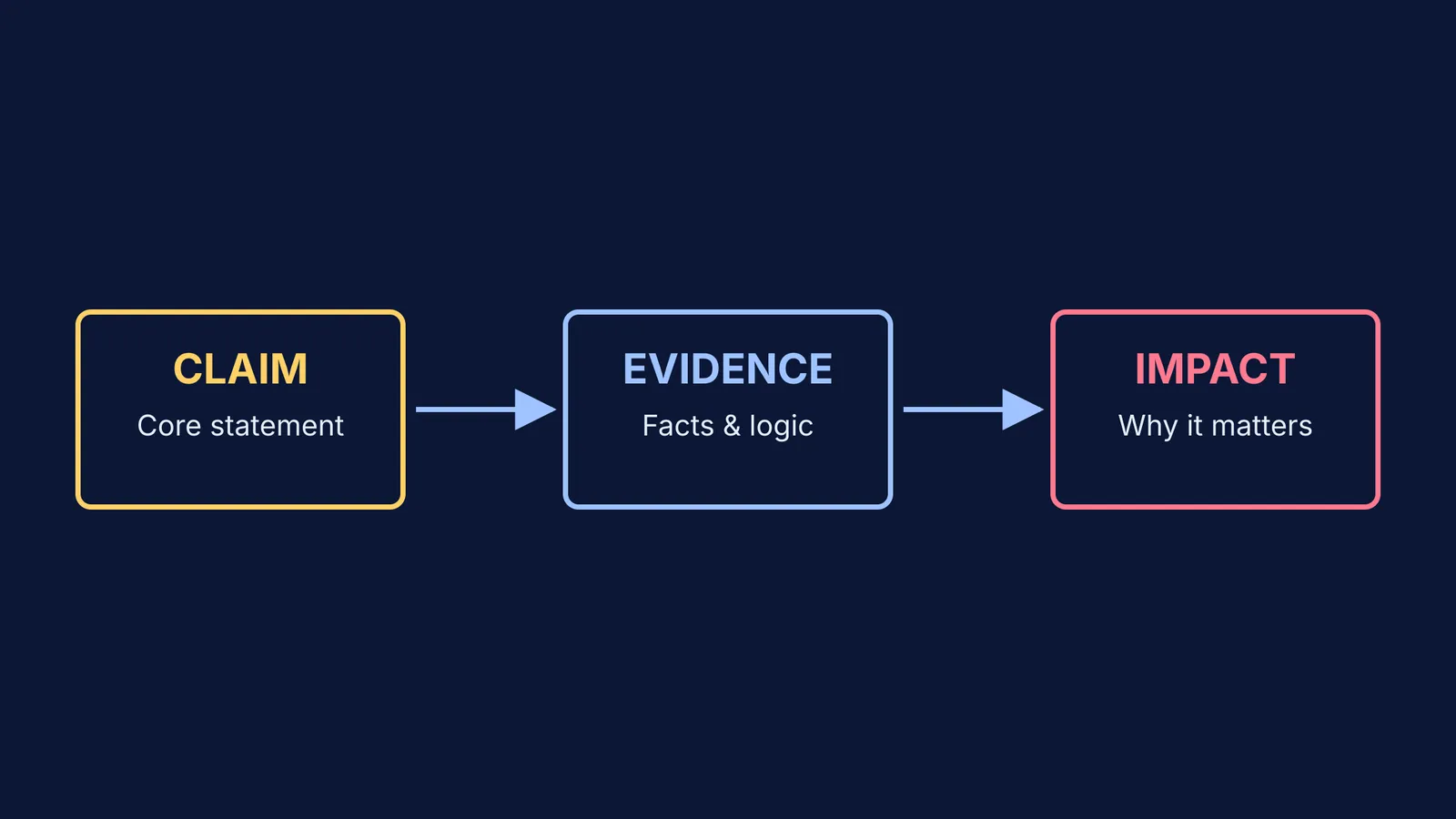
A common mistake new debaters make is stating a strong opinion without backing it up. To win a debate, you must construct a complete logical chain. The most reliable framework for this is the Claim-Evidence-Impact model.
Claim: This is the core statement of your argument. It should be one clear, concise sentence that the judge can easily write down. For example, "Renewable energy creates more local jobs than fossil fuel extraction."
Evidence: Here, you provide the facts, statistics or logical reasoning that prove your claim is true. This is where thorough research becomes critical. If your motion touches on science and you find yourself struggling with the underlying facts, the Fermi Concept Library contains every concept in physics, chemistry, biology, mathematics and computing, each with its own lesson and its place in the map. A solid understanding of the principles prevents you from making factual errors on stage.
Impact: This is the most important part of the argument. You must explain why your claim matters in the context of the debate. Who does it help? Why is it more significant than the opponent's claim? Without an impact, your evidence is just trivia.
Predicting your opponent's arguments helps you prepare effective rebuttals in advance.
How can you practice with friends?
You do not need to wait for a formal school club to start debating. Gathering a few friends and running mock debates is an excellent way to build your skills in a low-pressure environment. For parents, understanding how to help children learn without pressure ensures debating remains an enjoyable and enriching activity rather than another stressful academic demand.
Choose a topic you all care about, set a timer and stick to the time limits strictly. Start with shorter speeches, perhaps 3 or 4 minutes, and gradually increase the time as you become more comfortable with the structure. Treat these sessions seriously; organizing a useful mock debate requires the same focus as running study groups that work. Ensure someone acts as a timekeeper and a judge to give constructive feedback.
It is completely normal to feel nervous before you stand up to speak. Your heart rate might rise, your palms might sweat, and your mind might temporarily go blank. However, learning about treating exam nerves as energy can change how you view these physical responses. Instead of interpreting them as fear, you can recognise them as your body preparing you to perform at your absolute best.
Finally, review your performance after every session. Ask your friends for honest feedback on your clarity, your pace and the strength of your logic. When you struggle to construct a line of reasoning, remember that learning to hold an argument takes time and patience. In subjects like physics or mathematics, Fermi's AI tutor holds a line of reasoning across a whole session, notices where a student is stuck, and decides whether to explain, ask, or show. You can apply that same methodical patience when structuring and reviewing your own debate speeches.
With consistent practice, the structure of debating will become second nature, and you will find yourself communicating more clearly both on stage and in the classroom.