On this page
When you book a train ticket on IRCTC, stream a video, or check board exam results, thousands of read and write requests strike the storage layer every second. Behind those applications sits a database administrator (DBA), ensuring that records remain consistent, durable, secure, and rapidly retrievable. Without rigorous administration, even the cleanest software application collapses under data corruption, deadlocks, and slow queries.
What does a database administrator actually do?
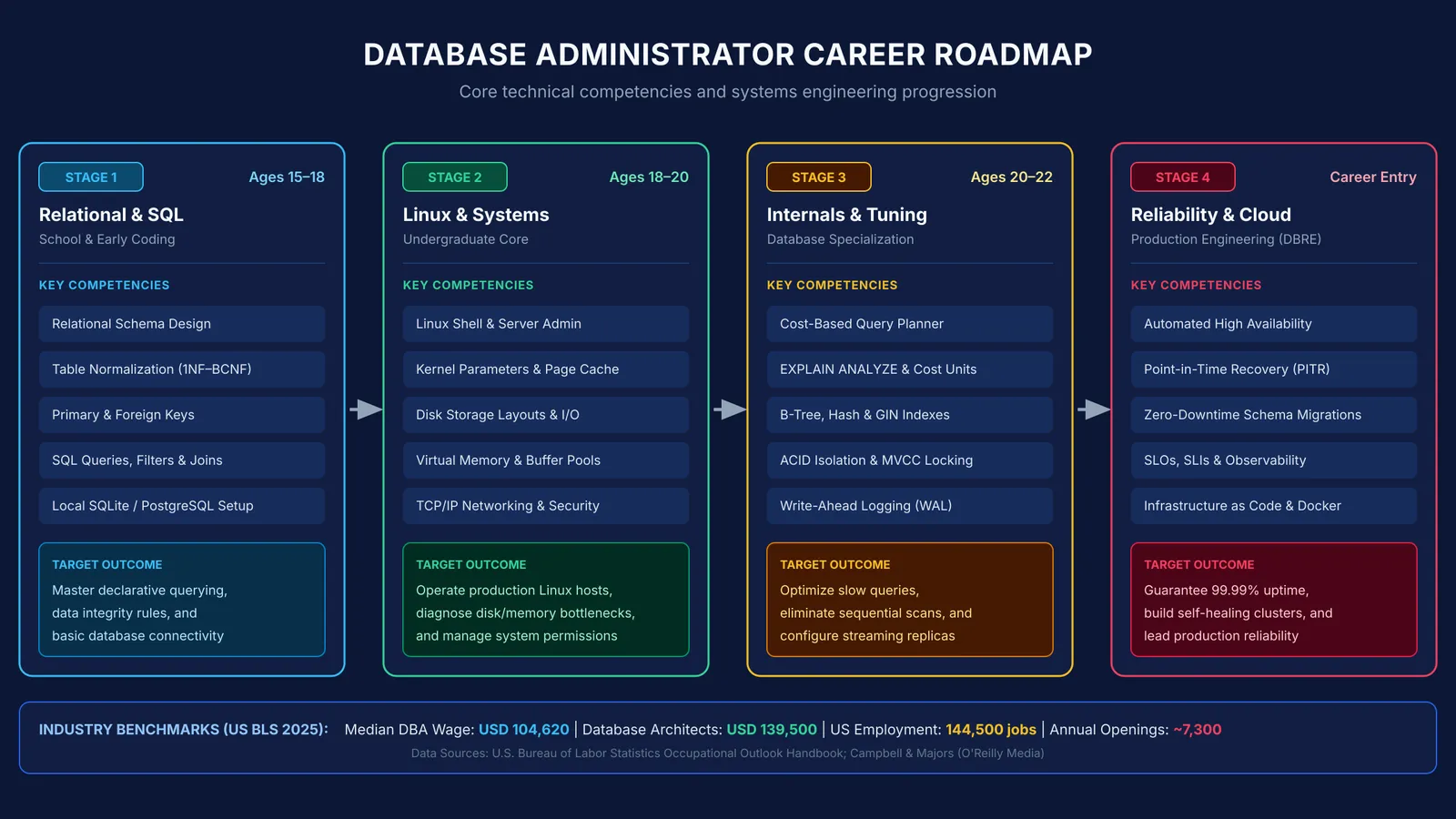
The U.S. Bureau of Labor Statistics reports that database administrators earned a median annual wage of USD 104,620, while database architects earned USD 139,500, with roughly 7,300 annual job openings projected across the decade.
The role historically split into two specialisations: system DBAs and application DBAs. System DBAs manage the underlying infrastructure, including database server operating systems, storage layouts, patch installations, memory allocation, and disaster recovery. Application DBAs work directly with software teams to design table structures, write efficient queries, and enforce referential integrity.
As companies shifted data systems to managed cloud platforms, the DBA role evolved into Database Reliability Engineering. In their book Database Reliability Engineering (O'Reilly Media, 2017), authors Laine Campbell and Charity Majors explain how database operations transformed from manual server maintenance to automation, observability, and Service Level Objectives (SLOs). Modern database engineers write automation code to provision replicas, manage zero-downtime schema migrations, and build automated failover routines.
Which SQL and systems skills matter most?
Database administration sits at the intersection of mathematical relational theory and low-level computer systems. The theoretical foundation traces back to Edgar Codd's relational model, which organizes data into mathematical relations (tables) governed by strict integrity rules.
In Indian secondary schools, students taking CBSE Computer Science already encounter these principles in Unit III: Database Management, which covers table creation, integrity constraints, and query filtering. To advance toward professional engineering, you must progress across four core areas:
Schema Normalization: Organizing attributes into Normal Forms (from First Normal Form up to Boyce-Codd Normal Form) to eliminate data anomalies, paired with our CBSE guide to SQL queries and joins.
Concurrency and ACID Transactions: Ensuring Atomicity, Consistency, Isolation, and Durability. As explained in the textbook Database System Concepts by Abraham Silberschatz, Henry F. Korth, and S. Sudarshan (7th ed., McGraw-Hill, 2019), database engines prevent dirty reads, non-repeatable reads, and phantom reads through multi-version concurrency control and transaction isolation levels.
Operating Systems and Memory: Managing Linux kernel parameters, page caching, memory buffer pools, and disk I/O scheduling. A DBA must understand how the operating system handles file systems and virtual memory.
Backup and Point-in-Time Recovery: Designing strategies based on Recovery Point Objective (RPO) and Recovery Time Objective (RTO). This involves configuring Write-Ahead Logging (WAL) so that a database can restore every confirmed transaction up to the exact second before a hardware failure.
When building the mathematical and algorithmic foundations needed for data structures and query complexity, the Fermi Concept Library maps every concept in mathematics and computing, each with its own lesson and its place in the map.
How does query tuning work in practice?
One of a database administrator's highest-impact duties is query performance tuning. When an application runs slowly, developers often assume the server processor is overloaded, but unindexed queries scanning millions of rows are almost always the cause.
According to the PostgreSQL Documentation on EXPLAIN, relational database engines use a cost-based optimizer to evaluate different execution strategies before running a query. Cost is calculated in arbitrary units where 1.0 represents a single sequential disk page fetch (`seq_page_cost`).
Consider a table storing 1,000,000 student enrollment records:
```sql SELECT * FROM students WHERE enrollment_id = 849201; ```
Without an index, the database engine executes a sequential scan, reading every disk page from storage into memory to inspect all 1,000,000 rows. In PostgreSQL, this scan requires thousands of cost units and takes tens of milliseconds under disk I/O bottlenecks.
When the DBA adds a B-tree index on `enrollment_id`, the engine switches to an index scan. Instead of scanning rows in linear O(N) time, the engine traverses a balanced tree structure in logarithmic O(log N) operations. The engine reads only 3 or 4 index pages to locate the exact row pointer, reducing execution cost from thousands of units to under 10 units and completing in less than 1 millisecond.
Tuning also involves inspecting buffer usage with `EXPLAIN (ANALYZE, BUFFERS)`, which reports shared buffer cache hits against disk reads so administrators can verify that frequently requested data remains in memory rather than forcing physical disk I/O.
For students working through computational and algorithmic logic, the Fermi Problem Library provides worked problems with a step-by-step solver that explains the reasoning rather than printing an answer.
How can a student build a database career path?
You do not need to wait for a university degree to start building database skills. Because the data industry relies heavily on open-source database systems, the tools used by global technology platforms are freely accessible:
School Foundations (Ages 15–18): Master relational table design and query syntax. Review our CBSE guide on database concepts and keys to solidify candidate, primary, and foreign keys. Install PostgreSQL or SQLite locally and practice writing queries that aggregate, filter, and join related tables.
Systems and Linux Foundations (Ages 18–20): In college—whether pursuing Computer Science engineering, BCA, or B.Sc. IT—focus on operating systems and computer networking. Install Linux in a virtual machine, master the terminal, and practice managing background services, file permissions, and memory metrics.
Internals and Performance Tuning (Ages 20–22): Study query execution plans using `EXPLAIN ANALYZE`, test B-tree indexing strategies, and configure automated Write-Ahead Log archiving. Practice setting up streaming replication between a primary database and a read-only replica.
Cloud and Reliability Engineering (Career Entry): Learn containerization with Docker and cloud database platforms. Build automated deployment scripts and practice disaster recovery drills, verifying that you can restore a corrupted database to a clean state.
By combining disciplined SQL design with operating system fundamentals and reliability engineering, you build a durable technical foundation for managing the data that powers modern society.