

On this page
The Direct Admission of Students Abroad (DASA) scheme allows Non-Resident Indians (NRIs), Persons of Indian Origin (PIOs), Overseas Citizens of India (OCIs), and foreign nationals to study engineering in India's technical institutes. If you live abroad and want your child to study at a National Institute of Technology (NIT), Indian Institute of Information Technology (IIIT), or School of Planning and Architecture (SPA), DASA is the official and only route.
Introduced by the Ministry of Education, the scheme coordinates a centralized counselling process, much like JoSAA does for domestic students. Instead of applying to each NIT individually, students submit one application and a preference list of colleges and branches. The scheme ensures that the Indian diaspora has a structured pathway to return to India for higher education without competing in the domestic general category.
Who is eligible for DASA?
To apply under DASA, a student must meet strict academic and residential criteria based on the official guidelines Source.
Academic requirements: The student must have passed Class 12 (or an equivalent international board such as A-Levels or IB) with Mathematics, Physics, and a third subject (such as Chemistry, Biology, Biotechnology, or Computer Science). They need a minimum aggregate of 75% marks or a 7.5 CGPA on a 10-point scale Source.
The entrance exam: Historically, DASA accepted SAT Subject Test scores. This has changed. Admission is now strictly based on the JEE Main rank (Common Rank List).
Residential requirements: For Indian nationals (NRIs), the student must have completed at least two years of education in a foreign country during the last eight years Source. Crucially, this must include their 11th and 12th standard education, and they must pass the qualifying exam from an institution abroad.
If your child is in Class 11 abroad and preparing for the entrance exam, Fermi's AI tutor can work out what they already know and build a plan for their session, so they sit down to a clear next step instead of a blank page.
How does the CIWG quota work?
A significant feature of the DASA scheme is the Children of Indian Workers in Gulf (CIWG) category. This sub-quota reserves one-third of all DASA seats specifically for students whose parents work in one of eight Gulf countries Source: the United Arab Emirates (UAE), Saudi Arabia, Qatar, Oman, Kuwait, Bahrain, Iraq, and Iran.
To claim this quota, parents must provide a valid passport, visa, work permit, and a formal certificate from their employer confirming their employment status. The CIWG category is highly competitive because it offers a significant fee reduction, bringing the cost of studying at an NIT down to the exact level paid by domestic Indian students.
What is the DASA scheme fee structure?
The fee a student pays depends on their country of residence and whether they qualify for the Gulf quota. In all cases, a non-refundable registration fee of US$ 300 is required at the time of online application Source.
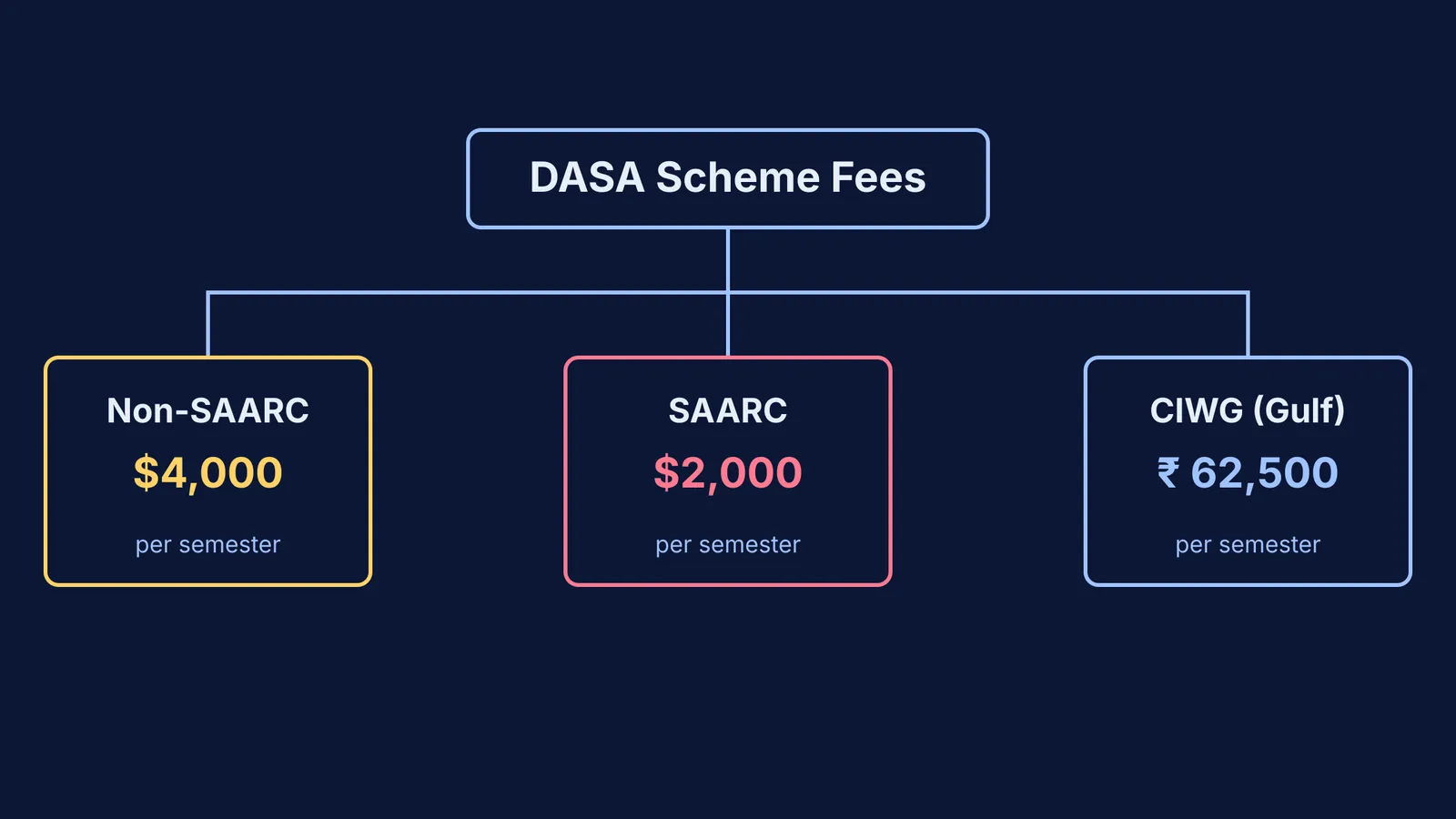
The tuition fees per semester are:
Non-SAARC countries: US$ 4,000 per semester Source. This is the standard DASA rate for students in the US, UK, Singapore, and other non-Gulf, non-SAARC nations.
SAARC countries: US$ 2,000 per semester Source. Students who passed their qualifying exam in a SAARC country (Afghanistan, Bangladesh, Bhutan, Maldives, Nepal, Pakistan, or Sri Lanka) receive a 50% tuition fee waiver.
CIWG category: ₹ 62,500 per semester Source. This matches the domestic tuition fee of ₹ 1,25,000 per annum across all NITs.
These amounts cover tuition only. Hostel rent, mess charges, library fees, and other institute-specific deposits must be paid separately upon admission directly to the allotted college.
What documents are needed for DASA registration?
When the registration portal opens (usually in June, shortly after JEE Main results are declared), you will need scanned copies of several documents. Having these ready in advance prevents last-minute stress:
Proof of identity: The student's valid passport.
Proof of age: Class 10 certificate showing the date of birth.
Academic records: Mark sheets for Class 10, 11, and 12.
Entrance score: The official JEE Main scorecard showing the Common Rank List (CRL).
Residential proof: A certificate from the school abroad confirming the student studied there for Class 11 and 12.
For CIWG applicants: The parent's passport, visa, work permit, and a company letter verifying employment in an eligible Gulf country.
If you are planning for college expenses and admissions, you can also read our guide on how to spot capitation fee scams in Indian college admissions. If your child is also considering medical courses, it helps to understand the rules around NEET eligibility and attempts.


