

On this page
Gaming is not the enemy of JEE or NEET preparation. The trouble starts when one game becomes two hours, taken from revision or sleep. The fix is not more willpower at 10 pm. It is setting the rules earlier, when you are calm, and making them easy to keep.
Does gaming actually hurt exam preparation?
In a randomized controlled study, young boys who were given a games console straight away spent more time gaming and less time on after-school academic activities than boys who received theirs four months later (Weis and Cerankosky, Psychological Science, 2010). At follow-up they also had lower reading and writing scores and more teacher-reported academic problems. The boys were much younger than you, but the lesson carries over: gaming time comes out of something else.
The other cost is sleep. The American Academy of Sleep Medicine recommends that teenagers aged 13 to 18 sleep 8 to 10 hours per 24 hours (Paruthi et al., 2016). A session that runs late eats straight into that, and sleep before an exam beats an all-nighter for good reason.
Why do gaming limits keep failing?
Most limits are decided in the moment, with the game already open. In a randomized experiment, economists Hunt Allcott, Matthew Gentzkow and Lena Song found that allowing people to set limits on their future screen time substantially reduced use (Allcott, Gentzkow and Song, American Economic Review, 2022). Their model suggests that self-control problems cause 31 percent of social media use. The study was about social media, not games, but the lesson carries over: decide the limit before you play.
Research also shows how to word the rule. A meta-analysis of 94 tests by Peter Gollwitzer and Paschal Sheeran found that if-then plans, called implementation intentions, had a medium-to-large effect on reaching goals, d = 0.65 (Gollwitzer and Sheeran, 2006). “If it is 9:30 pm, then I finish this match and log out” is an implementation intention. “I will game less” is not.
How do you control gaming during JEE or NEET preparation?
Use three rules together; each covers a gap the others leave.
Rule 1: fixed windows
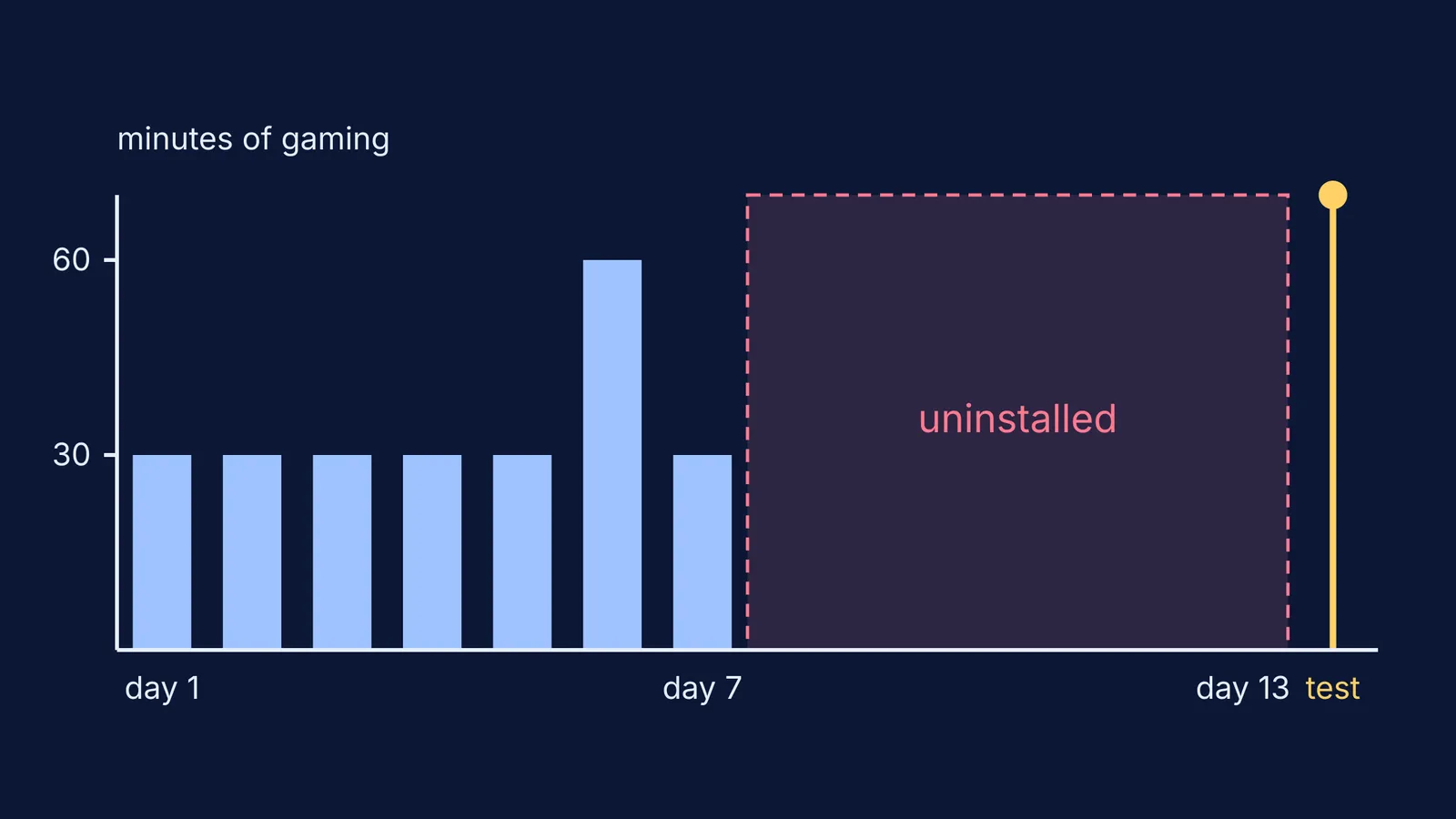
Pick one window a day at the same time, for example 30 minutes from 9:00 pm, well before bed.
Allow one longer window on your weekly off day, such as 60 minutes.
The window ends at a clock time, not “after this match”. Set your phone's own screen-time limit for the game to match.
Write your if-then rule on a sticky note where you play.
Rule 2: uninstall cycles before tests
Uninstall the game six days before each major mock or school exam.
Reinstall only after the paper is written and you have gone through your mistakes.
Spend the freed-up time on mock analysis. The Fermi Problem Library has worked problems with a step-by-step solver that explains the reasoning rather than printing an answer, which helps when you cannot see why a question went wrong.
Rule 3: a short session as a planned break
Only after a full study block, never in the middle of one.
Only games that end on their own in about 10 to 15 minutes, like a single puzzle or one quick chess game. Skip games with matchmaking queues, daily rewards or a squad waiting for you.
Set a timer before you start, and decide what you will study when it rings.
For non-game options, see what to do in a study break. The hard part of any break is coming back. If you return to a blank page, Fermi's AI tutor can work out what you already know and build a plan for the session, so you sit down to a clear next step.
What should parents say about gaming?
Rules hold better when the student helps write them. Try something like this:
“I'm not asking you to stop gaming. Let's pick a time that suits you.”
“Before big tests, the game comes off for six days, and it goes back on after the paper.”
“If the plan slips, we fix the plan together. No shouting.”
Review it every two weeks and fold it into a study routine that lasts.
When is gaming more than a habit?
The World Health Organization defines gaming disorder as a pattern of impaired control over gaming, gaming taking priority over other interests and daily activities, and continued gaming despite negative consequences (WHO). For a diagnosis, the pattern must cause significant impairment and would normally have been evident for at least 12 months. WHO says studies suggest it affects only a small proportion of people who game.
If gaming keeps winning over sleep, meals and studies despite real effort, or mood is changing, talk to a doctor or counsellor. Tele MANAS, the Indian government's free 24x7 mental-health helpline, is on 14416 or 1800-891-4416 (IIT Kanpur Counselling Service).
Tonight, pick your window, write your if-then rule and mark the date of your next uninstall.


