

On this page
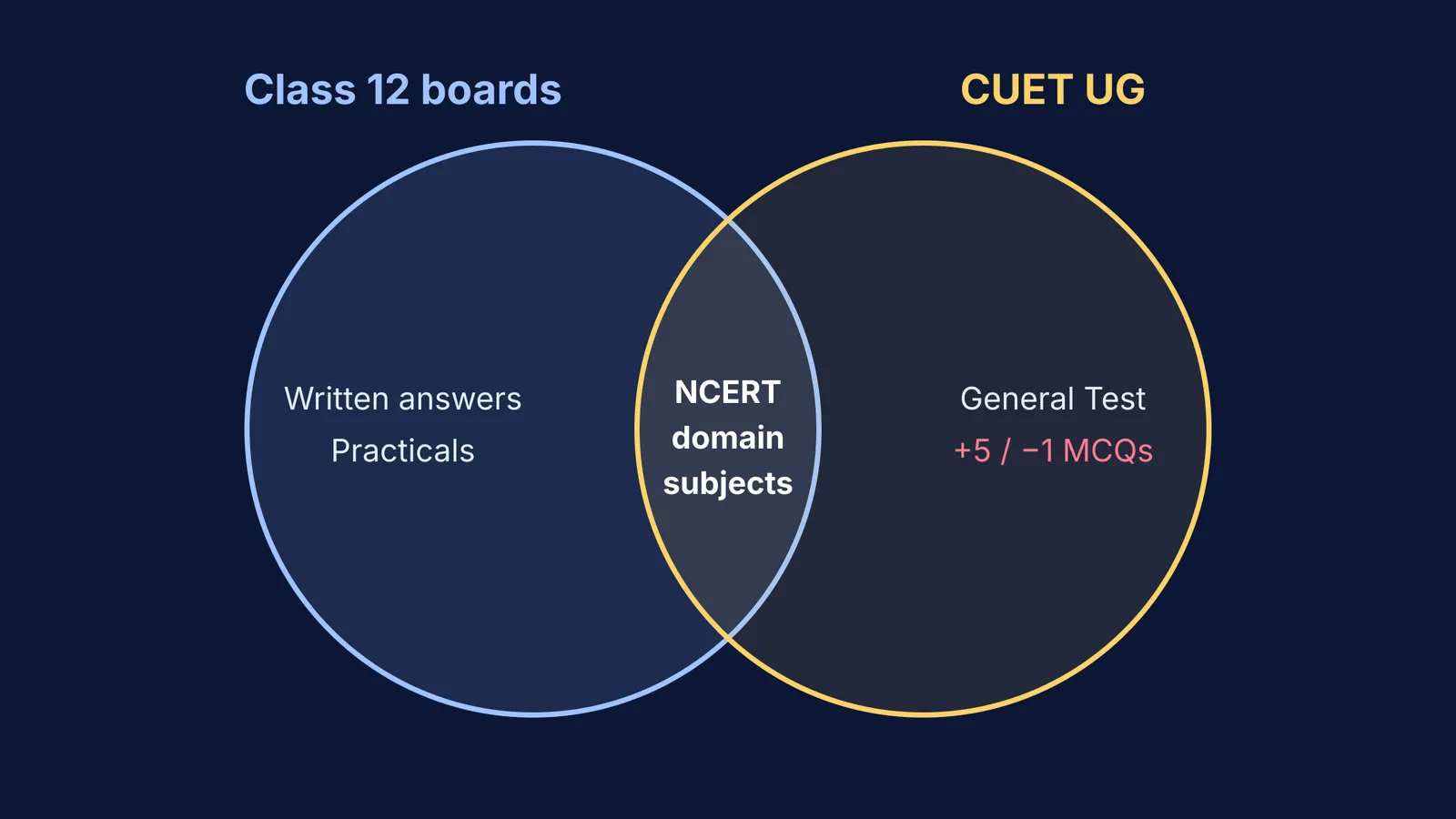
If you are in Class 12 and also taking CUET UG, you are preparing for one syllabus tested in two ways. Boards want written answers and derivations. CUET wants fast, accurate multiple-choice answers. Plan around that difference and both get easier.
The details below come from the NTA CUET (UG) 2026 Information Bulletin. NTA publishes a new one every year, so check the official CUET site for the next.
How much of CUET is already in your board syllabus?
For your domain subjects, most of it. In the 2026 bulletin, the domain subjects are tested "As per NCERT syllabus" (NTA bulletin). If your board follows NCERT, most chapters you revise for physics, chemistry or maths also count for that CUET paper. Compare the subject PDFs on NTA's CUET UG 2026 syllabus page with your board syllabus and mark any chapter that appears in only one.
The format is what changes. In the 2026 bulletin, each CUET paper had 50 compulsory multiple-choice questions in 60 minutes, with 5 marks for a correct answer and minus 1 for a wrong one (NTA bulletin). That works out to about 72 seconds per question. A ten-minute board derivation only helps if you can spot its result among the options.
Which CUET subjects should you choose?
The 2026 bulletin lists 37 tests: 13 languages, 23 domain subjects and one General Aptitude Test. It lets you take up to five in total, including languages and the General Aptitude Test, "irrespective of the subjects opted in class XII" (NTA bulletin). The bulletin adds that you may select subjects based on the eligibility criteria for a programme at the university you want, so check each university's programme rules, not just the CUET form.
List three to five programmes you would actually join, and the CUET subjects each asks for.
Give priority to subjects more than one of them needs.
Fill remaining slots with your Class 12 subjects.
Add a subject you don't study in school only if a programme requires it.
Take a science student with two BSc programmes and one BA programme on their list. They might end up with English, Physics, Chemistry, Mathematics and the General Aptitude Test: five papers, four of which overlap with board study. See also our guide to CUET UG for science students.
What is in the CUET General Test, and when should you practise it?
In the 2026 bulletin, the General Aptitude Test covered general knowledge, current affairs, general mental ability, numerical ability, quantitative reasoning (arithmetic, algebra, geometry, mensuration and statistics) and logical and analytical reasoning (NTA bulletin). Apart from some basic maths, little of it is on your board syllabus. It also fits into short sessions during the school year.
Two short sessions a week can be enough before boards: one timed reasoning or arithmetic set, and a few minutes on current affairs. Keep a list of question types you get wrong to work through after boards.
What should you do between boards and CUET?
In the 2026 cycle, applications closed on 30 January and CUET was scheduled for 11 to 31 May (tentative) (NTA bulletin). For most boards, that puts the form in pre-board season and the exam a few weeks after your last board paper. Put the dates in the family calendar now, and split the post-board weeks into three phases:
First two or three days: rest. Then sit one full timed paper in each of your subjects to see where you stand.
Middle weeks: spend most of each day on timed domain question sets from NCERT chapters, and one block on the General Test. Mark every wrong answer as one of three things: concept gap, misread question or time pressure.
Final week: one full paper a day in exam order, a quick look back at your error list, and a normal sleep schedule.
If the error list keeps pointing to the same chapter, go back to the concept rather than drilling more MCQs on it. The Fermi Concept Library has a lesson for every concept in physics, chemistry, biology and mathematics. If you sit down and don't know where to start, Fermi's AI tutor works out what you already know and builds a plan for the session.
How do you avoid burning out in Class 12?
During the board months, boards come first; that revision is also CUET revision for your domain subjects. Our eight-week Class 12 board revision plan has room for a weekly MCQ set. If you are also preparing for JEE, read balancing Class 12 boards with JEE before adding CUET to your week.
Your next step: open the CUET syllabus PDF for each subject you are likely to take and mark the chapters you have already finished for boards.


