

On this page
When seat allotment results come out, many students find themselves with a seat that isn't their absolute first choice. The counselling portal then presents a nerve-wracking decision: do you lock what you have, or do you try for something better?
The terminology varies. Engineering boards often use the terms Float, Slide and Freeze, while medical counselling usually offers a simple Upgrade option, but the underlying logic is the same across India.
Should I accept upgrade in counselling round?
Upgrading is almost always a good idea if your current allotment is lower on your preference list than a seat you truly want more. According to the Joint Seat Allocation Authority (JoSAA), choosing to upgrade means you accept the seat you have been offered, but you remain in the race for seats you ranked higher on your choice list.
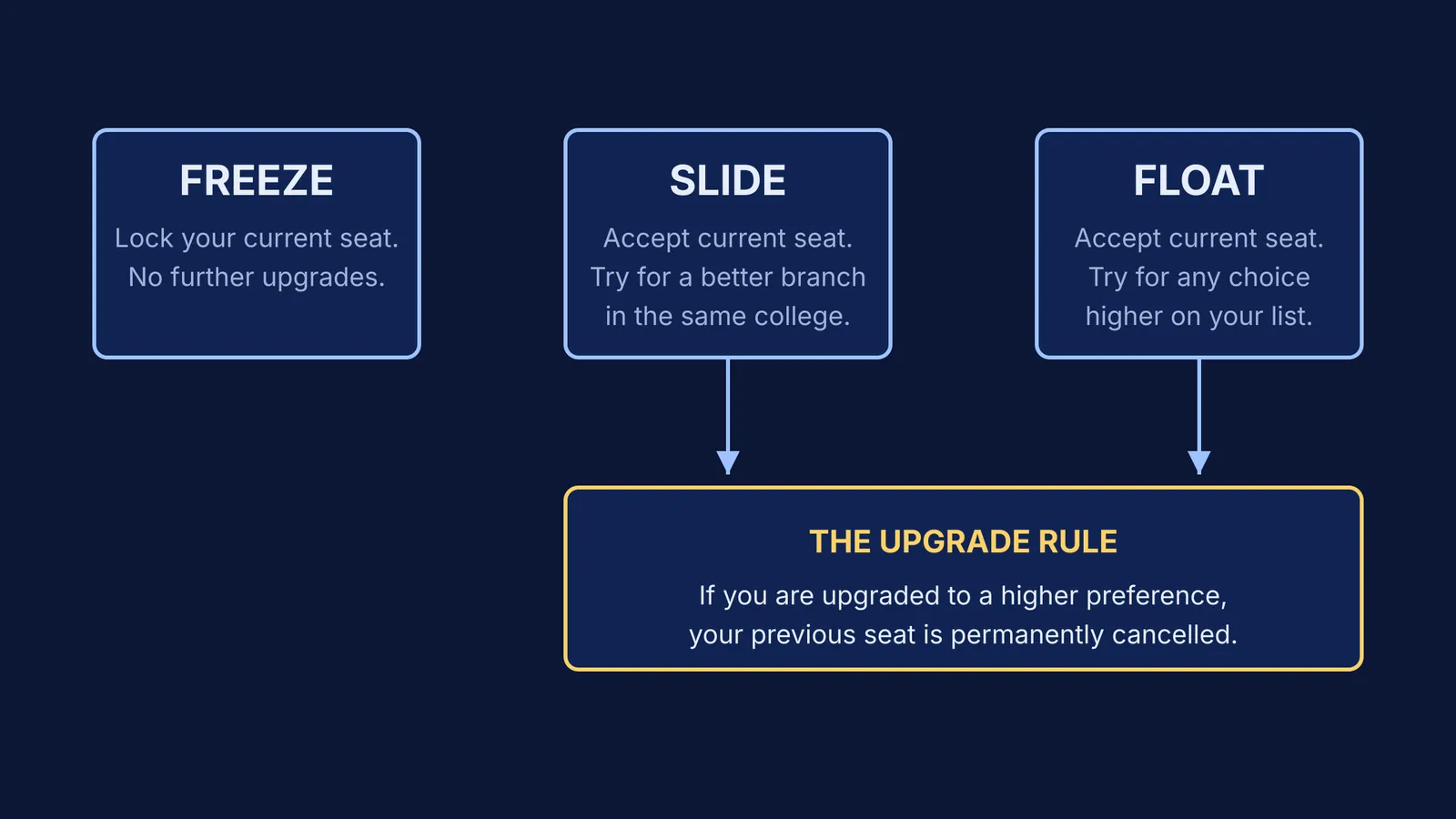
If a higher-preference seat becomes available in the next round, you will be upgraded to it. The catch is that the moment the new seat is allotted, your previous seat is automatically cancelled. You cannot change your mind and go back to your old college.
Float, slide or freeze: what do they mean?
In engineering counselling like JoSAA, you usually get three choices when you are offered a seat:
Freeze: You lock the seat. You are satisfied with both the college and the branch, and you will not participate in further rounds.
Float: You accept the seat, but you want to be considered for a higher preference in any institute. If you put a computer science degree at one college above your current mechanical engineering seat at another, Float keeps you in the running for your top choice.
Slide: You accept the seat, but you only want to upgrade to a better branch within the *same* institute. You will not be given a seat at any other college, even if it was higher on your preference list.
For medical admissions, NEET UG counselling simplifies this to a single "Willingness for Upgradation" option when you report for your Round 1 or Round 2 seat. State boards follow similar logic; for example, you can read about how Karnataka handles this in KEA counselling after KCET: option entry, rounds and seat allotment.
What happens to my current seat if I choose upgrade?
Your current seat is protected while you participate in the next round. If you do not get an upgrade, you simply keep your existing seat. You only lose it if you are successfully upgraded to a choice you ranked higher.
There is no risk of ending up with nothing, provided you have paid the seat acceptance fee and completed the document verification for your initial seat. However, if you are upgraded, the cancellation of the old seat is permanent.
If you are struggling to rank your choices because you are not sure which branch fits you best, taking a moment to explore the foundational subjects can help. For instance, you can use the Fermi Concept Library to look into advanced physics or biology topics to see if the actual science interests you before you commit to four years of studying it.
A checklist for deciding to upgrade
Before you hit Float or Upgrade, ask yourself these three questions:
Did I make a mistake in my preference list? Look at every choice listed above your current allotment. If there is a college there you do not actually want to attend, you must modify your list if the rules allow, or choose Freeze if they do not.
Am I ready to move? Upgrading from one round to the next might mean changing cities at short notice. In NEET counselling, you will need to get a relieving letter from your first college and travel to the new one.
Is the branch better? Sometimes, sliding to a better branch in the same college is a safer bet than floating to an unknown campus.
For a deeper look at how the rounds are structured, read our guides on JoSAA counselling for parents: rounds, choices and documents and NEET UG counselling for parents: MCC, state quota and rounds.


