

On this page
Entering national admission portals can be overwhelming for Class 12 school-leavers and their parents. A common belief among families is that qualifying under a reserved category—such as SC, ST, OBC-NCL, GEN-EWS, or PwD—means all counselling fees are waived. The reality is more nuanced: fee concessions exist, but complete fee waivers during online counselling do not, and missed payments lead to immediate disqualification.
Understanding how registration fees, seat acceptance fees, and college tuition waivers differ ensures you secure the seat you worked hard to earn.
Do reserved category candidates get a counselling fee waiver?
Counselling authorities do not waive upfront fees completely. Centralized portals establish two separate financial stages: a registration charge to fill choices, followed by a seat acceptance fee once an allocation is made.
Many parents confuse counselling seat confirmation with university tuition fee waivers. Under Ministry of Education guidelines, SC, ST, and PwD undergraduates admitted to IITs and NITs receive a 100% tuition waiver upon enrolment. However, that institutional waiver does not exempt candidates from paying the mandatory Seat Acceptance Fee during counselling.
How do JoSAA and MCC counselling fee structures differ?
Engineering and medical admissions operate under different financial rules:
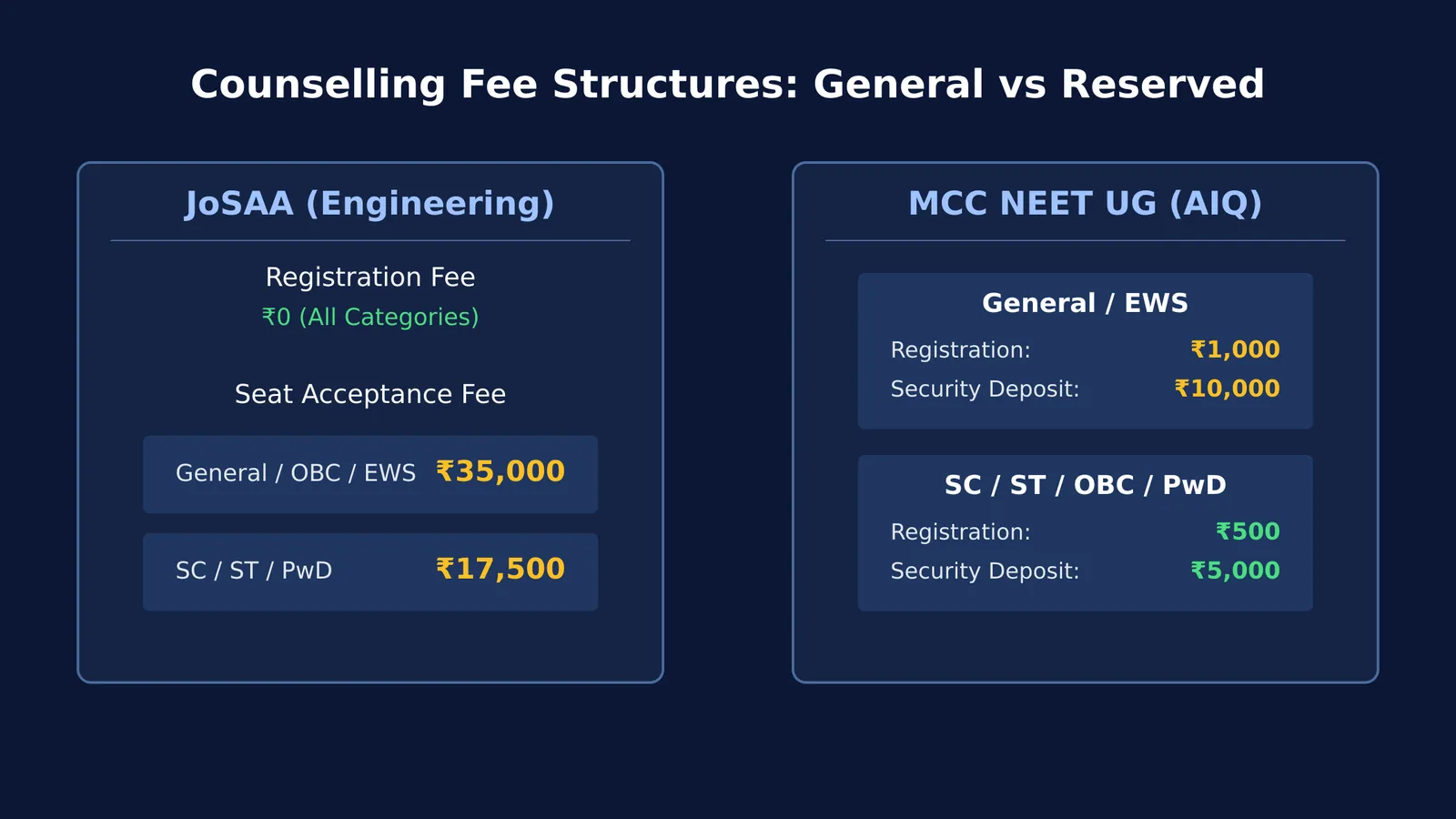
In engineering admissions under the Joint Seat Allocation Authority, initial registration and choice filling are completely free for all candidates. However, as noted in our JoSAA counselling guide, once a seat is allotted, candidates must pay a Seat Acceptance Fee to confirm the offer:
General, OBC-NCL, and GEN-EWS candidates pay ₹35,000, which includes a non-refundable processing charge of ₹5,000.
SC, ST, and PwD candidates pay a concessional fee of ₹17,500.
For subsequent rounds under the Central Seat Allocation Board, fresh participants pay an enrollment fee of ₹45,000 for General or OBC categories, compared to ₹25,000 for SC, ST, and PwD candidates.
In medical admissions governed by the Medical Counselling Committee, candidates pay a non-refundable registration fee and a refundable security deposit before filling choices:
For 15% All India Quota (AIQ) and Central Universities, unreserved and EWS candidates pay ₹1,000 registration plus a ₹10,000 security deposit, totaling ₹11,000.
SC, ST, OBC, and PwD candidates pay a 50% reduced rate: ₹500 for registration and ₹5,000 for deposit, totaling ₹5,500.
For Deemed Universities, all candidates pay a non-refundable ₹5,000 registration fee and a ₹2,00,000 security deposit without category concession.
Our companion NEET UG counselling walkthrough explains how that medical deposit is refunded to the originating account after counselling concludes.
What proof is checked during document verification?
Claiming a concessional fee or quota seat requires passing document verification before allotment confirmation:
Financial year date: Under guidelines from the National Commission for Backward Classes, OBC-NCL and GEN-EWS certificates must be issued on or after April 1 of the admission year. A certificate dated before April 1 reflects the previous financial year and is rejected.
Central List verification: An OBC caste must be included in the Central OBC list at the National Commission for Backward Classes. State-only listings do not qualify for central quota seats.
Non-Creamy Layer wording: The certificate must explicitly state the candidate belongs to the Non-Creamy Layer under the ₹8 lakh parental income limit.
PwD verification: Candidates must show at least 40% permanent disability. Engineering candidates verify online through the Department of Empowerment of Persons with Disabilities UDID portal or in person at an IIT or NIT board. NEET candidates must secure a certificate from one of 16 designated Medical Counselling Committee disability assessment centres.
What happens if your category certificate is rejected?
When a verifying officer flags a document discrepancy, the portal issues a query. Under Joint Seat Allocation Authority rules, candidates get 24 to 48 hours to respond:
The allotted reserved seat is cancelled immediately.
The candidate converts to General (OPEN) for subsequent rounds.
The candidate remains eligible only if their score meets the general cut-off and the 75 percent board marks rule where applicable. Scoring below the unreserved cut-off results in complete disqualification.
While waiting for verification or the next round, students can explore core concepts in the Fermi Concept Library, which has every concept in physics, chemistry, biology, mathematics and computing, each with its own lesson and its place in the map. For problem-solving practice before college starts, the Fermi Problem Library provides worked problems with a step-by-step solver that explains the reasoning rather than printing an answer.
Pre-counselling verification checklist:
Check that your caste is on the central list at ncbc.nic.in.
Obtain OBC-NCL or EWS certificates dated on or after April 1.
Ensure certificate names match your Class 10 marksheet exactly.
Keep the Seat Acceptance Fee ready in an active bank account.
Monitor portal queries twice daily to respond within 24 hours.


