On this page
In recent years, management consulting has become one of the most visible non-core career paths for engineering students. The official IIT Bombay 2023-24 placement report notes that consulting firms made 117 offers to students. While this was a dip from the previous year due to global economic caution, it still accounted for nearly 8% of the total placements, with consulting roles offering an average CTC of ₹18.68 LPA.
What do management consultants actually do?
A management consultant is hired to solve complex, high-stakes business problems for other companies. If a global airline is suddenly losing money on its domestic routes, or if a retail brand wants to launch a new product in India but doesn't know the market size, they bring in consultants to figure out why and what to do next.
Consultants spend their time gathering raw data, interviewing the client's staff, running financial models, and building structured presentations. They do not usually implement the final software or build the factories; their job is to deliver the strategy and the analytical proof that the strategy will work.
Why do consulting firms hire engineering graduates?
You might wonder why a firm diagnosing a retail company's supply chain would want a mechanical or chemical engineer. Consulting firms look for analytical rigour and a high tolerance for ambiguity. Engineers are trained to break down massive, ill-defined systems into smaller, testable parts—a process of "debugging" that translates directly to business strategy.
For example, when you learn to tackle Equations and inequalities with modulus: the case-split method, you are practising how to divide a messy problem into distinct, manageable scenarios. Consulting firms rely on exactly this skill. They also value the quantitative horsepower that engineering students build through years of handling advanced calculus and physics. Whether you are finding currents using the Node potential method: solving circuits by assigning voltages or estimating the market size for electric vehicles, the underlying mathematical confidence is the same.
What is the case interview process?
To test these skills, firms like McKinsey, BCG, and Bain use the "case interview." You are given a hypothetical business scenario and asked to solve it on the spot.
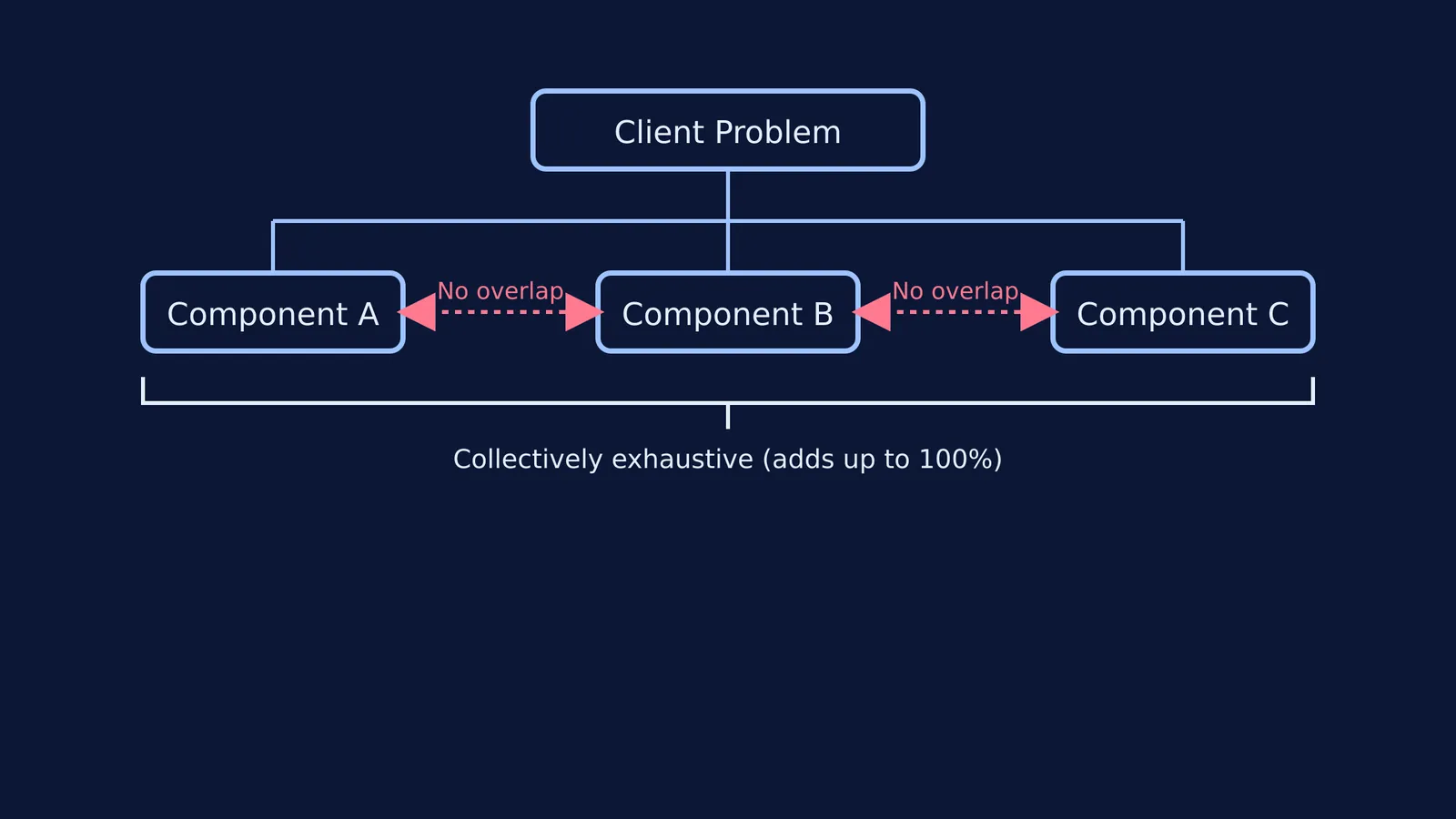
A cornerstone of case interviews is the MECE framework—an acronym for Mutually Exclusive, Collectively Exhaustive. When you split a problem into parts, those parts should not overlap (mutually exclusive) and together they should cover the entire problem (collectively exhaustive). If you are categorising a population, splitting them by "students" and "adults" is not MECE because an adult can be a student.
The interviewer expects you to think out loud. Much like the Fermi Problem Library offers worked problems with a step-by-step solver that explains the reasoning rather than printing an answer, your goal in a case interview is to walk the recruiter through every step of your logic. If you make an assumption in your mental math, you must state it clearly.
Some firms also screen candidates with digital assessments before the live interview. For instance, the McKinsey Solve game tests data synthesis and logic under time pressure, tracking how you gather information and allocate resources to solve simulated scenarios.
Getting comfortable with these rounds requires you to hold a line of reasoning while an interviewer challenges your assumptions. Fermi's AI tutor is designed around this exact educational principle—it holds a line of reasoning across a whole session, notices where a student is stuck, and decides whether to explain, ask, or show.
What is a practical framework for the case interview?
When you walk into a case interview, follow a consistent four-step plan:
Clarify the objective: Never start solving immediately.
Structure the problem: Ask for a minute of silence. Draw a MECE issue tree to break the problem down.
Analyse the data: Work through each branch of your tree. Do the mental math out loud.
Synthesize and recommend: Finish with a concise, "top-down" conclusion. Start with your final recommendation, back it up with two data points you calculated, and highlight one major risk.