

On this page
SN1 and SN2 look alike on paper, and exam questions ask which one happens. Mitosis and meiosis are the same trap in biology. Study each idea on its own page and you learn each one, but never practise telling them apart. A comparison table puts the pair side by side so the differences become the thing you study.
Why do comparison tables help you learn?
A 2013 meta-analysis in Educational Psychologist by Louis Alfieri, Timothy Nokes-Malach and Christian Schunn pooled 57 experiments with 336 tests. Comparing cases generally led to more learning than other kinds of case study and traditional instruction, with an average effect size of d = 0.50. It helped more when learners were asked to find similarities, when the principle came after the comparison, and when testing was immediate.
Bethany Rittle-Johnson and Jon Star randomly assigned 70 seventh-grade students to compare algebra solution methods side by side or study them one at a time. The comparing group gained more procedural knowledge and flexibility, and as much conceptual knowledge.
In a study of learning painting styles, Sean Kang and Harold Pashler found that showing different artists' paintings together or interleaved helped learners name the artists of new paintings better than grouping them by artist. The authors argue this works by sharpening the contrast between styles.
How do you make a comparison table in your notes?
Rule three columns (feature, idea A, idea B) and fill them in this order.
Header: the two ideas, with the confusing exam question above, such as "Which mechanism will this alkyl halide follow?"
Shared row: what the two have in common. Finding similarities helped in the meta-analysis.
Feature rows: four to six rows, each asking the same question of both ideas.
Cue row: the words in a question that tell you which idea it is about.
Rule line: after filling the table, one sentence in your own words that sums up the difference, so the principle comes after the comparison.
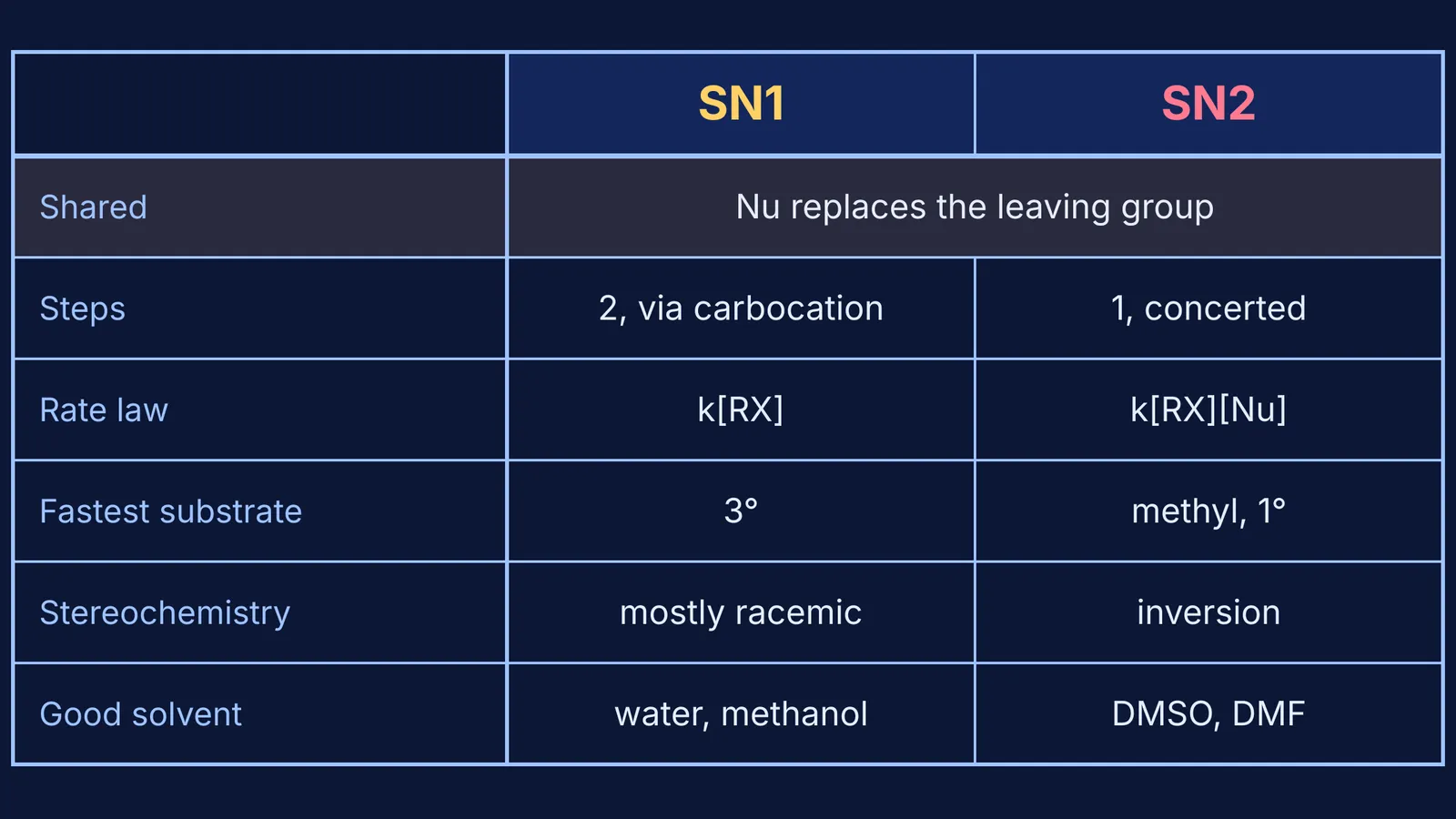
What does an SN1 vs SN2 comparison table look like?
Each line below is one row of your grid. Entries come from OpenStax Organic Chemistry, sections 11.2, 11.3, 11.4 and 11.5.
Shared: a nucleophile replaces the leaving group on carbon.
Steps: SN1 has two, through a carbocation intermediate / SN2 has one concerted step.
Rate law: SN1 rate = k[RX] / SN2 rate depends on both alkyl halide and nucleophile.
Fastest substrate: tertiary / methyl, then primary; tertiary effectively halts SN2.
Stereochemistry: mostly racemic / inversion, from backside attack.
Solvent: strongly polar solvents such as water and methanol / polar aprotic solvents such as DMSO and DMF.
Cue: tertiary halide in water or methanol / methyl or primary halide in DMSO or DMF.
Rule: SN1 waits for a stable carbocation, so the substrate decides; SN2 is one push from behind, so crowding stops it. Our SN1 and SN2 guide for haloalkanes covers the full chapter. If you still pick the wrong mechanism, the Fermi Problem Library has a step-by-step solver that explains the reasoning rather than printing an answer.
What does a mitosis vs meiosis comparison table look like?
Entries come from OpenStax Biology 2e.
Shared: both divide a nucleus and separate sister chromatids.
Nuclear divisions: one / two.
Nuclei produced: two / four.
Ploidy: same as the original / reduced from diploid to haploid.
Genetic identity: identical to the original nucleus / genetically distinct.
Synapsis and crossing over: none / homologous pairs bind and cross over, in meiosis I only.
What separates: sister chromatids / homologous chromosomes in meiosis I, then sister chromatids in meiosis II.
Rule: mitosis copies; meiosis halves and shuffles. Our cell cycle, mitosis and meiosis explainer walks through the phases.
Does this work for physics too?
Yes. Try distance travelled vs displacement, using OpenStax College Physics 2e.
Shared: both describe how far something has moved.
Meaning: total length of the path / change in position, final minus initial.
Direction: none, so no sign / has direction, so it can be positive or negative.
Worked case: a lecturer who paces 150 m but ends 2.0 m right of the start: distance travelled 150 m, displacement +2.0 m.
Cue: "total path" or "how far did it travel" / "net", "from the start", or a direction.
Rule: distance travelled counts every step; displacement only cares where you ended up.
What mistakes make a comparison table useless?
Copying a ready-made table. Building the rows is where the comparing happens.
Uneven rows, with a fact on one side and a blank opposite.
A table longer than a page. You have rewritten the chapter.
Never testing yourself. Cover one column and say the other aloud.
A column that stays blank has found a gap. Look the idea up in the Fermi Concept Library, which gives each concept in physics, chemistry, biology, mathematics and computing its own lesson, then fill the cell. When a pair grows into a web of ideas, try concept maps for science.
Pick one pair you mixed up in your last test and build its table tonight.


