

On this page
When you search for college fees, you often see just the base tuition cost. But tuition is only part of the bill. By the time you add hostel rent, mess advances, exam fees, internet charges and refundable deposits, the full four-year cost of a B.Tech degree looks very different. For parents and students planning their finances, comparing colleges requires looking at the total outlay, not just the headline fee.
If you are planning your college budget, here is how the real numbers stack up across different tiers of Indian engineering colleges for the 2024–2025 cycle.
What is the total cost of B.Tech across IITs?
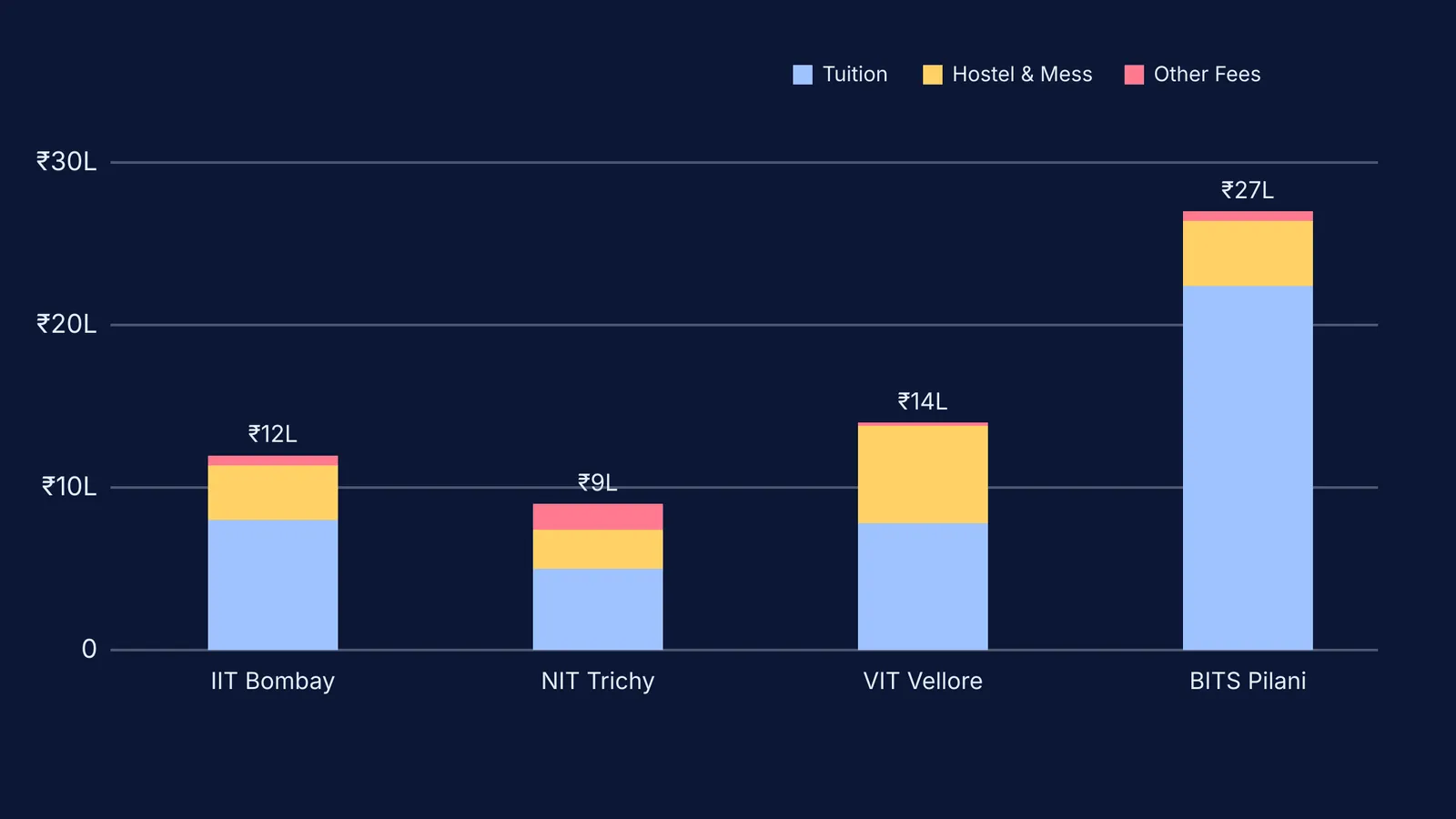
The total estimated cost for a four-year B.Tech at IIT Bombay is roughly ₹11.5 Lakhs to ₹12 Lakhs for a General or OBC student with a family income above ₹5 Lakhs (IIT Bombay).
The primary cost is the tuition fee, which is ₹1,00,000 per semester. However, the government mandates strict fee waivers based on income. If your family earns between ₹1 Lakh and ₹5 Lakhs, you get a 2/3rd tuition remission, bringing the total four-year cost down to around ₹8 Lakhs. For SC, ST and PwD students, or those with a family income below ₹1 Lakh, tuition is fully waived, leaving a total cost of ₹4 Lakhs to ₹5 Lakhs mostly to cover living expenses.
Beyond tuition, students pay about ₹42,000 per semester for hostel and mess charges, plus around ₹10,000 in other academic fees for registration, gymkhana and medical facilities.
How much does NIT Trichy cost for four years?
At NIT Trichy, a top government college, the four-year total is slightly lower, ranging from ₹9 Lakhs to ₹10 Lakhs for General and OBC students without fee waivers (NIT Trichy).
The tuition fee is ₹62,500 per semester, totalling ₹5 Lakhs over four years. Like the IITs, NIT Trichy applies the same government fee waivers for lower-income families. Hostel and mess charges add another ₹2 Lakhs to ₹3 Lakhs over the four years, and students also pay around ₹15,000 to ₹25,000 per semester in other institute fees for the library and computer access.
What is the fee structure at private colleges?
Private institutions receive less government funding, so their fees are substantially higher and rarely offer income-based waivers.
At BITS Pilani, the total cost for a four-year B.Tech is estimated between ₹22 Lakhs and ₹28 Lakhs (BITS Pilani). For the 2024–2025 batch, the first-year tuition is roughly ₹2,60,000 per semester, and BITS typically applies a 5% hike each year. Hostel and mess advances add roughly ₹4 Lakhs to ₹5 Lakhs over four years. While there are no income waivers, BITS does offer merit and merit-cum-need scholarships that can waive 25% to 100% of the tuition for top performers.
VIT Vellore uses a category system tied to your VITEEE exam rank. If you secure a top rank (Category 1) in a popular branch like Computer Science, your total four-year tuition is around ₹7.8 Lakhs (VIT Vellore). If you fall into Category 5, that tuition jumps to ₹19.6 Lakhs. Once you add hostel and mess fees, which range from ₹60,000 to ₹1,90,000 per year depending on your room type, the total cost for a Category 5 student can reach ₹25 Lakhs to ₹28 Lakhs.
If you are currently studying for the JEE or VITEEE and need a clear path forward, Fermi's AI tutor can work out what you already know and build a plan for the session, so you sit down to a clear next step.
What are the hidden costs of an engineering degree?
When budgeting for four years, several costs do not appear on the main tuition schedule:
Summer terms: If you need to repeat a course or want to take a summer internship track, colleges often charge extra. At BITS Pilani, a summer term adds roughly ₹90,000 in tuition alone.
Laptops and software: Engineering students need a capable laptop, and sometimes specific software licenses for courses like CAD or data science, which can add ₹50,000 to ₹1,00,000 to your starting costs.
Travel: If you choose a college far from home, booking flights or trains two to four times a year will become a significant recurring expense over four years.
How should you compare college costs?
When looking at a college brochure, build your comparison using three buckets:
Tuition and academic fees: Look for the per-semester tuition, but also check for annual charges (library, gymkhana, internet).
Fixed living costs: Add up the hostel rent and the mess advance. Remember that mess advances are often adjusted based on what you actually eat, and hostel fees usually rise by 5% to 10% each year.
One-time deposits: You will usually pay ₹10,000 to ₹20,000 in admission fees and security deposits in your first semester. The security deposits are refunded when you graduate.
Before you make a final list, you might also want to read about balancing Class 12 board exams with JEE preparation to make sure you secure the scores you need for admission. You can also look at your first semester at college to understand what changes when you arrive. And once you move in, setting up a good routine for studying in a hostel can make a huge difference.


