

On this page
Starting college brings independence, unfamiliar academic schedules, and the responsibility of managing your own health. When an unexpected fever strikes at night or an injury occurs over the weekend, knowing how your campus clinic operates and how student medical insurance pays for hospital treatment prevents panic and out-of-pocket expenses.
Does every college have an on-campus health centre?
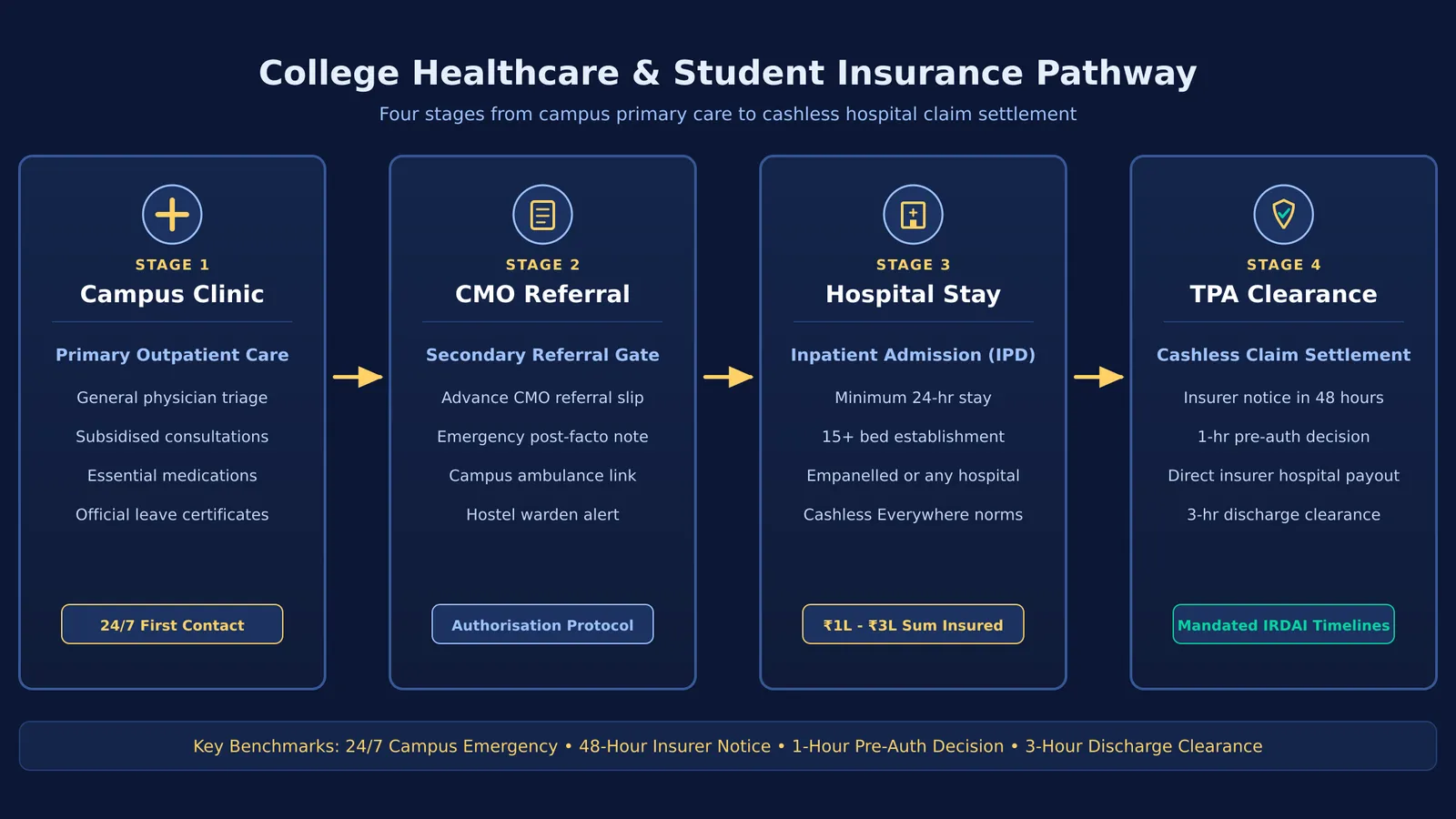
Most residential universities and technical institutes in India operate an on-campus health centre or dispensary to provide primary medical care. At major institutions such as the Indian Institute of Technology Delhi, the campus hospital runs 24/7 with round-the-clock emergency triage, outpatient consultations, diagnostic pathology, and dedicated ambulance services (IIT Delhi Hospital).
These health centres serve as your first point of medical contact. Resident doctors treat routine illnesses such as viral fevers, seasonal infections, and minor injuries, dispensing essential prescription medications without charge. The centre also issues official medical certificates required to excuse absences from compulsory classes or laboratory sessions. During orientation, locating the clinic is as essential as finding your lecture halls; see our guide on questions for families before moving cities for a smooth transition.
Campus healthcare facilities also connect to broader mental health networks. If you experience academic burnout or emotional distress, national initiatives like Tele MANAS offer free, 24/7 psychological counseling in over 20 languages through toll-free helpline 14416, coordinated by the Ministry of Health and Family Welfare alongside NIMHANS.
How does student group medical insurance work?
When paying annual college fees, a mandatory line item for student welfare or medical insurance—typically ranging from ₹500 to ₹2,500 per year—enrolls you in a Group Medical Insurance (Mediclaim) policy (IIT Bombay Hospital).
Unlike individual private insurance that imposes waiting periods of two to four years for pre-existing conditions, student group policies provide coverage from day one of enrollment. These policies focus on inpatient hospitalisation, offering a sum insured typically between ₹1,00,000 and ₹3,00,000. For example, the student medical scheme at the Indian Institute of Technology Bombay covers indoor hospitalisation at empanelled network hospitals up to ₹2,00,000 per semester (IIT Bombay Hospital).
Group coverage has definite limits. Under standard insurer guidelines, policies require a minimum hospital stay of 24 hours to trigger claims, meaning external outpatient visits, routine tests, and non-emergency pharmacy bills outside the campus dispensary remain out-of-pocket costs (General Insurance Council).
When recovering from an unexpected illness causes you to miss coursework, catching up can feel daunting. Fermi's AI tutor works out what you already know, builds a plan for the session, and teaches through it step by step, so you can regain your footing without falling behind. This structured pacing pairs naturally with our framework for adapting your study routine to college semesters.
How do you make a cashless emergency claim?
A cashless claim enables a hospital to settle bills directly with your insurer's Third Party Administrator (TPA), sparing students and parents from paying large sums upfront. For non-emergencies, the campus health centre serves as the mandatory gatekeeper.
Under the "Cashless Everywhere" framework coordinated by the General Insurance Council, policyholders can obtain cashless admission across hospitals with 15 or more registered beds, provided the insurer is notified within 48 hours of an emergency admission or 48 hours prior to planned hospitalisation.
For planned treatment, obtain a referral slip from the campus Chief Medical Officer before visiting a network hospital.
In an emergency, proceed directly to the nearest hospital casualty ward and notify the campus health centre within 24 to 48 hours for a post-facto referral.
Present your college ID card and insurance electronic card at the hospital TPA desk upon arrival.
The hospital submits a pre-authorization request to the TPA, which must issue an initial decision within 1 hour under national regulations.
At discharge, the hospital sends final itemized billing, which the TPA must settle within 3 hours.
What medical documents should you keep in your hostel room?
When an emergency arises, searching through disordered drawers or digital drives wastes critical time. As highlighted in our guide on studying in a hostel or PG, having vital documents organized in advance prevents unnecessary panic.
Keep a designated emergency medical folder in your hostel desk containing:
College identity card and campus health registration number.
Printed student insurance electronic card showing policy and TPA helpline contacts.
Photocopy of government identification, such as an Aadhaar card.
Medical note listing blood group, allergies, chronic conditions, and active prescriptions.
Contact sheet with phone numbers for your hostel warden, campus ambulance, local guardian, and parents.
If managing health issues interrupts your semester, the Fermi Concept Library has a lesson for every concept in physics, chemistry, biology, mathematics, and computing, each with its place in the map, helping you review foundational material independently.


