

On this page
If your child's mock test scores are consistently high but they seem anxious or reluctant to discuss the material, you might wonder if those scores are real. When students cheat in coaching tests, it is rarely just about laziness or malice. It is often a desperate reaction to intense academic pressure. However, cheating does not just inflate a number on a scorecard; it breaks the most powerful learning tool a student has.
Why do students cheat in coaching tests?
High-stakes preparation for exams like JEE and NEET creates a pressure-cooker environment where falling behind feels catastrophic to a teenager. When mock tests are unproctored at home or conducted online without strict supervision, the temptation to quickly look up a formula on a phone or copy a method from a textbook is incredibly strong.
Students often cheat on practice tests as an avoidance tactic to manage exam anxiety. It provides short-term relief from parental disappointment or negative peer comparison. Unfortunately, this avoidance tactic increases the long-term pressure as the final exam approaches and the student remains fundamentally unprepared. This creates a dangerous "calibration gap": the student's confidence is artificially inflated by high mock scores, blinding them to the specific chapters they actually need to study. Instead of learning how to manage time and recall facts under pressure, they learn how to look busy while making zero academic progress.
How does cheating break the testing effect?
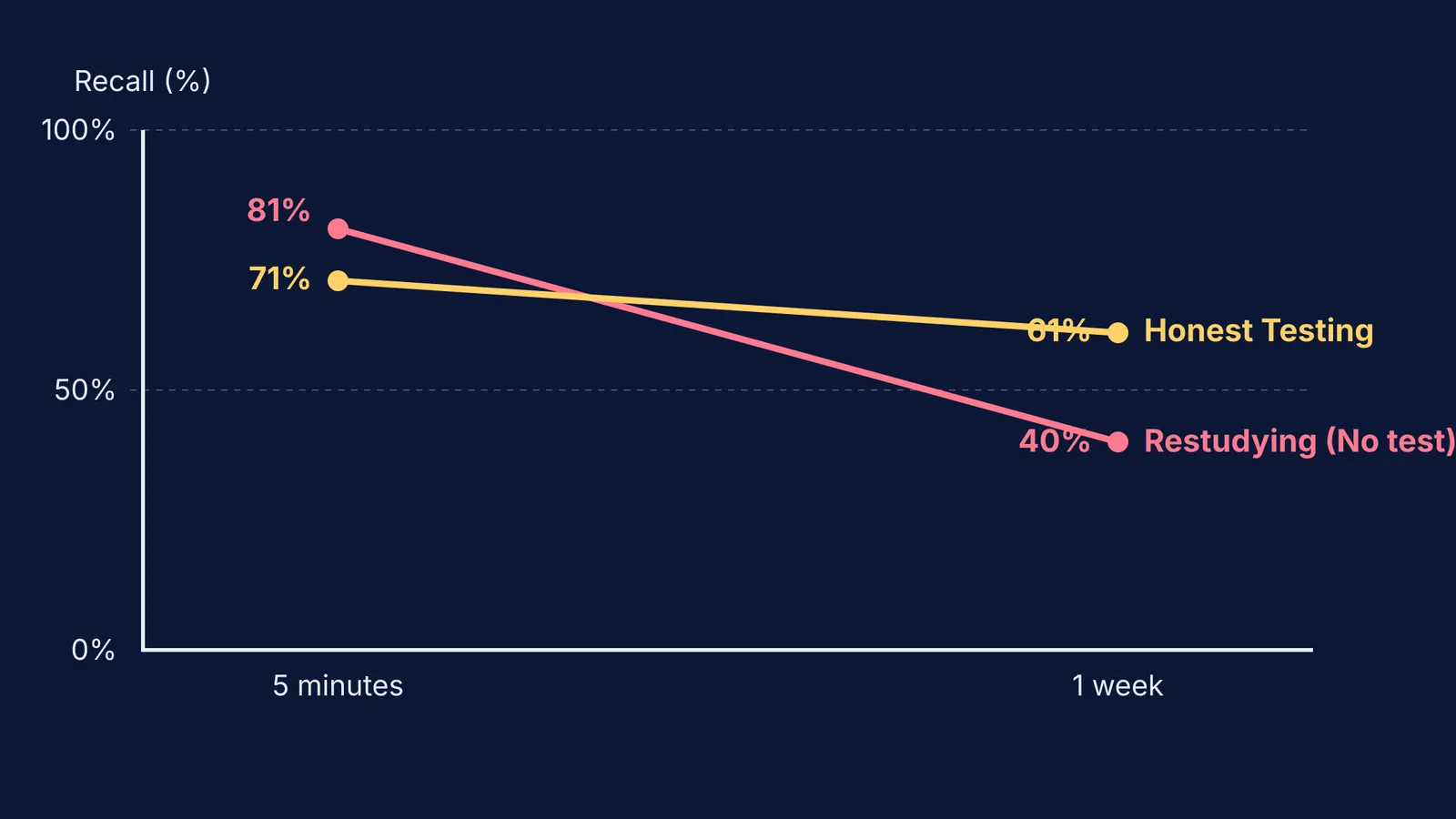
The primary benefit of taking a mock exam is not the grade at the end, but the cognitive effort required to retrieve information from memory. In cognitive psychology, this mechanism is known as the testing effect.
A 2006 study published in *Psychological Science* found that students who took a practice test retained 61% of the material a week later, whereas those who only restudied the material retained just 40%.
When a student copies an answer from a textbook or a friend during a mock test, they are completely bypassing this vital retrieval process. They are merely restudying. This means they lose out on the memory-strengthening workout that an honest test provides. Without the struggle of trying to remember the steps of a physics derivation or a chemical equation, the neural pathways are never reinforced.
What is the long-term cost of inflated mock scores?
While cheating provides a temporary ego boost, it consistently leads to severe underperformance on the actual, high-stakes final exam.
A 2016 study by the CALDER Center on test-score manipulation showed that when scores are artificially inflated, student achievement drops significantly below expected levels in the following year.
The reason for this drop is simple: a false high score prevents the student from receiving necessary remediation. If the coaching institute and the parents believe the student has already mastered rotational mechanics or organic chemistry, they will not step in to offer extra help. The student's weakness remains hidden until the proctored final exam, where cheating is impossible and the score crashes. In extreme cases, relying on unauthorized aids during mocks means a student never builds the stamina required to sit through a three-hour paper honestly.
What should I do if my child cheats on mock tests?
If you suspect your child is cutting corners, you need to change what you reward. Shift the family's focus away from the raw mock test score and towards the learning process itself.
Normalize mistakes: Make it clear that a low score on a practice test is a good thing because it highlights exactly what needs work. Remind them that mock tests are diagnostic tools, not final judgments.
Supervise gently: If tests are taken at home, set up a quiet, monitored environment where phones and textbooks are kept in another room. If you are unsure how to start this transition, reading about practice tests at home for children can help establish a healthy routine.
Build custom, low-stakes tests: Sometimes coaching tests are simply too hard for a student's current level, prompting them to cheat out of sheer frustration. You can build your own mock paper with AI to give them achievable milestones that build genuine confidence.
Use tools that teach, not just grade: When a student is stuck and tempted to copy an answer, they need step-by-step guidance rather than a quick fix. The Fermi Problem Library has worked problems with a step-by-step solver that explains the reasoning rather than printing an answer.
If you want to see how this changes a study session, Fermi's AI tutor works out what a student knows and builds a plan for the session, so they sit down to a clear next step.


