

On this page
One week is enough to add marks in Class 9 if you spend it answering questions instead of rereading. In the 2013 review of ten study techniques by John Dunlosky and colleagues, practice testing and distributed practice were the only two rated high utility; rereading and highlighting were rated low. So this plan is built from timed questions, with old topics returning every evening. Our post on what the Dunlosky review found has more.
How should you split one week before Class 9 exams?
Let the marks decide where time goes inside each subject. The CBSE Class 9 Mathematics curriculum for 2026-27 sets an 80-mark theory paper in 3 hours, with Geometry worth 25 marks and Algebra 20. The CBSE Class 9 Science curriculum for 2026-27 also sets an 80-mark, 3-hour annual paper: World of Living 27 marks, Matter 25, Motion, Force, Work and Sound 23, and Earth as a system 5. In this plan, Maths and Science get the most blocks, and each gets one full mock.
Your school sets the Class 9 annual exam, so check its datesheet and syllabus first; the CBSE Class 9 Social Science curriculum still says its course structure "will be provided shortly". Our guide to the new Class 9 NCERT books lists what changed.
What does each day look like?
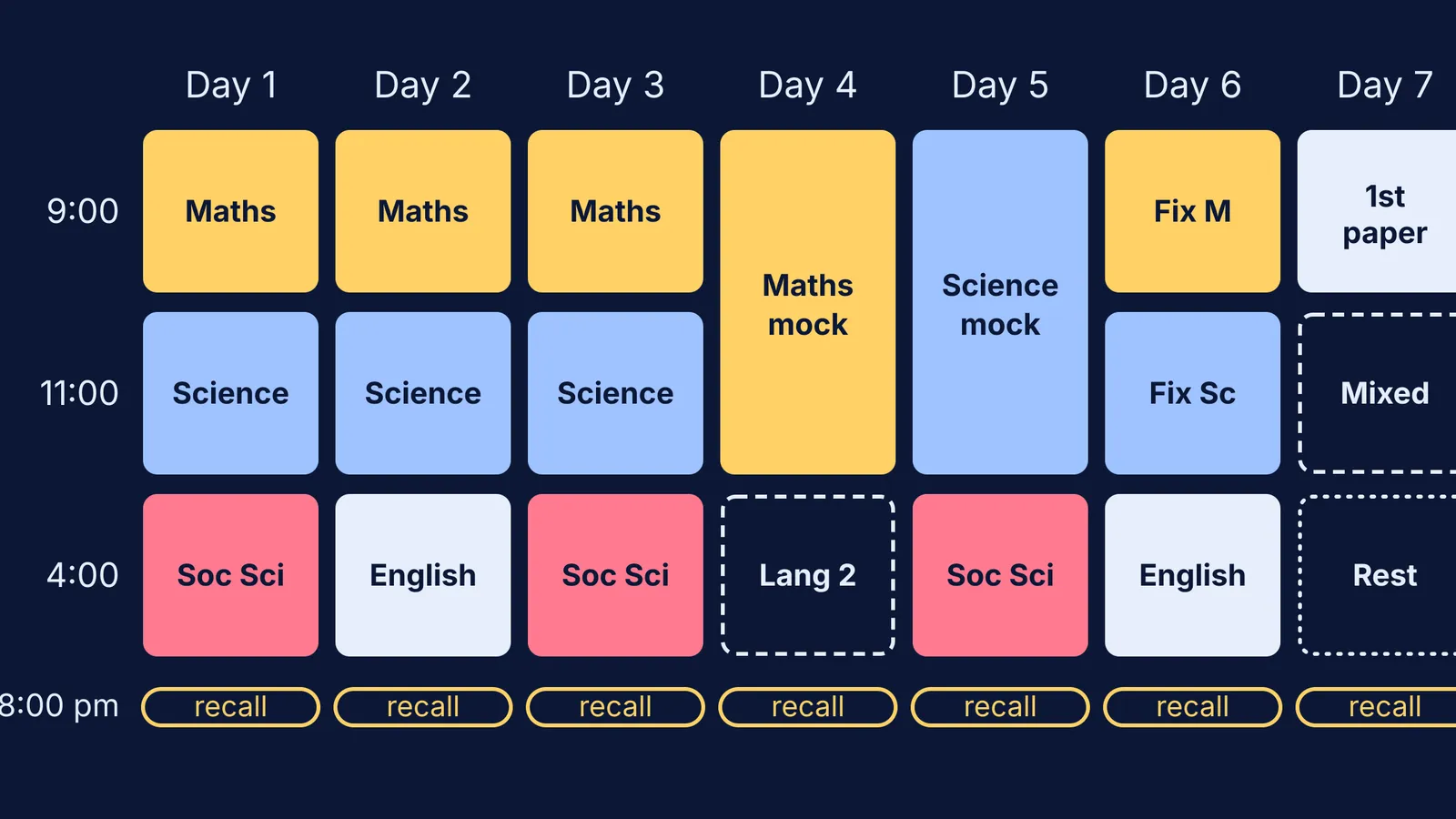
Use three 90-minute blocks, at 9:00, 11:00 and 4:00, plus 20 minutes of recall at 8:00 pm. Put the hardest subject first, while you are fresh.
Day 1: Maths (Algebra), Science (World of Living), Social Science (first half of the chapters).
Day 2: Maths (Geometry), Science (Matter), English.
Day 3: Maths (the remaining units), Science (Motion, Force, Work, Sound, plus Earth), Social Science (second half).
Day 4: a timed 3-hour Maths mock from 9:00 to 12:00, then your second language.
Day 5: a timed 3-hour Science mock the same way, then Social Science past questions.
Day 6: fix your Maths mock mistakes, fix your Science mistakes, then English.
Day 7: mixed questions for your first paper, a light mixed recall, then rest, with books shut by 6 pm.
A worked example: your Maths mock shows you lost 6 marks on circle proofs and 3 on probability tree diagrams. Day 6's first block is ten circle-theorem proofs and five tree-diagram questions, not a reread of the whole book.
Keep the same bedtime all week. The American Academy of Sleep Medicine consensus statement recommends that teenagers aged 13 to 18 sleep 8 to 10 hours per 24 hours. See why sleep before an exam beats an all-nighter.
Which Maths questions should you practise?
The 2026-27 Maths question paper design gives about 54% of marks to remembering and understanding, 24% to applying, and 22% to analysing, evaluating and creating.
Geometry (25 marks): congruence proofs with SAS, ASA, SSS and RHS; why SSA fails; circle theorems on chords and angles; quadrilateral proofs.
Algebra (20 marks): slope and y-intercept of y = ax + b; factorising with identities; the nth term of an AP and a GP; a pair of linear equations by substitution, elimination and graph.
Mensuration (14 marks): Heron's formula; areas of circles and sectors; surface area and volume of cuboids, cylinders, cones and spheres.
Statistics and Probability (10 marks): weighted averages, stacked bar graphs, tree diagrams.
Number System (7 marks) and Coordinate Geometry (4 marks): proving that root 2 is irrational; distance, midpoint and checking whether three points lie on a line.
Write every step, even in practice. When the method is wrong rather than the arithmetic, the Fermi Problem Library has worked problems with a step-by-step solver that explains the reasoning rather than printing an answer.
Which Science questions should you practise?
The 2026-27 Science question paper design is 50% knowledge and understanding, 30% application, and 20% analysing, evaluating and creating. It uses very short, assertion-reasoning, short, long and case-based questions, with internal choice of about 33%.
Biology: diffusion versus osmosis; plant versus animal tissues; labelled diagrams of cheek cells, onion peel and a bisexual flower.
Chemistry: true solution, suspension and colloid, including the Tyndall effect; which separation method suits which mixture; the law of conservation of mass.
Physics: distance-time and velocity-time graphs; F = ma problems; work, kinetic and potential energy, and power; mechanical advantage as load divided by effort; speed of sound, time period and frequency.
Every day: one assertion-reasoning set and one case-based passage.
If a whole idea is shaky rather than one question, the Fermi Concept Library gives every concept in physics, chemistry, biology and mathematics its own lesson.
How can parents help during exam week?
Ask "What did you get wrong today, and what did you fix?" instead of "How many hours did you study?"
Try saying: "You don't need to finish every chapter. Show me the three questions you will redo tomorrow."
Some nerves are normal. If worry stops your child eating, sleeping or coping, talk to a doctor or the school counsellor, or call Tele MANAS, the health ministry's free, 24x7 mental-health helpline, on 14416.
Write your first paper's subject on Day 7, then start Day 1 with Algebra.


