On this page
Most students notice it by the first unit test: a question that earned full marks in Class 8 now needs a reason for every line. That feeling has clear causes, and you can plan for them.
Why does Class 9 feel so much harder than Class 8?
India's national learning survey suggests many students find secondary maths hard. In the PARAKH Rashtriya Sarvekshan 2024, run by NCERT's assessment body PARAKH, Class 9 students averaged 37% in maths and 40% in science, while Class 3 students averaged 60% in maths. Each grade sat its own test, so this is not a direct Class 8 to 9 comparison, but Class 9 maths was the lowest average of all grades in a survey of more than 21 lakh students, as The Federal reported.
Three shifts drive most of the jump:
From calculating to proving. In Class 8 you mostly found answers. In Class 9 you also have to show why an answer must be true.
From words to symbols and graphs. Science now describes motion with graphs and equations, so your maths skills carry straight into physics.
One big annual paper. In CBSE's 2026-27 Class 9 maths and science curricula, the theory paper is worth 80 marks, with 20 more from internal assessment, so a weak chapter early in the year still costs you at the end.
What changes in Class 9 maths?
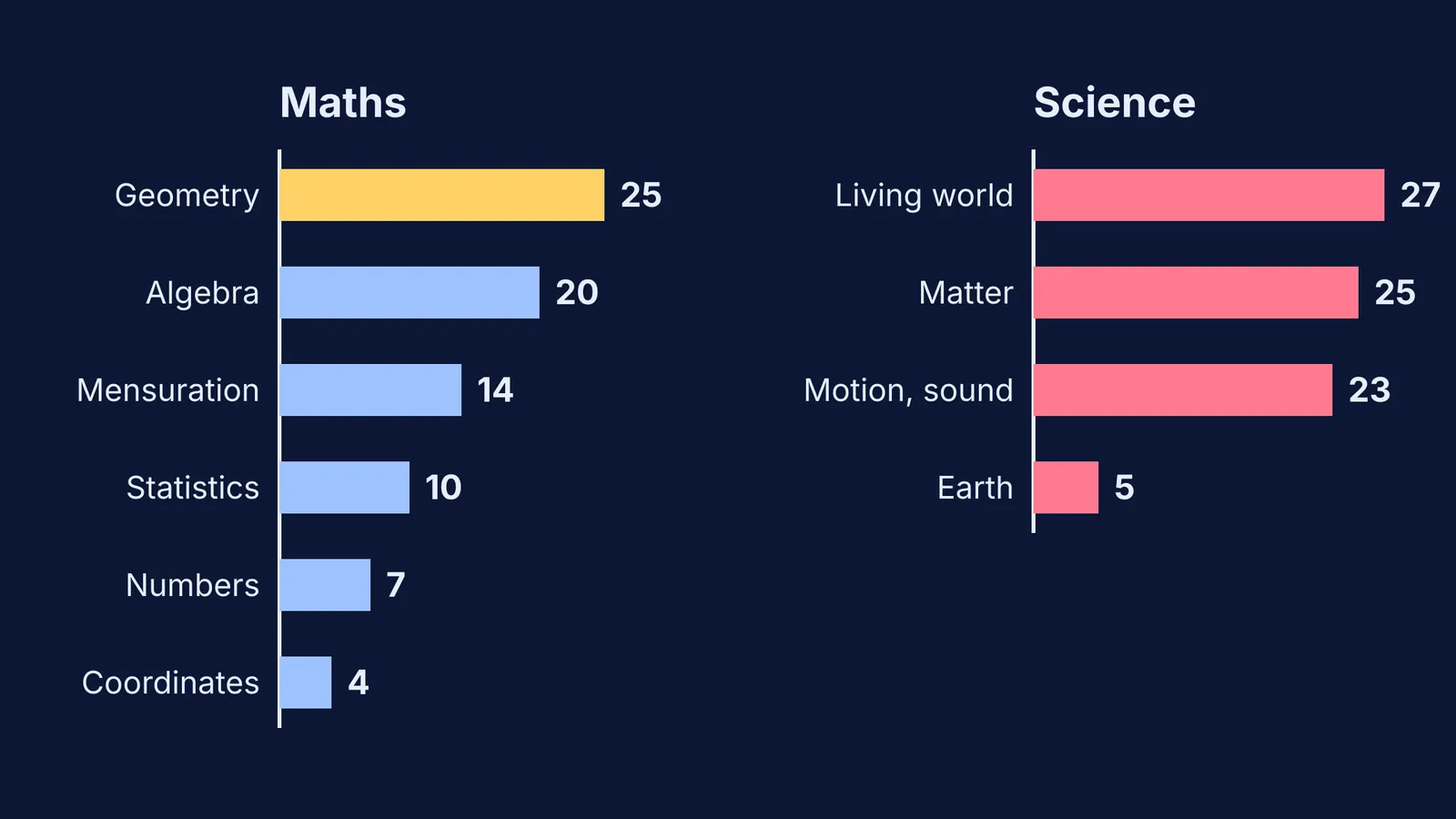
The CBSE Class 9 maths curriculum for 2026-27 gives geometry 25 of the 80 theory marks, the largest share, and algebra 20. Geometry here means proving: you start from Euclid's axioms and postulates and prove results about lines, triangles, quadrilaterals and circles. Even the number system chapter asks you to prove that √2 and √3 are irrational.
Algebra grows too: you solve pairs of linear equations by graphing, substitution and elimination, and meet arithmetic and geometric progressions. CBSE also offers maths and science at a standard level and an optional advanced level, as its curriculum page lists. Our guide to the new NCERT Class 9 books covers the textbooks.
So practise writing every reason ("given", "vertically opposite angles", "by SAS") instead of jumping to the conclusion.
What changes in Class 9 science?
From Class 9, CBSE teaches science "using an integrated approach that combines Biology, Chemistry, Physics, and Earth Science", according to its Class 9 science curriculum. The 80-mark annual paper splits into World of Living (27 marks), Matter (25), Motion, Force, Work and Sound (23) and Earth as a system (5), with 20 more marks from internal assessment.
The physics unit is where many students first feel lost, because it asks you to read graphs of motion and turn them into equations. Our explainer on motion in Class 9 works through them. If a graph still feels flat on paper, the Fermi Simulation Lab has interactive simulations for ideas that are easier to see than to read.
Which study habits should you set up in the first two months?
Two habits have strong evidence behind them. A 2013 review by John Dunlosky and colleagues in Psychological Science in the Public Interest rated practice testing and distributed practice (spreading study over time) as high utility among ten techniques, and rated rereading and highlighting as low utility. In a classic experiment, Roediger and Karpicke (2006) found that recall tests beat restudying on delayed tests, even though restudying looked better after five minutes.
Here is an eight-week plan that uses both:
Week 1: map the year. Copy the unit names and marks into the front of your maths and science notebooks.
Week 1: fix a daily slot. Same time each school day, phone in another room.
Weeks 2-8: close the book and recall. After each class, write the main ideas from memory, then check your notes.
Weeks 2-8: come back later. Revisit each chapter after a few days and again a week or two later, not only before a test. Our 4-week spaced revision schedule shows one way to set the gaps.
Weeks 3-8: keep an error log. For every wrong answer, note the mistake type (concept, method or careless) and the corrected step.
Weeks 3-8: write proofs in full. Two geometry proofs a week, every reason written out, checked against the book.
Week 8: test yourself. Sit one mixed, timed set of questions and use your error log to choose what to fix next.
If your error log keeps showing the same method mistake, the Fermi Problem Library has worked problems with a step-by-step solver that explains the reasoning rather than printing an answer.
What can parents say when Class 9 marks drop?
A lower first score often reflects new demands, not lower ability. Questions like these help:
"Which kind of question cost you marks: proofs, graphs or calculations?"
"Show me one question you got wrong and how you would do it now."
"Which habit from the plan will you keep going this week?"
Avoid comparing with Class 8 marks; the papers ask for different things. If worry affects sleep, appetite or mood for weeks, talk to the school counsellor or a doctor. The government's Tele MANAS mental health helpline is free on 14416.
Pick one habit from the plan and start it this week.