

On this page
School ends, tuition starts, and the evening disappears. The plan below starts from those fixed blocks, then fits self-study into what is left.
How many hours should a Class 10 student study after school and tuition?
Sleep comes first. Teenagers aged 13 to 18 should sleep 8 to 10 hours per 24 hours on a regular basis, according to a consensus statement of the American Academy of Sleep Medicine. It links regularly sleeping less with attention, behaviour and learning problems.
Movement comes next. The WHO 2020 guidelines on physical activity say an average of 60 minutes a day of moderate-to-vigorous activity across the week benefits children and adolescents.
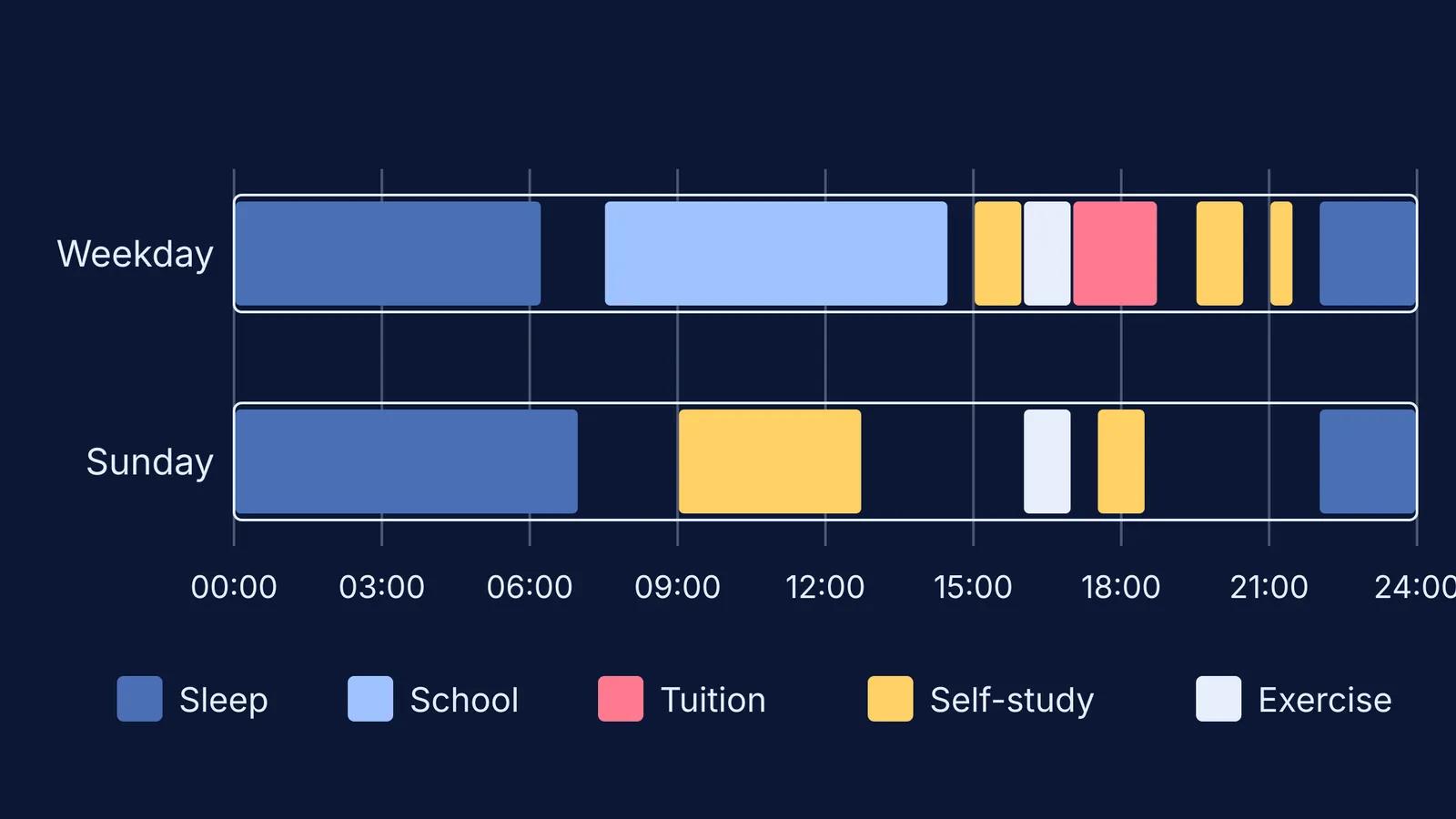
Once school, tuition, those two needs and meals are in, a school-and-tuition weekday leaves room for about two to two and a half hours of focused self-study.
For the parent's side of this, read our guide on how much sleep teenagers need and how parents can help.
What does a realistic weekday timetable look like?
This example assumes school from 7:30 to 2:30 including travel, and tuition from 5:00 to 6:45. Shift the times to match your day, but keep the order.
6:15 Wake up, get ready, breakfast
7:30 to 2:30 School
2:30 to 3:00 Lunch and rest
3:00 to 4:00 Study block 1: homework and a quick recap of today's lessons
4:00 to 5:00 Sport, cycling or a brisk walk
5:00 to 6:45 Tuition, including travel
6:45 to 7:30 Snack and family time
7:30 to 8:30 Study block 2: practice questions on the tuition topic, solutions closed
8:30 to 9:00 Dinner
9:00 to 9:30 Study block 3: ten minutes of recall from memory, then write tomorrow's three tasks
9:30 Screens away, wind down
10:00 Lights out
That gives two and a half hours of self-study and just over eight hours in bed, inside the AASM sleep range. Block 3 is recall, not new chapters.
What should a Class 10 weekend timetable include?
Treat Saturday as a lighter weekday. Sunday is where the week comes together:
7:00 Wake up, within an hour of your weekday time
9:00 to 12:00 One timed paper or chapter test under exam conditions
12:00 to 12:45 Mark it yourself and copy every mistake into a mistakes notebook
Afternoon off for family, friends and rest
4:00 to 5:00 Sport or outdoor time
5:30 to 6:30 Plan the week: which chapters at school, which at tuition, which mistakes to redo
10:00 Lights out, as on weekdays
If school and coaching keep colliding, our post on time blocking for students juggling school and coaching shows how to plan by the week rather than the day.
How should the timetable change through the board year?
Shift the shape of the day by term.
April to July: the weekday plan as above, with Sunday tests on the current chapter only.
August to October: Sunday tests become cumulative, mixing old and new chapters, plus past board questions for each finished chapter.
November to January: if tuition has finished the syllabus, swap one tuition evening for self-study. Sundays become full papers in board timing.
February to March: keep the same wake time on exam days, revise formulas and your mistakes notebook, and skip all-nighters.
After results: plan May study only if you choose to improve a subject.
That last step is new. Under CBSE's two-exam scheme for Class 10, it is mandatory for all students to appear in the first board examination, and passed students may take the second to improve up to three subjects from science, mathematics, social science and languages. CBSE's draft scheme proposed the 2026 first phase for 17 February to 6 March and the second for 5 to 20 May; later dates appear on cbse.gov.in. Our explainer on how the CBSE Class 10 two board exams work has the details.
What if the timetable keeps breaking?
It will, sometimes. Keep the two anchors fixed, wake time and lights out, and drop block 3 first, then block 1. Block 2, practising the tuition topic, is the one to protect.
If you sit down to a block and do not know where to start on a chapter, Fermi's AI tutor can work out what you already know and build a plan for the session, so the hour starts with a clear next step. For a stuck maths or science question, the Fermi Problem Library has worked problems with a step-by-step solver that explains the reasoning rather than printing an answer.
If stress starts affecting sleep, eating or mood for more than a few days, talk to a school counsellor or a doctor. Tele MANAS, a toll-free, 24x7 tele-mental health counselling line on 14416, is a national service students and parents can call.
Print the weekday plan, fit the times to your school, and run it for a week before you judge it.


