

On this page
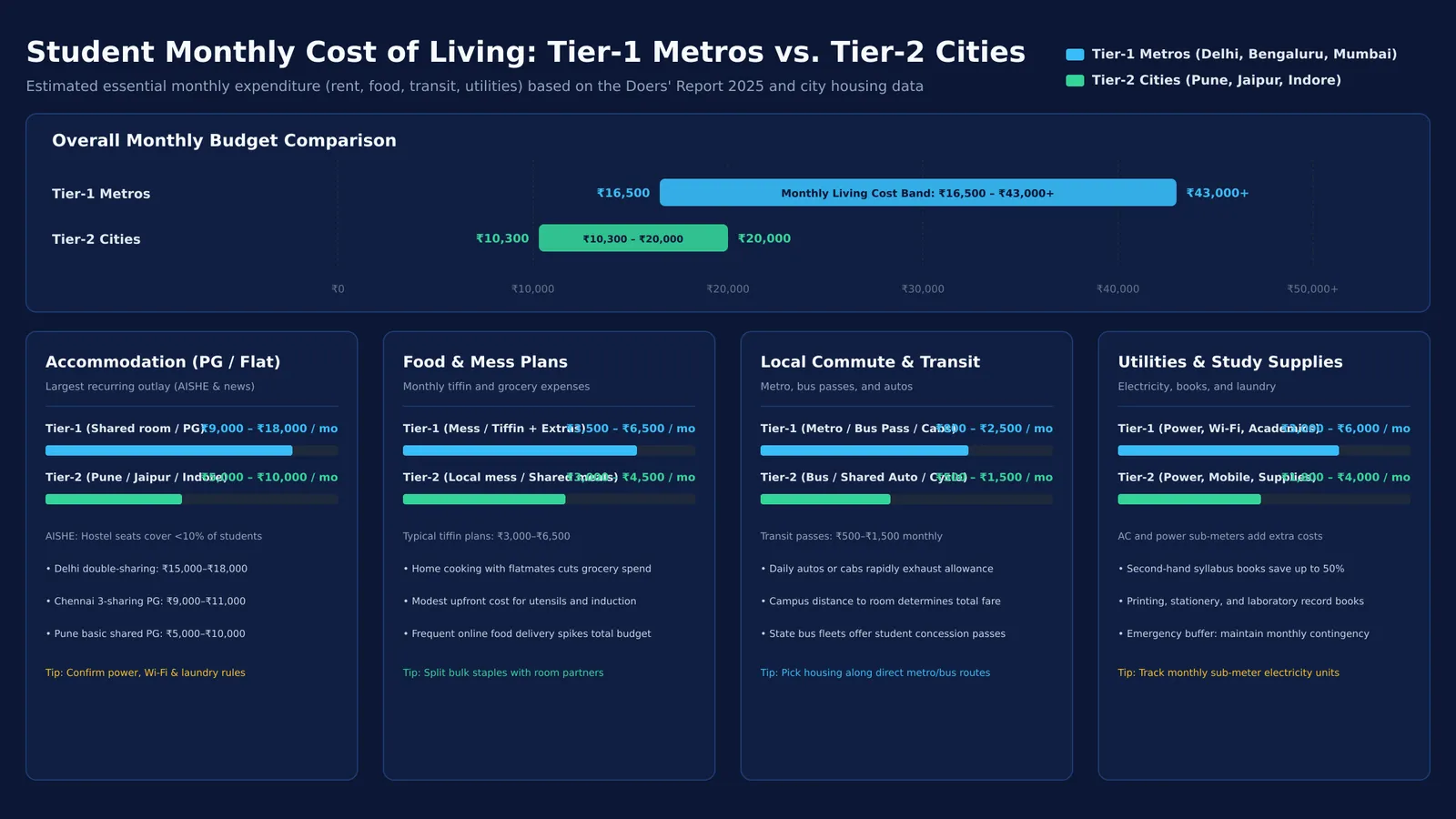
When you choose a college, the tuition fee is only part of the financial picture. The day-to-day cost of living varies sharply depending on where you study, and living in a major metro can double the total cost of completing your degree. According to the Doers' Report 2025, cited by *The Times of India*, the monthly cost of living for a student in a Tier-1 city like Bengaluru or Delhi ranges from ₹16,500 to over ₹43,000. In Tier-2 cities, the monthly range is a more affordable ₹10,300 to ₹20,000.
Comparing cities means looking beyond broad averages and breaking down the discrete expenses a student encounters: housing, daily meals, local commuting, and academic incidentals. If you are studying away from home, estimating these categories early prevents unexpected financial stress once the semester begins.
What will rent cost in a student hub?
Accommodation is usually the largest single recurring outlay. While staying in an on-campus hostel is the most economical choice, residential seats remain limited across the country. The Ministry of Education's All India Survey on Higher Education (AISHE) reports that total hostel capacity in colleges accommodates approximately 40 lakh students—less than 10% of the more than 4.3 crore students enrolled in higher education nationwide. Because of this structural shortfall, the vast majority of outstation students enter the private rental market.
If you do not secure a hostel spot, you will likely look for a Paying Guest (PG) accommodation or a shared flat. In Pune, *The Indian Express* reports that basic shared student accommodation typically costs between ₹5,000 and ₹10,000 per month. In contrast, *The Times of India* notes that a three-sharing PG room in Chennai costs ₹9,000 to ₹11,000, while double-sharing rooms in Delhi's prime North Campus or South Campus hubs frequently exceed ₹15,000 to ₹18,000 per month. These figures fluctuate based on amenities such as air conditioning, attached washrooms, and included food services. Once you find a room, creating an organized study space is the next hurdle; you can read our guide on studying in a hostel or PG for practical setup routines.
How much should you budget for food and transport?
If your PG does not include meals, or if you rent an independent flat with flatmates, you will need a separate monthly meal budget. Many student residences now charge separately for food, with monthly mess or tiffin service plans typically costing between ₹3,000 and ₹6,500, according to *The Times of India*. Cooking your own meals can keep grocery bills near the lower end of that range, though setting up a kitchen requires a modest upfront spend for basic utensils and an induction cooktop.
Local commuting costs depend heavily on the city's transport infrastructure. Relying on daily auto-rickshaws or ride-hailing apps quickly depletes a student's allowance. Securing a student concession pass on a city metro or municipal bus network keeps monthly transit expenses between ₹500 and ₹1,500 in most hubs.
What are some practical ways to save money?
Once your basic framework is established, small daily habits can prevent month-end shortfalls. Here are four proven strategies that help students stretch their allowance across Indian college cities:
Use public transport passes: Instead of paying for individual daily tickets or booking cabs, register for student concession passes on local metro networks or state bus fleets to keep monthly commuting expenses as low as possible.
Buy second-hand course books: Academic textbooks carry high sticker prices. Famous student markets like Delhi's Nai Sarak or Bengaluru's Avenue Road offer standard syllabus texts at steep discounts, and departmental seniors frequently sell or pass on their previous semester copies.
Cook shared meals with flatmates: Dining out or ordering through food delivery apps rapidly escalates meal expenses. Preparing basic staples and splitting bulk grocery purchases with room partners is significantly cheaper than full-time restaurant dining.
Use student identity discounts: Keep your university identity card on hand. Major software suites, technology manufacturers, subscription services, and campus-area cafes offer dedicated student concession tiers.
How to build a realistic monthly budget?
To evaluate two or more prospective college locations on equal footing, build a side-by-side expense ledger before finalizing your seat. Investigate local PG listings or consult current students at each campus to record realistic estimates across six core buckets:
Rent: The monthly fee for your room or PG bed.
Utilities: Electricity charges, water supply, and Wi-Fi if billed separately.
Food: Mess fees, tiffin subscriptions, groceries, and weekend meals.
Transit: Monthly metro or bus passes alongside emergency auto fares.
Academics: Textbooks, laboratory manuals, printing, and stationery.
Incidentals: Mobile recharges, laundry fees, personal toiletries, and an emergency cushion.
Comparing this composite sum against available family support helps clarify the true cost of attendance. If covering these living costs is a major factor in your decision, look early into scholarships for science students to help offset tuition and accommodation expenses.
Managing an independent budget while adjusting to rigorous academic expectations can feel challenging during your first semester. As you settle into your new city, maintaining momentum in your coursework is essential. If you run into difficulties with complex homework problems, the Fermi Problem Library has worked problems with a step-by-step solver that explains the reasoning rather than printing an answer. And for lectures that left conceptual gaps, Fermi's AI tutor can work out what you already know and build a plan for the session, so you sit down to a clear next step.


