

On this page
Why is choice filling so overwhelming?
When the counselling portal opens, students and parents confront an intimidating matrix: more than 500 academic programs across 138 participating institutes, including 23 Indian Institutes of Technology (IITs), 31 National Institutes of Technology (NITs), and 26 Indian Institutes of Information Technology (IIITs) listed on the official JoSAA portal. Evaluating branches, cities, and institutions against a ticking countdown clock quickly triggers decision fatigue. In a landmark investigation published in the *Journal of Personality and Social Psychology*, psychologists Sheena S. Iyengar and Mark R. Lepper demonstrated that confronting decision-makers with an extensive array of options dramatically increases cognitive burden and regret while decreasing satisfaction with the final selection.
Without an objective framework, families often make impulsive compromises or surrender to social media rumors about branch prestige. Creating a private research spreadsheet before logging into the portal replaces chaotic guesswork with deliberate analysis. Reviewing foundational guidelines, such as our guide on JoSAA counselling for parents: rounds, choices and documents, helps families understand the process, but an offline evaluation sheet remains the most reliable safeguard against last-minute panic.
How does the choice filling allocation algorithm actually work?
To construct an effective college list, you must first understand the mathematics governing seat distribution. Modern centralized counselling relies on the Deferred Acceptance algorithm, originally formulated by mathematicians David Gale and Lloyd S. Shapley in their 1962 paper in *The American Mathematical Monthly*. When Indian technical admissions unified under this framework, researchers Surender Baswana, Partha Pratim Chakrabarti, Sharat Chandran, Yashodhan Kanoria, and Utkarsh Patange reported in the *INFORMS Journal on Applied Analytics* that centralized joint allocation reduced undergraduate seat vacancies at IITs by nearly 75%.
Because the JoSAA allocation algorithm is candidate-proposing, truth-telling is mathematically the dominant strategy for every student. The computer evaluates your preference list strictly from Choice 1 downward, matching your rank against program cutoffs. Once a seat is tentatively allocated—say, Choice 12—the system completely ignores all options below it (Choices 13, 14, and beyond). In later rounds, you can only retain that seat or move upward toward Choice 1 through float or slide mechanisms; you can never drop to a lower-ranked choice. Understanding this prevents fatal ordering errors before exploring subsequent options like CSAB special rounds after JoSAA: who they are for and how they work.
Which columns should you include in your research spreadsheet?
A well-structured spreadsheet strips away marketing rhetoric and isolates objective data. Open a new sheet and build five essential columns for every candidate choice:
Institute and program details: Record the college name, campus location, degree type, and exact branch code. To understand what each engineering discipline actually demands, students can explore foundational coursework in the Fermi Concept Library, which covers every concept in physics, chemistry, biology, mathematics and computing, each with its own lesson and its place in the map.
Historical closing ranks: Record closing ranks across the past 3 years from the official JoSAA archive. Distinguish carefully between Home State and Other State quotas for NITs, as cutoffs vary widely, and verify eligibility conditions like the 75 percent board marks rule for NIT and IIIT admission.
Audited placement realities: Ignore promotional banners advertising single international packages. Instead, record the audited median salary and percentage of placed graduates from the official Data Capturing System disclosures on the National Institutional Ranking Framework portal, where verified Graduation Outcome metrics reflect typical earnings.
Total 4-year expenditure: Calculate tuition fees alongside hostel rent and mess charges. Under official guidelines from the Ministry of Education, undergraduate tuition at IITs is waived 100% for SC, ST, and PwD students, as well as students with family income under ₹1 lakh per annum, with a two-thirds waiver for annual incomes between ₹1 lakh and ₹5 lakh.
Connectivity and logistics: Log realistic transit times from your home town, proximity to major airport hubs, and regional weather conditions.
How do you balance ambitious, realistic, and safe choices?
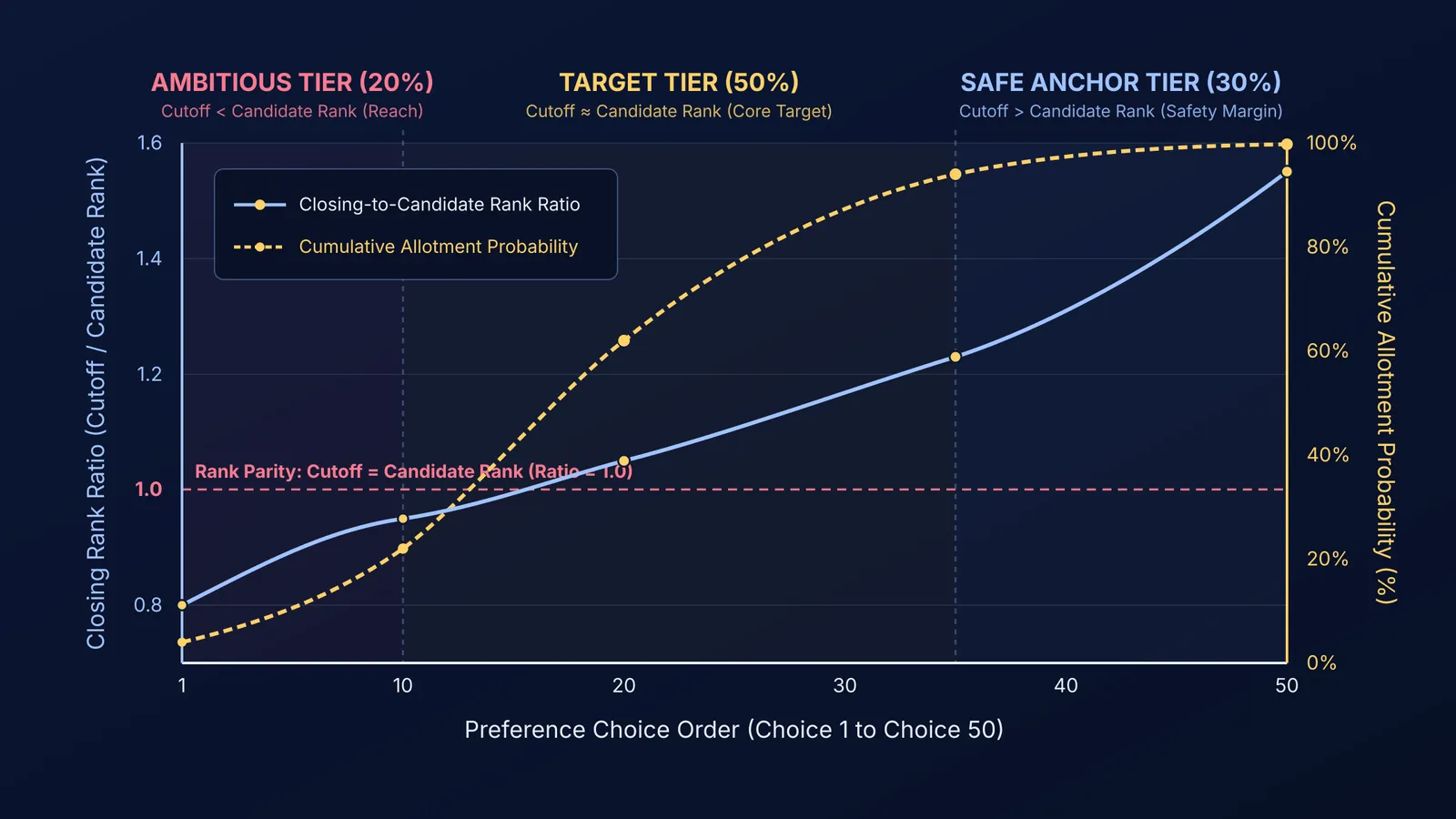
A resilient preference list on the JoSAA portal functions like an investment portfolio balanced across three distinct risk tiers:
Ambitious tier (15% to 25% of choices): Dream programs where the previous closing rank was 5% to 15% higher than your rank. Because deferred acceptance carries no penalty for unfulfilled early choices, including these costs nothing.
Realistic tier (40% to 50% of choices): Core target programs where your rank falls comfortably within the historical closing rank spread over the past three years.
Safe tier (25% to 35% of choices): Solid anchor programs where recent closing ranks were 20% to 50% below your rank, ensuring you secure an allotment even if cutoffs tighten unexpectedly.
When evaluating analytical coursework and curriculum rigor across different academic programs, students who need to strengthen prerequisite reasoning can turn to the Fermi Problem Library, which provides worked problems with a step-by-step solver that explains the reasoning rather than printing an answer.
Once your spreadsheet is complete, conduct a final sanity test with your family: compare Row N against Row N+1. If you would prefer being allotted Row N+1 over Row N, swap them immediately. Locking this verified order into the counselling portal turns an otherwise chaotic submission into a calm, confident decision.


