

On this page
Water infrastructure sits at the intersection of public health, urban expansion, and environmental protection. According to the Press Information Bureau, India's urban centres generate 72,368 million litres per day (MLD) of sewage, against an installed treatment capacity of only 31,841 MLD (43.9% of generation). Furthermore, NITI Aayog's Composite Water Management Index 2.0 reports that 600 million people in India face high to extreme water stress, with national demand projected to double available supply by 2030. Bridging this gap requires technical teams that unite fluid mechanics with chemical reaction kinetics. Historically pioneered by figures like Ellen Swallow Richards and her foundational water quality surveys, water treatment remains a high-impact path for students navigating your first semester at college in civil or chemical engineering.
How do civil and chemical engineering roles divide in a treatment plant?
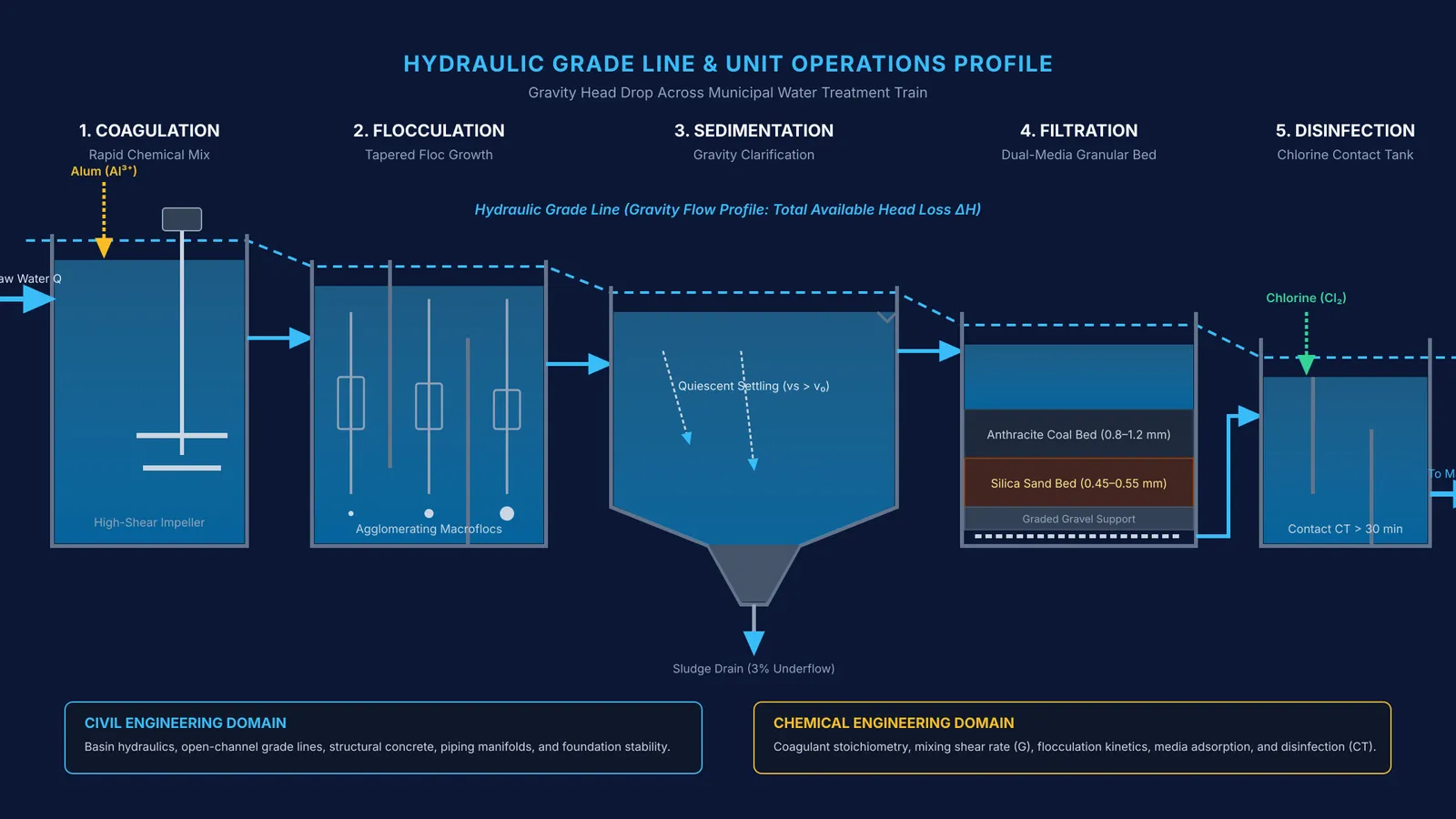
Water and wastewater treatment facilities operate where civil structural design meets chemical process engineering. Civil engineers govern physical conveyance, site hydraulics, and containment structures. They design intake wells, transmission mains, pumping stations, and reinforced concrete basins, calculating hydraulic grade lines, gravity head drops across weirs, and foundation stability against hydrostatic uplift.
Chemical engineers govern reaction kinetics and phase separation within those basins. They optimize coagulant dosing, rapid-mixing shear rates, dissolved oxygen transfer in aeration basins, and pH neutralization. In tertiary treatment, they manage ultrafiltration, reverse osmosis membrane flux, and activated carbon adsorption. To see how physical settling pairs with biological oxidation, review the principles behind sewage treatment stages and biological oxygen demand. When visualizing how fluid flow fields and settling trajectories behave inside clarifiers, the Fermi Simulation Lab provides interactive simulations for ideas that are easier to see than to read.
What does an engineer actually do on a typical plant shift?
On shift, plant engineers balance digital process monitoring, wet chemistry testing, and regulatory compliance. In the control room, they monitor Supervisory Control and Data Acquisition (SCADA) dashboards linked to Online Continuous Effluent Monitoring Systems (OCEMS). They track dissolved oxygen, filter head loss, and chemical feed rates. On the laboratory bench, engineers perform jar tests to adjust coagulant dosages whenever raw water turbidity shifts after rainfall.
Operational parameters are tied to statutory limits. In India, Central Pollution Control Board (CPCB) standards require treated effluent discharged into inland surface water to meet Biochemical Oxygen Demand (BOD) ≤ 10 mg/L, Chemical Oxygen Demand (COD) ≤ 50 mg/L, and Total Suspended Solids (TSS) ≤ 10–20 mg/L. Drinking water plants adhere to Bureau of Indian Standards (BIS) IS 10500:2012, requiring turbidity below 1 NTU and pH between 6.5 and 8.5. Globally, the World Health Organization Guidelines for Drinking-water Quality advocate a catchment-to-consumer risk management approach through comprehensive Water Safety Plans.
Worked example: Sizing chemical dosage and sludge yield for a 10 MLD plant
Under design guidelines established in the U.S. Environmental Protection Agency Drinking Water Regulations, conventional surface water treatment requires coordinated chemical coagulation, flocculation, and sedimentation to achieve robust particulate removal. Consider a municipal water plant treating an inflow Q = 10 MLD (10,000,000 litres per day), where jar tests establish an optimal alum coagulant dose of 25 mg/L.
Daily chemical mass:
10,000,000 L/day × 25 mg/L = 250,000,000 mg/day = 250 kg/day of commercial alum.
Alkalinity consumption:
Hydrated alum reacts with natural bicarbonate alkalinity: Al₂(SO₄)₃·14H₂O + 3Ca(HCO₃)₂ → 2Al(OH)₃↓ + 3CaSO₄ + 14H₂O + 6CO₂ Each 1 mg/L of alum consumes approximately 0.50 mg/L of natural alkalinity as CaCO₃. Dosing 25 mg/L consumes 12.5 mg/L alkalinity (25 × 0.50). If raw water alkalinity is below 30 mg/L, operators dose lime to keep the pH within the optimal 6.5–7.5 coagulation range.
Dry sludge and volume:
Chemical precipitate: Each kilogram of alum produces 0.26 kg of dry Al(OH)₃, generating 250 kg × 0.26 = 65 kg/day.
Suspended solids: With 40 mg/L raw TSS and 90% clarifier removal, solids captured equal 10,000,000 L/day × 36 mg/L = 360 kg/day.
Total dry solids = 360 kg + 65 kg = 425 kg/day.
At 3% solids concentration in the clarifier underflow, wet sludge volume equals 425 / 0.03 = 14,167 litres per day (14.2 m³/day). Civil engineers size dewatering beds using this volume. For students working through reagent stoichiometry and solution equilibria, the Fermi Problem Library offers worked problems with a step-by-step solver that explains the reasoning rather than printing an answer.
What qualifications and core skills do employers expect?
Entry-level roles require a B.Tech or B.E. in Civil, Chemical, or Environmental Engineering. Civil-focused engineers model pipe networks using EPANET or WaterGEMS and design physical layouts in AutoCAD Civil 3D. Process engineers use BioWin or GPS-X for biological kinetics and Aspen Plus for industrial evaporation systems.
According to the U.S. Bureau of Labor Statistics, environmental engineers earned a median annual salary of $107,110 in May 2025, with employment projected to expand 6% through 2035. In India, infrastructure programmes like the Jal Jeevan Mission, AMRUT 2.0, and industrial Zero Liquid Discharge (ZLD) mandates have driven strong hiring across municipal utilities, EPC contractors, and environmental consultancies. To build the foundational science across transport phenomena, fluid mechanics, and reaction engineering, students can explore the Fermi Concept Library, which organizes every concept in physics, chemistry, biology, mathematics and computing, each with its own lesson and its place in the map.


