On this page
India produced 239.30 million tonnes of milk in 2023-24 and is the world's largest milk producer, according to a Press Information Bureau backgrounder for National Milk Day 2025. Every litre starts with what the animal eats. Animal nutritionists decide what goes into that feed. If you like biology, chemistry and a bit of arithmetic, this career is worth knowing about.
What does an animal nutritionist actually do?
The core skill is ration balancing. The National Dairy Development Board (NDDB) defines ration balancing as the process of balancing nutrients from the available feed resources to meet an animal's requirements for maintenance and production. The same NDDB booklet breaks the work into four steps:
Assess the animal: milk yield, milk fat, body weight and lactation stage.
Know the chemical composition of local grains, oil cakes, fodder and crop residues.
Work out the requirement for dry matter, crude protein, energy (TDN), calcium and phosphorus.
Formulate the least-cost ration from local feeds.
This work affects farmers' incomes directly. On its Ration Balancing Programme page, NDDB reports that the programme covered 28.65 lakh dairy animals in 33,374 villages under the first National Dairy Plan. It says feed cost fell by about Rs 16.3 per animal per day and net daily income rose by Rs 25.5 per animal. These are NDDB's own reported figures. Poultry diets follow the same logic, adjusted for birds, which have no rumen.
How do you become an animal nutritionist after Class 12?
The main route is the veterinary degree, BVSc & AH. The Veterinary Council of India's 2026-27 information bulletin sets out the basics:
The BVSc & AH course lasts five and a half years, including a compulsory one-year internship.
You need Physics, Chemistry, Biology or Biotechnology, and English in Class 12. General-category students need at least 50% aggregate in these subjects, and SC, ST and other special categories need 47.5%.
Admission to the 15% all-India quota is by NEET-UG merit alone, and 858 seats were available under it for 2026-27.
For seats outside that quota, read your own state veterinary university's admission notice. Under VCI's 2016 degree regulations, Animal Nutrition is taught in the second professional year. At TANUVAS's Veterinary College and Research Institute, Theni, the course runs as two papers in four units, from principles of nutrition and feed technology to applied ruminant and non-ruminant nutrition. To specialise, you take an MVSc in Animal Nutrition. ICAR's national master's entrance, the AIEEA PG, is conducted by NTA and was scheduled for 4 July 2026. Our guide to career options after BVSc shows where nutrition sits among the other paths.
The second route runs through dairy and agriculture degrees. ICAR-National Dairy Research Institute in Karnal offers a B.Tech in Dairy Technology. Its 2026-27 notice for additional paid seats says admission is strictly on CUET-UG (ICAR) merit, and that candidates admitted with a PCB background must complete a bridge course in mathematics. For how ICAR admissions work, see our explainer on agriculture university admission after Class 12. If NEET doesn't go your way, our list of PCB careers without NEET has more options.
Can you try feed formulation yourself?
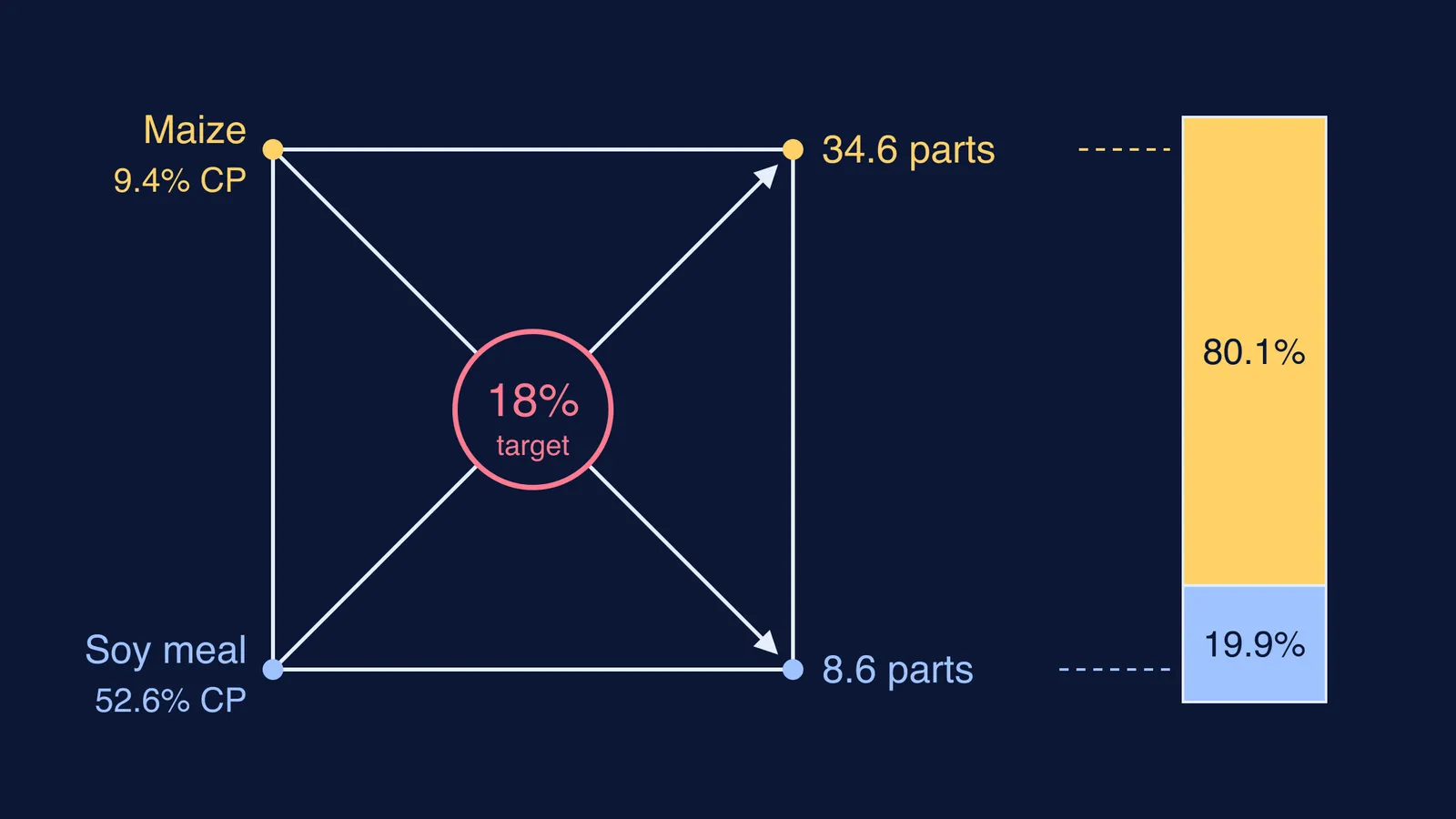
Yes. The classic starting tool is the Pearson square, which mixes two feeds to hit one nutrient target. NC State Extension's guide walks through the method and stresses working on a dry-matter basis. For our ingredients we use Feedipedia's maize grain average of 9.4% crude protein and its soybean meal (type 48) average of 52.6%, both on a dry-matter basis. The 18% target below is a practice number for the exercise, not a feeding recommendation for any animal.
Draw a square: 18 in the centre, maize (9.4) top-left, soybean meal (52.6) bottom-left.
Subtract along each diagonal, ignoring minus signs: 52.6 minus 18 gives 34.6 parts maize (top-right), and 18 minus 9.4 gives 8.6 parts soybean meal (bottom-right).
Add the parts: 34.6 + 8.6 = 43.2.
Convert to shares: maize is 34.6 ÷ 43.2 = 80.1%, and soybean meal is 8.6 ÷ 43.2 = 19.9%.
Check: 0.801 × 9.4 + 0.199 × 52.6 = 7.53 + 10.47 = 18.0. The mix hits the target.
If mixture problems like this trip you up, the Fermi Problem Library has worked problems with a step-by-step solver that explains the reasoning rather than printing an answer.
Which Class 11 and 12 topics matter most?
In biology, focus on digestion and on how ruminants differ from poultry. In chemistry, focus on proteins, carbohydrates, fats and minerals, because feed analysis is chemistry. In maths, practise ratios, percentages and simultaneous equations. If one feels shaky, the Fermi Concept Library covers every concept in physics, chemistry, biology, mathematics and computing, each with its own lesson.
A plan for this year:
Decide whether you will sit NEET-UG, CUET-UG (ICAR) or both, and check each eligibility rule against the official bulletin.
Visit a dairy cooperative, a veterinary college open day or a feed mill if one is near you.
Next step: redo the square with feeds sold in your own district.