

On this page
A ranking tells you which institution scores highest on a published formula. Your question is different: which college teaches the course you want, at a price your family can manage, in a place you can live, with a seat you can actually get? Here is a five-column scoring sheet for that, with a worked example.
Why shouldn't rankings decide your college list?
India's official ranking, NIRF, uses five groups of parameters. The Ministry of Education's 2025 release gives their weights as Teaching, Learning and Resources 0.30, Research and Professional Practice 0.30, Graduation Outcome 0.20, Outreach and Inclusivity 0.10, and Perception 0.10.
Those describe the whole institution, not your branch. Research output matters more to a PhD scholar than to a first-year student, and the formula knows nothing about your budget or home town. The same release says institutions "offered themselves for ranking", so a college missing from the list may simply not have applied.
The name on the gate may also matter less than people assume. Stacy Dale and Alan Krueger compared US students who were accepted and rejected by similar sets of colleges, published in the Quarterly Journal of Economics in 2002. Students who attended more selective colleges did not earn more than those admitted to comparable schools who went to less selective ones. Caveats: the data are American, the payoff to an elite college appeared larger for students from more disadvantaged families, and higher tuition was linked to higher later earnings.
Rankings do touch your wallet once. PM-Vidyalaxmi, the central scheme for collateral-free, guarantor-free education loans, covers institutions chosen mostly by NIRF rank. The Cabinet release adds a 3% interest subvention, during the moratorium period, on loans up to Rs 10 lakh for families earning up to Rs 8 lakh a year who get no other government scholarship or subvention. Check current eligibility on the official portal.
What should you score instead?
Score each college from 1 to 5 in five columns. The weights are a starting point.
Course content (weight 30). Read the department's curriculum. Do the first two years teach what you want? Are there electives, labs, a minor?
Total cost (weight 25). Tuition, hostel, mess and travel home for every year, minus scholarships you qualify for. Our guide to scholarships for science students in India lists where to look.
Admit chance (weight 20). From past closing ranks, explained below.
Location (weight 15). Travel time home, climate, language, family comfort.
Campus life (weight 10). Hostel seats, clubs, sports. Ask two current students how a normal week goes.
Change the weights to suit you (if money is tight, make cost 35, location 10 and campus life 5), as long as they add up to 100. Weighted score = the sum of (score × weight), divided by 5, which gives a number out of 100.
How do you check your admit chances?
For JoSAA institutes such as IITs and NITs, the JoSAA opening and closing ranks archive lets you pick a year from 2016 to 2025, a round, an institute, a programme and a seat type. Open-seat ranks there are CRL; category seats use category ranks. Check the final round for your category across three years, not one. State counselling bodies publish similar data.
A simple rule for the admit column:
5: your rank is comfortably inside the closing rank every year.
3: you are inside some years, outside others.
1: you are outside every year.
Scores of 1 or 2 mean reach, 3 match, 4 or 5 likely. A balanced list has some of each, including at least two likely colleges you would be glad to join. Our explainer on JoSAA counselling rounds, choices and documents shows how this list becomes your choice-filling order.
A worked example: three colleges, one sheet
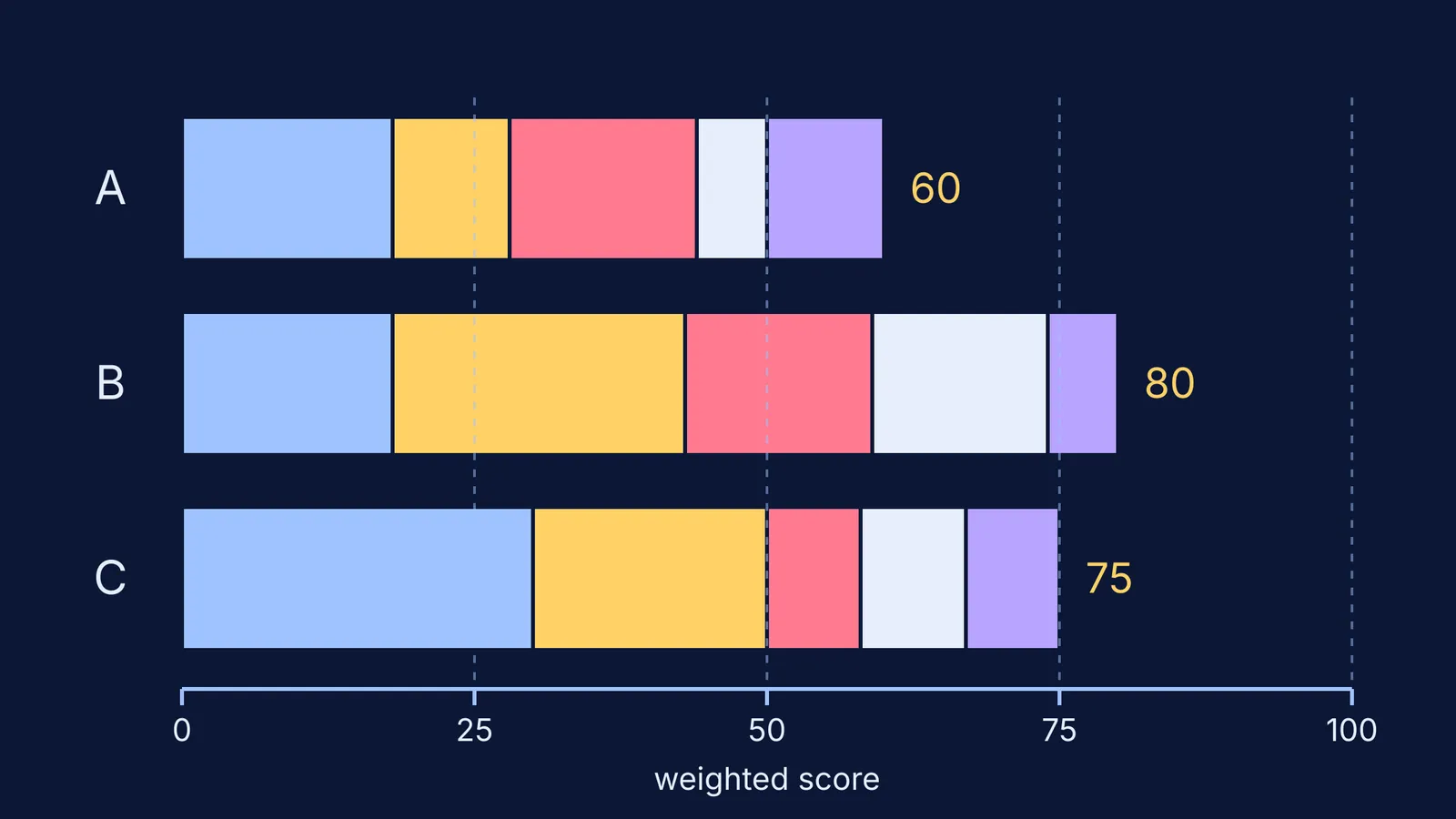
Riya, an illustrative student, scores three options (course, cost, admit, location, campus life):
College A, a well-known private university in another state with high fees: 3, 2, 4, 2, 5, weighted score 60.
College B, a state government college two hours from home: 3, 5, 4, 5, 3, weighted score 80.
College C, an NIT far from home with a strong department in her branch: 5, 4, 2, 3, 4, weighted score 75.
For College B: (3×30 + 5×25 + 4×20 + 5×15 + 3×10) ÷ 5 = 400 ÷ 5 = 80. The best-known name comes last. College C is her reach, College B a likely seat she would be happy with, and College A stays off unless a scholarship lifts its cost score.
What if your admit column is mostly 1s and 2s?
Add more match and likely colleges, or raise your score before the exam. There, the hard part is often knowing where to start. Fermi's AI tutor works out what you already know and builds a plan for the session, so revision starts with your gaps rather than the whole syllabus.
If list-making is causing constant stress at home, talk to a school counsellor or call Tele MANAS on 14416.
Once you have a seat, read what changes in your first semester at college.


