

On this page
Many students who perform exceptionally well in their Class 12 board exams assume scholarships are only for entrance exam rankers. However, both the central and state governments offer substantial financial support directly tied to board marks. These schemes ensure that academically strong students can pursue higher education regardless of their financial background.
Which central scholarships reward board toppers?
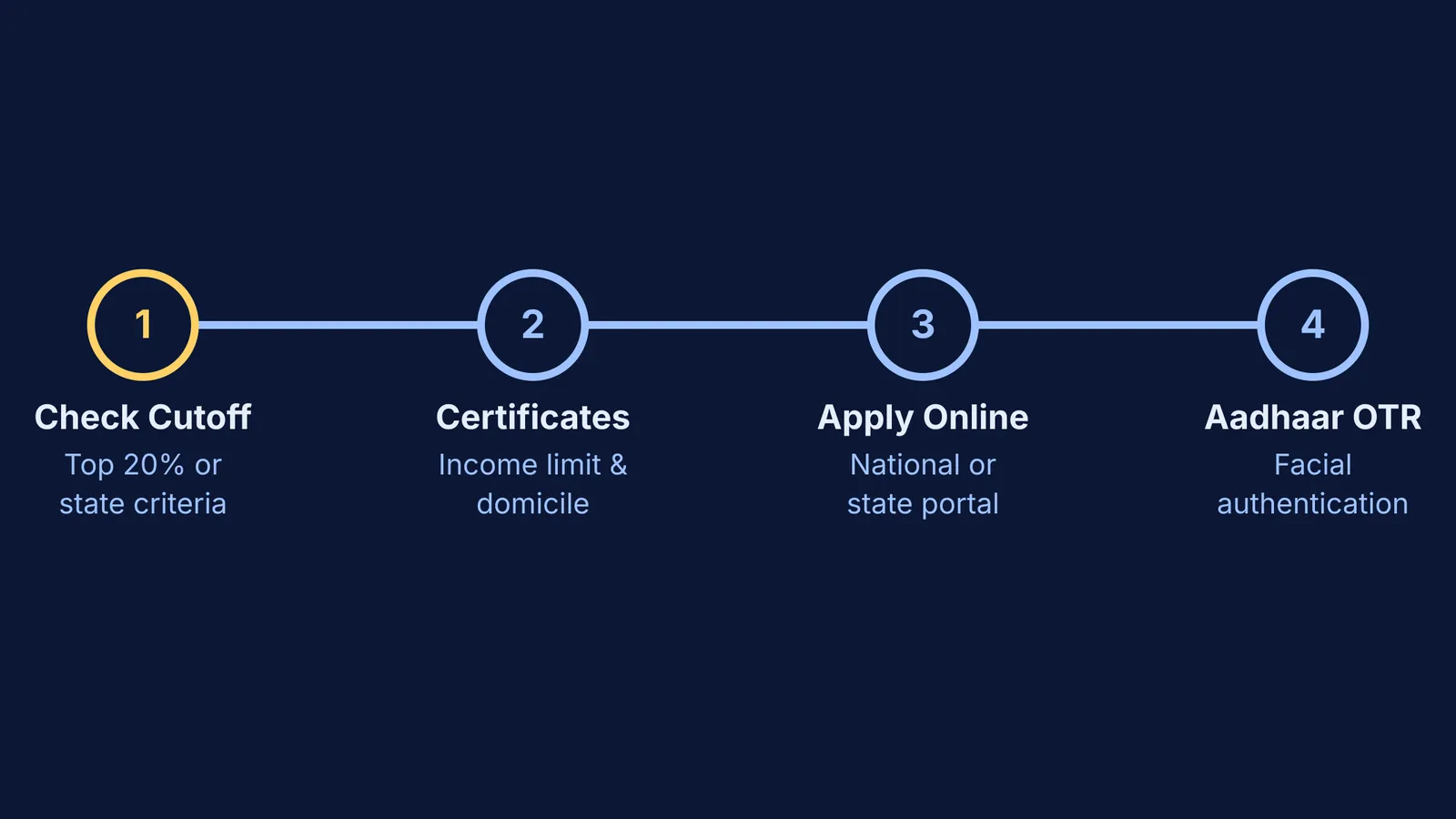
The primary national scheme is the Central Sector Scheme of Scholarship for College and University Students (CSSS). To qualify, you must be in the top 20th percentile of successful candidates in your respective board (such as CBSE, ICSE, or your state board) for Class 12 [[1]](https://scholarships.gov.in/). The percentile is calculated separately for science, commerce, and humanities streams, meaning the exact cutoff mark varies by board and subject each year.
The scheme is designed for students from families with a gross annual income of up to ₹4.5 lakh [[2]](https://www.myscheme.gov.in/schemes/pm-usp-csss). You must also be enrolled in a regular degree course at a recognized college or university. Students pursuing distance education or diploma courses are not eligible.
If selected, graduation students receive ₹12,000 per year for their first three years of college [[2]](https://www.myscheme.gov.in/schemes/pm-usp-csss). For postgraduate studies or the fourth and fifth years of professional courses, this amount increases to ₹20,000 per annum [[2]](https://www.myscheme.gov.in/schemes/pm-usp-csss).
What do state merit scholarships offer?
State governments run their own schemes, which often have different academic and income thresholds. Because education costs vary by state, the rewards can range from fixed annual stipends to complete tuition waivers.
For instance, the Mukhyamantri Medhavi Vidyarthi Yojana (MMVY) in Madhya Pradesh covers the full tuition fee for undergraduate courses, including engineering and medical degrees [[3]](https://medhavikalyan.mp.gov.in/). To be eligible, students must score at least 70% in the MP Board exams or 85% in CBSE/ICSE, and their family income must be under ₹6,00,000 per year [[3]](https://medhavikalyan.mp.gov.in/). This provides massive relief for students entering expensive professional courses in state institutions.
In West Bengal, the Swami Vivekananda Merit-cum-Means Scholarship (SVMCM) requires a minimum of 60% marks in Class 12 and a family income not exceeding ₹2,50,000 per annum [[4]](https://svmcm.wbhed.gov.in/). Eligible undergraduate students in arts and commerce receive ₹1,000 per month, while those in science or professional courses receive ₹1,500 per month [[4]](https://svmcm.wbhed.gov.in/).
When dealing with your first semester at science or engineering college: what changes, keeping up with coursework is essential because most of these scholarships require you to maintain a minimum percentage (often 50% or 60%) and strong attendance to renew the award each year [[1]](https://scholarships.gov.in/). If you are struggling with a difficult university topic and realizing that you might be misjudging your mastery (a common trap covered in knowing what you know: why students misjudge their own learning), it helps to practice actively. Fermi's AI tutor teaches rather than answers: it holds a line of reasoning across a whole session, notices where a student is stuck, and decides whether to explain, ask, or show. For specific calculations, the Fermi Problem Library has worked problems with a step-by-step solver that explains the reasoning rather than printing an answer.
How do you apply for these scholarships?
The application process is almost entirely online. Central schemes like the CSSS are hosted on the National Scholarship Portal (NSP). Starting recently, the NSP requires a mandatory One-Time Registration (OTR) using your Aadhaar number, which involves facial authentication [[1]](https://scholarships.gov.in/). Once your OTR is complete, you can apply for the CSSS and other central schemes through the same dashboard.
State schemes usually have their own dedicated portals, such as the SVMCM portal for West Bengal or the Medhavi Kalyan portal for Madhya Pradesh. Most scholarship portals open for applications between July and September, with deadlines often falling around late October or November.
What documents are needed for state merit scholarships?
Gathering paperwork is often the longest part of the application process. Bureaucratic delays with income or domicile certificates can cause you to miss tight deadlines. Use this practical checklist to prepare before the portals open:
Aadhaar card: Ensure your name and date of birth match your school records exactly. Discrepancies here are the most common reason for application rejection.
Aadhaar-seeded bank account: Government scholarships use Direct Benefit Transfer (DBT). This means the money is sent to whichever bank account is linked to your Aadhaar at the NPCI (National Payments Corporation of India) level. Simply giving your bank account number is not enough; you must explicitly ask your bank to seed it with Aadhaar for DBT.


