

On this page
Walking out of an examination hall knowing that a paper went badly is one of the most sinking feelings a student can experience. When the next exam is tomorrow morning, panic often takes over. The instinct is to check answer keys, calculate lost marks, and cram until 3:00 AM. That reaction turns one bad score into two.
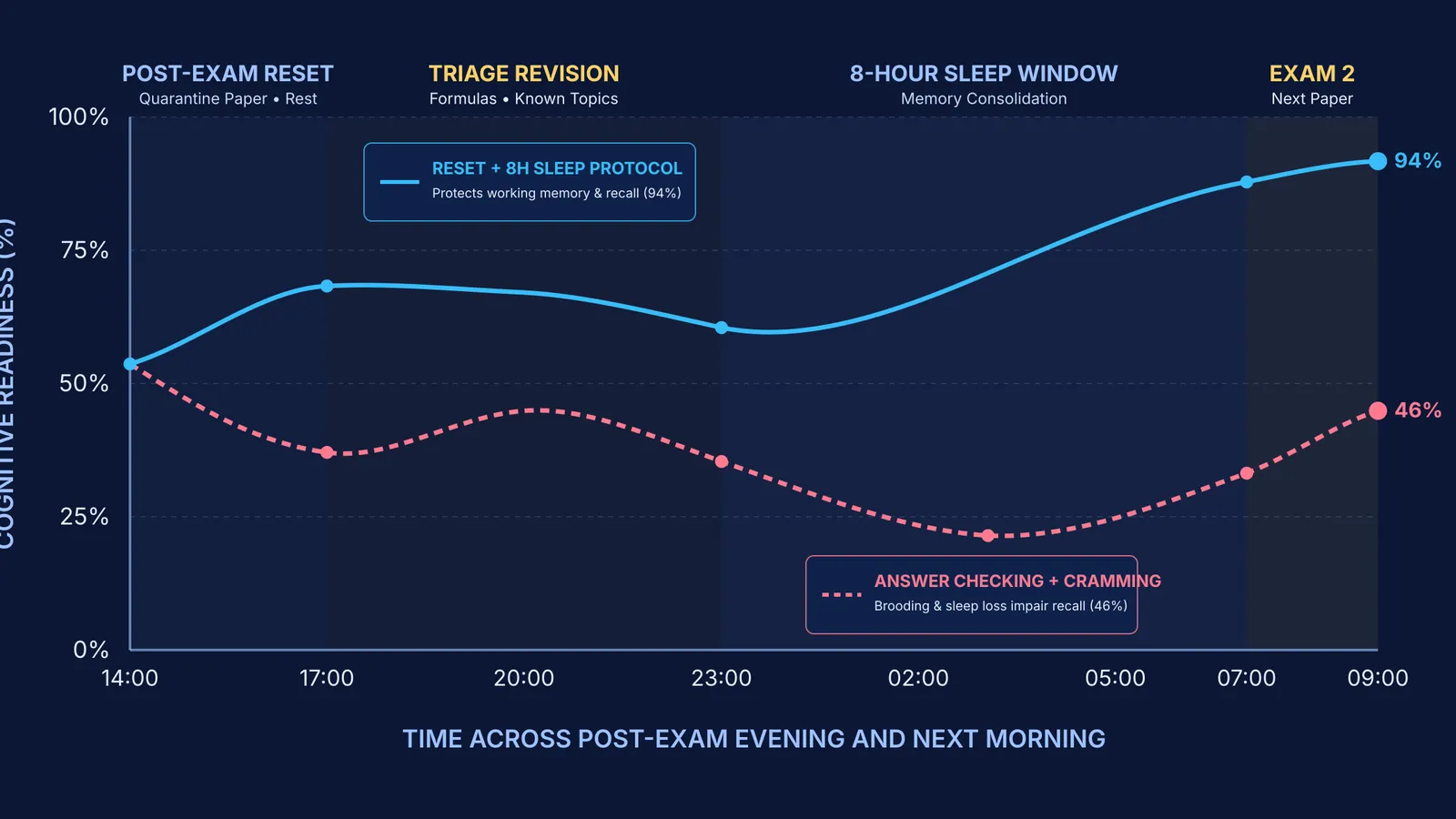
The primary goal of your evening is not to fix what already happened, but to defend tomorrow's cognitive performance.
Why is checking today's answers dangerous?
The moment you hand in your answer sheet, today's marks are locked. Checking answer keys cannot recover a single point, but it carries a severe cognitive cost.
In cognitive psychology, replaying an evaluation is termed post-event processing. In a 2024 study published in the *International Journal of Educational Research Open*, Sarah Möcklinghoff and colleagues found across three student cohorts that post-event processing maintains state and trait test anxiety. When you discover a calculation error or a missed question, your mind enters a cycle of counterfactual thinking, endlessly generating alternative scenarios that cannot change the outcome.
A 2021 study in *Frontiers in Psychology* by Bita Zareian and colleagues tracked students nine times across the 48 hours following a stressful exam. Post-exam brooding directly predicted increased negative affect at subsequent intervals, because struggling to inhibit emotional memories impairs cognitive shifting. Replaying today's errors clogs your working memory, leaving fewer executive resources to encode and retrieve tomorrow's formulas. If you want to evaluate your mistakes constructively, save your analysis for how to bounce back after a bad test after all papers finish.
How should you reset in the first hour after the paper?
Enforce a strict 60-minute buffer before touching tomorrow's syllabus. Attempting to revise while adrenaline and cortisol are elevated produces shallow, agitated learning.
Physical transition: Change out of exam clothes, wash your face or take a warm shower, and drink water.
Nutritional reset: Eat a balanced meal with complex carbohydrates and protein to restore depleted cerebral glucose.
Complete mental rest: Spend 30 minutes away from all screens by sitting outside, resting your eyes, or listening to quiet music.
Treat any lingering physical tension as preparatory energy rather than a forecast of failure, using test anxiety reappraisal. If distress feels unmanageable, the Ministry of Health and Family Welfare provides free, 24/7 tele-counselling support through Tele MANAS on 14416 (or 1800-891-4416).
How to triage revision for tomorrow's exam?
With only four to five usable evening hours, attempting to cover an entire syllabus causes panic. Apply a strict three-tier triage:
Consolidate known material: Review core definitions, standard formula sheets, and graphs you understand but might misremember under time pressure.
Practise high-yield question formats: Work through two or three standard derivations or numerical patterns that appear regularly in past papers.
Drop unfamiliar backlogs: Do not attempt to learn unstudied chapters from scratch tonight. Trying to grasp brand-new topics late in the evening triggers confusion and damages confidence.
To check key formulas quickly without flipping through hundreds of textbook pages, the Fermi Concept Library covers every concept in physics, chemistry, biology and mathematics, each with its own lesson and its place in the map. For numerical practice where you need to check method steps, the Fermi Problem Library provides worked problems with a step-by-step solver that explains the reasoning rather than printing an answer. If you get stuck on a derivation, Fermi's AI tutor can work out what you already know and build a plan for the session.
Why does sleep matter more than an all-nighter?
Staying awake past 2:00 AM does not save lost marks; it impairs tomorrow's problem solving.
In a meta-analysis in *Sleep*, June J. Pilcher and Allen I. Huffcutt analysed 19 studies across 1,932 participants and found that partial sleep deprivation severely damages cognitive functioning and mood, with executive tasks showing steep declines. Sacrificing sleep directly undermines the working memory required to interpret exam questions and avoid careless arithmetic slips.
Adequate sleep directly boosts exam performance. In a 2019 study in *Teaching of Psychology*, Michael K. Scullin evaluated university students during final exam week and found that students who maintained at least 8.0 hours of sleep per night scored significantly higher on their final exams than peers who slept 7.9 hours or fewer, even after adjusting for pre-final baseline grades. As research on sleep before an exam demonstrates, slow-wave sleep solidifies memory traces. Set a firm bedtime between 10:30 PM and 11:00 PM.
What should parents say when a paper goes wrong?
Parents shape the home environment after an exam. Critical interrogations about missed questions trigger acute rumination and panic.
A supportive script replaces post-mortems with practical care:
Avoid: "How could you make those silly mistakes after studying so hard?"
Say instead: "Today's paper is finished and put away. We will evaluate everything once all your exams conclude. Eat dinner, rest, and focus only on what is in front of you tonight."
Protecting an evening routine of calm transition, selective revision, and full sleep ensures today's setback stays isolated.


