

On this page
It is the most common shock of Class 12: opening your half-yearly report card and seeing a score that looks nothing like what you need for your board exams.
Half-yearly exams hit just as the syllabus gets heavy. But these strict, often poorly scored papers are the most useful tool you have for the coming months. Instead of ignoring a bad result, you can use it to find out exactly where your marks are leaking and change how you prepare.
Why do students get bad half-yearly marks in Class 12?
A sudden drop in marks midway through Class 12 is so common it is practically scheduled. The reasons usually fall into three buckets:
Strict marking: Schools often set harder papers and mark conservatively in September to jolt students into studying for the pre-boards.
Syllabus volume: The jump in complexity from the first few chapters to the middle of the textbook—like reaching integration in maths or optics in physics—exposes weak foundations.
Passive studying: Reading notes feels like learning, but it does not train you to retrieve facts under pressure.
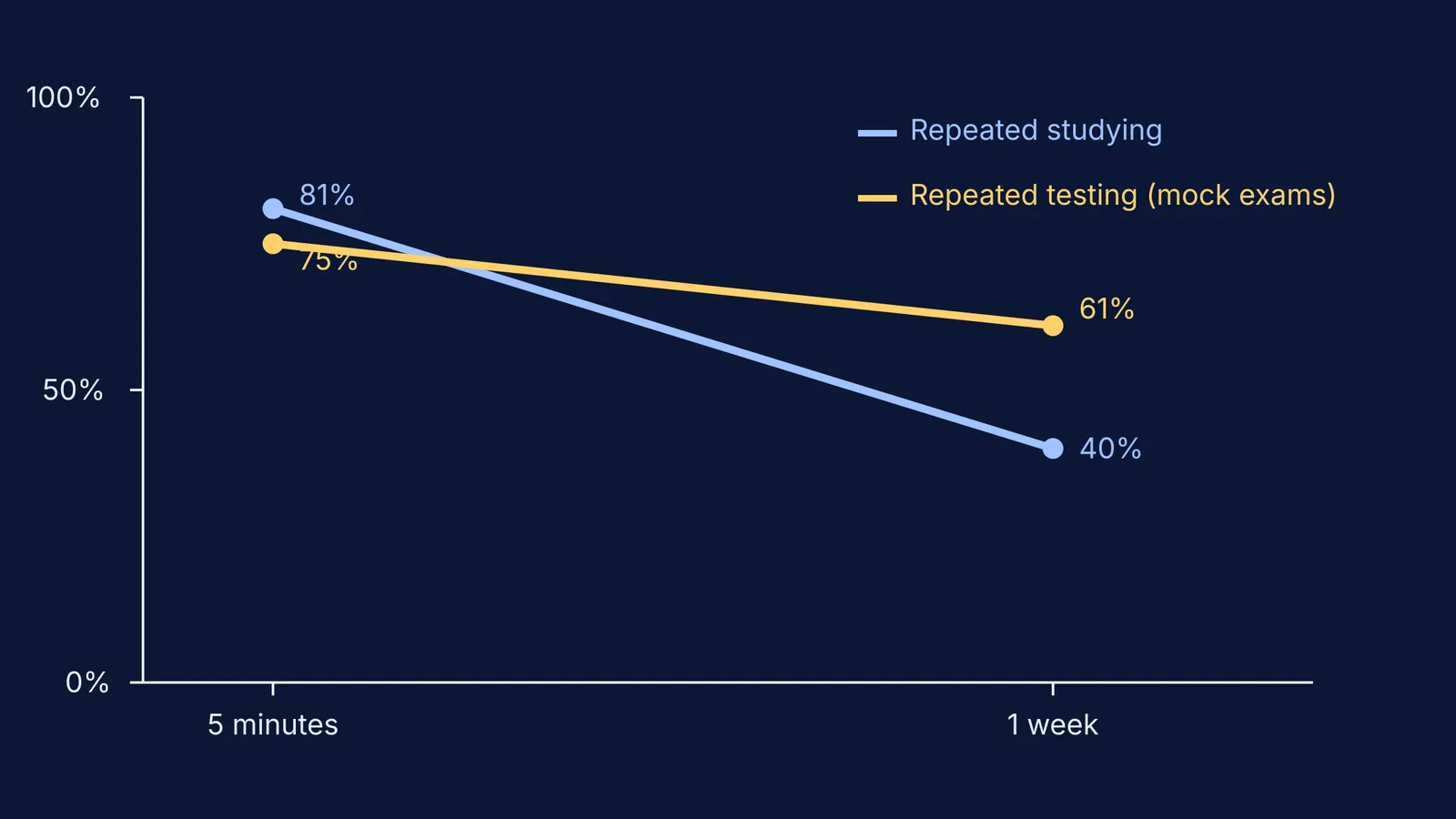
Testing yourself is far more effective than just rereading notes. Taking a practice test results in 61% retention after one week, compared to just 40% for students who only restudy the material.
Taking the half-yearly test, even if you did poorly, has already helped you remember the material better. Now you need to analyse the paper.
How to find your mark leaks?
Your half-yearly answer script is a diagnostic report. Do not just look at the total score; look at every crossed-out answer.
Categorise every mark you lost into one of these four leaks:
Concept leak: You did not understand the topic (e.g., you applied the wrong formula entirely).
Memory leak: You understood it in class but forgot a key step, definition or derivation during the exam.
Careless leak: A calculation error, misreading the question, or dropping a negative sign. This often requires you to rethink how you check your work to avoid careless exam errors.
Presentation leak: You knew the answer but the examiner did not give you the marks because you missed keywords, skipped steps, or wrote a messy paragraph.
If you have concept leaks in physics or maths, you need to go back to first principles. The Fermi Problem Library does not just give you the final answer; it has a step-by-step solver that explains the reasoning rather than printing an answer. This helps you see exactly where your method broke down.
How to fix your answer writing?
Knowing the physics or chemistry is only half the job; the other half is proving it to the examiner during the exam. If you lost marks to presentation leaks, change how you write:
Bullet points, not essays: Break long answers into distinct points.
Underline keywords: Examiners look for specific terms (like "equipotential surface" or "electrophilic substitution"). Make them easy to find.
Show the steps: In numericals, write the given values, the formula, the substitution, and the final answer with units.
Draw the diagram: Even if not explicitly asked, a neat, labelled diagram saves time and secures marks.
If you struggle to picture complex ideas to draw them, the Fermi Simulation Lab has interactive simulations for the ideas that are easier to see than to read, helping you build mental models you can easily sketch in an exam.
How to plan for pre-boards and boards?
The gap between half-yearlies and pre-boards is your recovery window. If you are also balancing Class 12 board exams with JEE preparation, here is a practical plan to bridge it:
Clear the backlog first: Spend October fixing the specific chapters where you had concept leaks in the half-yearlies. Do not just reread the textbook; solve the back exercises.
Spaced repetition: To fix memory leaks, do not cram a chapter in one sitting and ignore it for months. Review your weak topics every few days, then every few weeks.
Take more tests: Since testing improves long-term memory far better than reading, you must simulate exam conditions. If you do not know where to start, Fermi's AI tutor works out what you already know, builds a plan for the session, and teaches through it.
A bad half-yearly result is not a prediction of your board exam score. It is a map showing you exactly what to fix. Start with your hardest paper, find the leaks, and get to work.


