

On this page
It is 10 PM, your mock test is tomorrow, and you decide to watch a two-hour "one-shot" revision video on rotational motion. The teacher is engaging, the animations are clear, and you nod along, feeling that everything makes perfect sense. But when you sit in the exam hall the next day, the blank page stares back at you.
If this sounds familiar, you are not alone. This is a common reason Why some JEE aspirants plateau despite studying every day. The shift to digital learning has made high-quality explanations accessible to everyone, but it has also popularised a passive approach to studying. While educational videos are excellent for first-time comprehension, relying on them as your primary revision strategy can backfire.
Here is why watching a video feels so productive, and what you can do to turn that passive screen time into active, exam-ready knowledge.
Why do videos create an illusion of competence?
When you watch a well-produced video, your brain processes the information easily. Psychologists call this "processing fluency." Because the explanation is clear and easy to follow, you mistake the ease of watching for the ease of remembering—a trap similar to Why rereading feels like learning, and what to do instead.
A 2018 study on skill acquisition demonstrated this "illusion of competence" perfectly. Researchers found that people who watched a video of a task multiple times felt increasingly confident in their ability to perform it, but their actual performance did not improve at all. Watching someone else solve a complex physics numerical gives you the feeling of mastery, but it engages your brain's recognition pathways, not the recall pathways you need during a test.
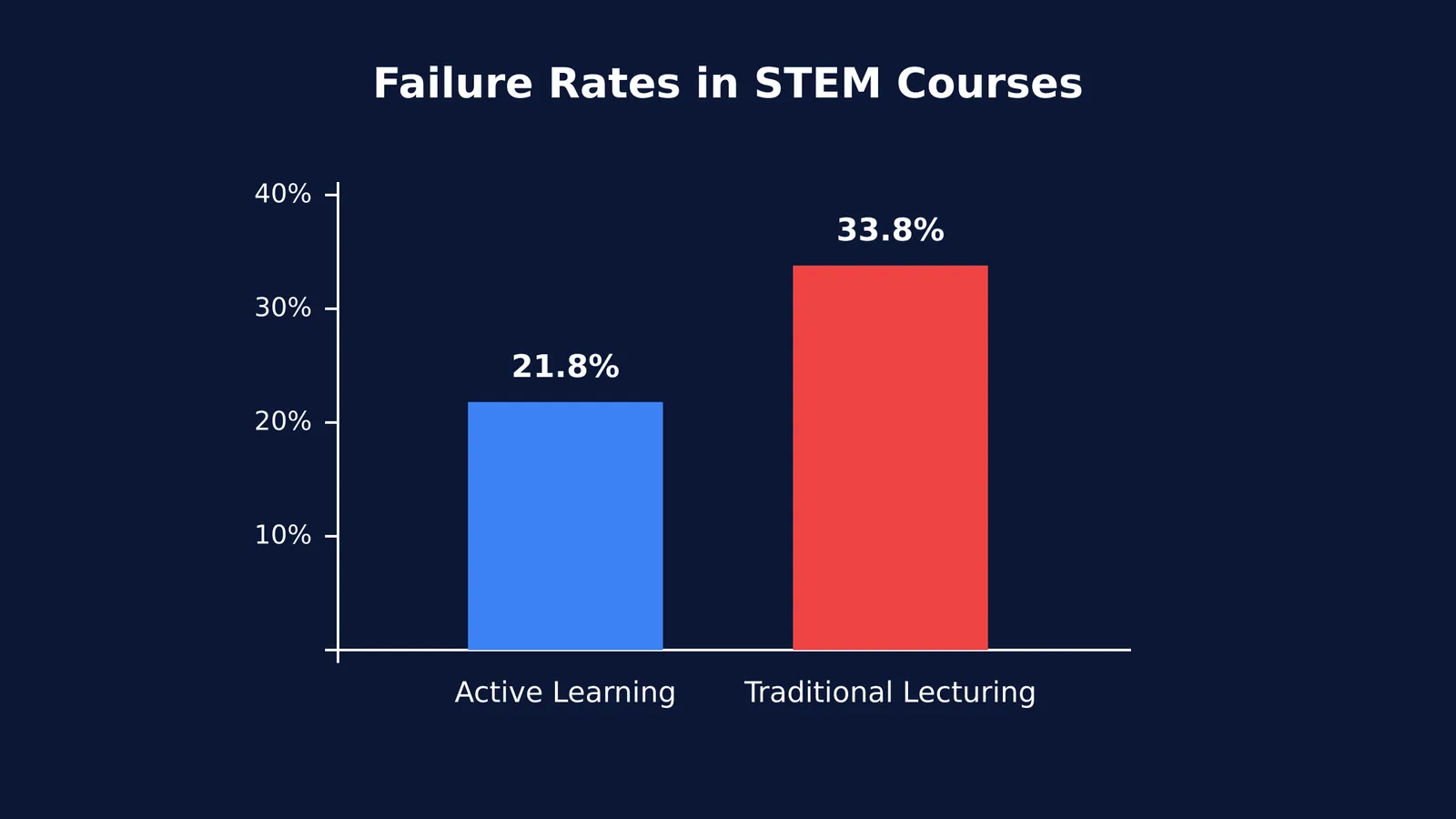
This is where the passive learning trap begins. A landmark meta-analysis of 225 studies published in the Proceedings of the National Academy of Sciences (PNAS) compared traditional passive lecturing with active learning in STEM courses. The results were stark: failure rates under traditional lecturing increased by 55% over the rates observed under active learning, while active learning also increased average exam scores by about half a letter grade.
Is watching revision videos enough to revise?
The short answer is no. If you only watch videos, you are doing the equivalent of watching a gym workout and expecting your own muscles to grow.
Videos are incredibly useful when you are stuck on a specific concept. If you cannot visualise how electric fields interact, or you are struggling with a tricky mechanism in organic chemistry, a good visual explanation can clear the roadblock. The problem arises when video consumption replaces solving problems.
When you use the Fermi Problem Library, the focus shifts from watching to doing. Instead of passively following a video, you actively work through numericals step-by-step, with an AI tutor that explains the reasoning when you get stuck, rather than just printing the final answer.
How can you use videos effectively for exam prep?
You do not need to abandon revision videos, but you do need to change how you interact with them. Try this three-step framework to make your video sessions active, and read How to learn from video lectures: pause, predict and test yourself for more detail:
The pre-test: Before you hit play on a revision video, take a moment to write down everything you already know about the topic. Try to solve one related numerical. This primes your brain to look for specific answers and highlights your actual knowledge gaps.
Active pauses: Do not treat a revision video like a movie. Pause frequently and summarise what you just learned without looking at the screen. If the teacher in the video introduces a problem, pause and try to solve it yourself before watching their method.
Immediate application: As soon as the video ends, close the laptop. Do not move on to the next video. Immediately tackle a set of problems on that exact topic. If you find that you still cannot solve them, you have identified a gap that passive watching could not fill.
For topics that are genuinely difficult to picture in your head—like orbits or wave optics—interactive tools often work better than static videos. The Fermi Simulation Lab provides interactive simulations for the ideas that are easier to see than to read, forcing you to engage with the mechanics rather than just watching them.
How do you build a better study routine?
The core of effective revision is testing yourself before the exam does. If your current study routine consists mostly of re-reading notes and watching long lectures on double speed, try swapping a short video session for active problem-solving.
When you sit down to study, the goal should be a clear next step instead of a blank page. Fermi's AI tutor can work out what you already know and build a plan for the session, holding a line of reasoning with you so that you learn how to think through the problem yourself.


