

On this page
If you are in Class 11 or 12 at an Indian school and thinking about university abroad, someone has probably told you to “do some APs”. Whether that is worth it depends on where you apply and whether the extra work will dent your boards.
What are AP exams?
Advanced Placement (AP) is the College Board's programme of “college-level courses and exams” that you can take while still at school, according to its What Is AP? page. Each AP exam is scored from 1 to 5, where 5 means “extremely well qualified” and 3 means “qualified” (AP score scale). Many US colleges give credit and/or advanced placement for scores of 3 and above, says the College Board's AP scores page.
AP exams are subject tests, not entrance exams. AP Physics C: Mechanics matches “a semester-long, introductory calculus-based college course in physics”, says the College Board course page. The AP Calculus AB exam lasts 3 hours 10 minutes (exam details).
Do AP exams help an application from an Indian school?
Sometimes a lot, sometimes barely. Sort the universities on your list into three groups.
Universities that ask for them. Cambridge is the clearest case. Its international entry requirements list “5 or more Advanced Placement (AP) Tests at Score 5, plus Grades A1 A1 A1 A1 A1 in relevant Class XII subjects” as an accepted combination for Indian applicants. Christ's College, Cambridge says Class XII on its own “is not considered to be suitable preparation for a competitive application”. Here the bar is five 5s.
Universities that welcome them. MIT asks applicants to self-report exams “such as Advanced Placement, International Baccalaureate, A-level” and does not require official score reports with the application (MIT Admissions). A strong score shows you can handle a subject at university level, but it is one line among many.
Universities that don't mention them. Check whether they use AP scores at all before you pay.
How do you register for AP exams in India?
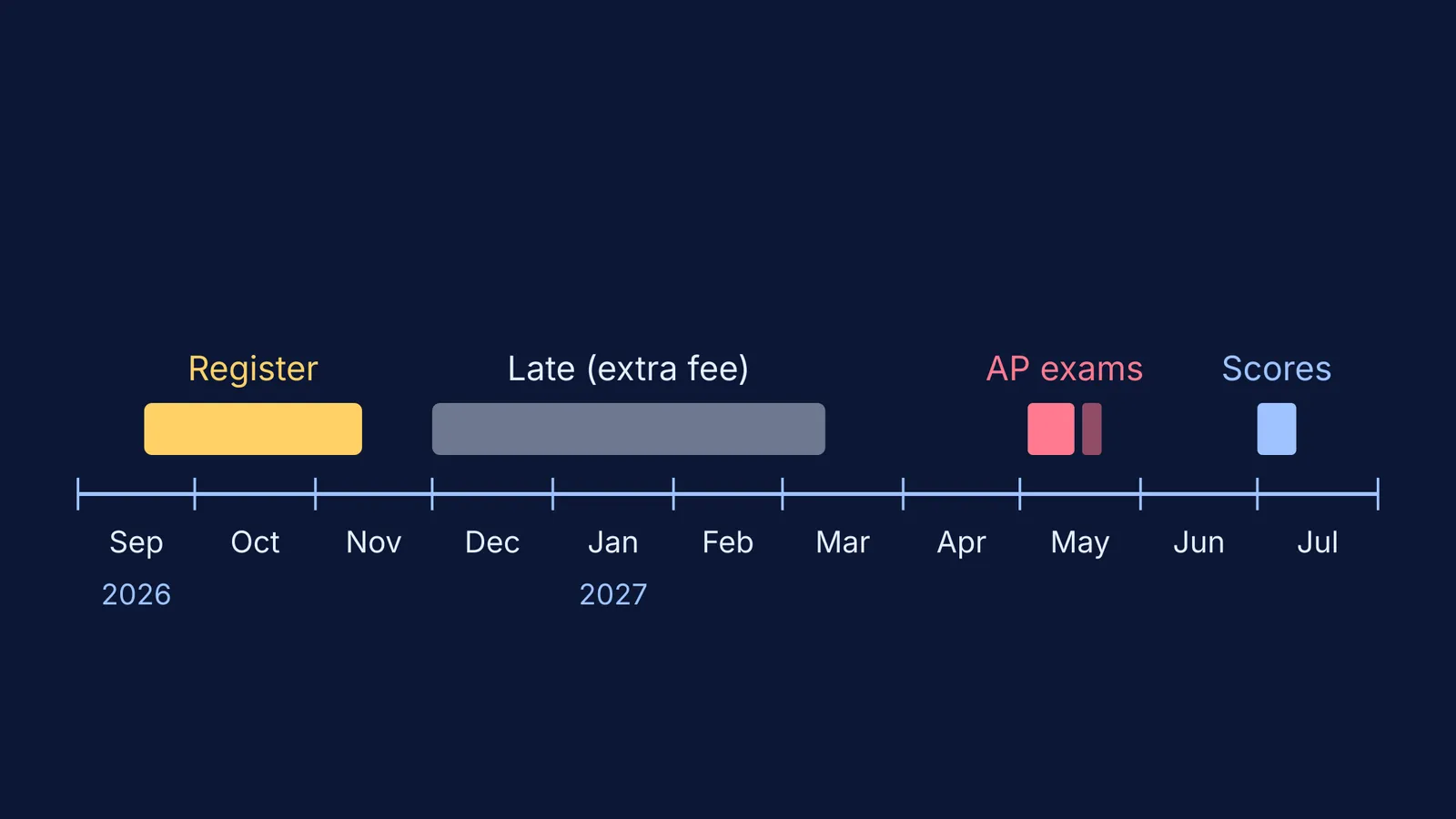
If your school does not offer the exam you want, you can register at an authorised AP test centre in India, which is open to all eligible students, according to the College Board's Taking AP in India page, which lists the centres. For the May 2027 exams, the official timeline there is:
18 September 2026: registration opens at most authorised test centres.
Mid-November 2026: standard registration and payment close.
December 2026 to mid-March 2027: some centres may offer a second window, with extra fees.
3–7 and 10–14 May 2027: regular testing, with late testing on 17–21 May where a centre offers it.
Early July 2027: scores are released.
From 2027 all AP exams are digital, taken in the College Board's Bluebook app, and most centres expect you to bring your own approved device. Sessions in India start at 6:30 am and 10:30 am IST, though a centre can begin up to an hour later (same page).
The College Board's fee for an exam taken outside the US is $129 for 2026-27, but fees at authorised test centres outside the US vary, and the College Board adds a $40 late fee per exam ordered between 14 November and 12 March (AP exam fees). Each centre sets its own fees, deadlines and refund rules, so email first:
“Hello, I am a Class 12 CBSE student hoping to take AP Calculus AB and AP Physics C: Mechanics in May 2027. Could you confirm the total fee per exam in rupees, your deadline, whether I bring my own device for Bluebook, and your refund policy?”
How much prep do AP exams need alongside boards?
It depends on how much each AP course overlaps with what you already study. Open each course description and mark every unit “done for boards”, “partly done” or “new”. Done units need format practice; new units need real learning time. Then set the AP weeks beside your board date sheet.
A worked plan for a Class 12 student taking two APs:
October to mid-November: register, sort the units, and pick the two exams closest to your intended degree.
November to January: two fixed weekly blocks for “new” units only; boards come first. Our guide to planning your week in time blocks shows how to protect them.
Pre-boards and boards: pause AP work apart from a short weekly review. The same trade-offs apply as in preparing for boards and JEE together.
After your last board paper: AP becomes the main job. Do timed past free-response questions and revisit weak units on a spaced revision schedule.
If a unit is new to you, such as rotation worked with calculus, the Fermi Concept Library has a lesson for every concept in physics, chemistry, biology, mathematics and computing, so you can fill the gap before you practise. For free-response practice, the Fermi Problem Library has worked problems with a step-by-step solver that explains the reasoning rather than printing an answer.
Start with your university list this week: it decides whether you need any APs at all.


