

On this page
The AP EAPCET (Engineering, Agriculture, and Pharmacy Common Entrance Test) opens the door to professional degrees in Andhra Pradesh. While the exam tests your knowledge, the web options process decides where you will spend the next four years. A single mistake in your preference order can result in missing out on a preferred college.
Here is the exact procedure to follow.
What are the prerequisites before web options?
You cannot simply log in and start picking colleges. The Andhra Pradesh State Council of Higher Education (APSCHE) requires candidates to complete several steps first (APSCHE).
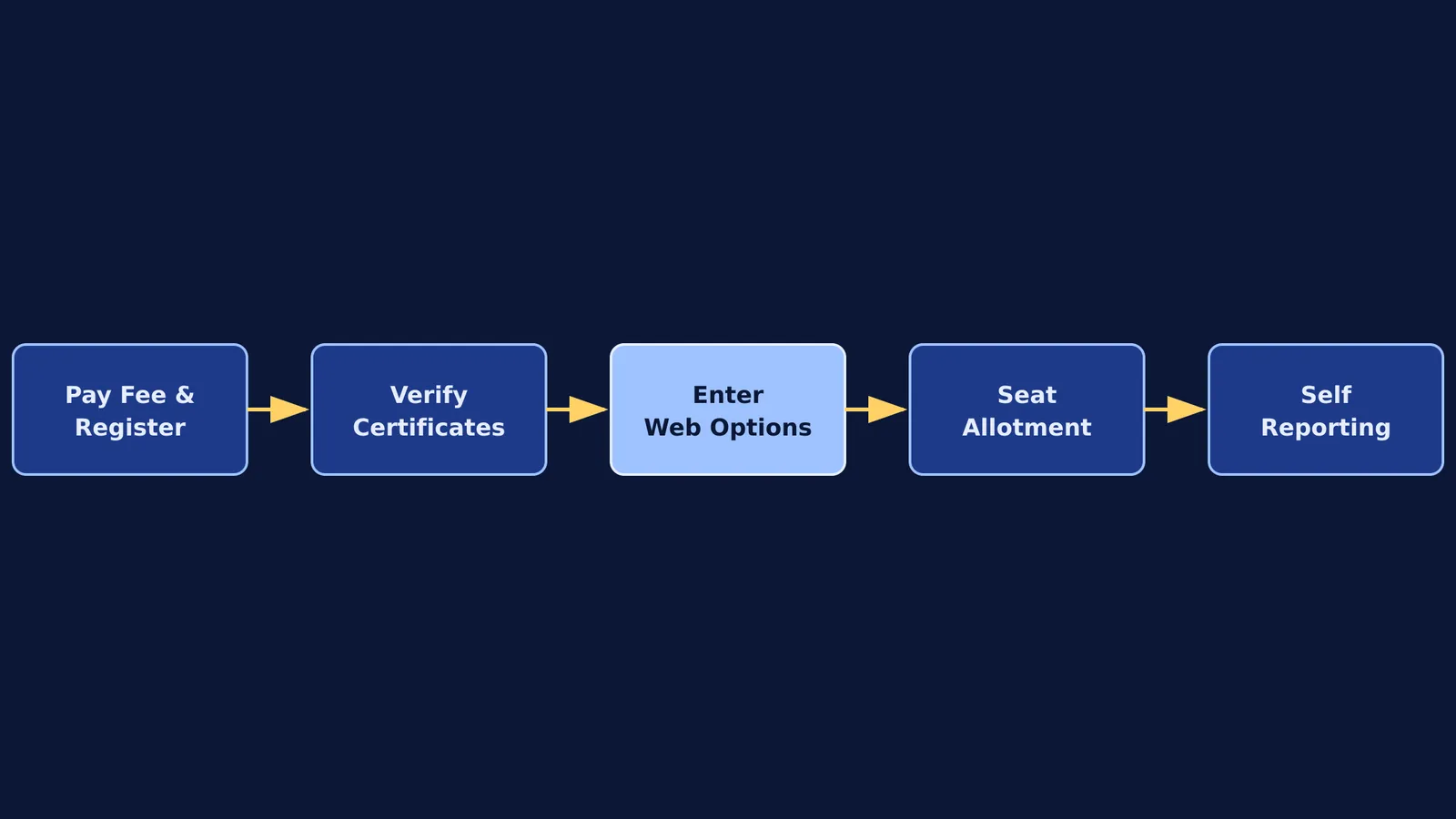
Registration and fee payment: You must first register on the official portal and pay the processing fee. The fee is ₹1,200 for OC/BC candidates and ₹600 for SC/ST candidates. You will need your AP EAPCET Hall Ticket Number and Date of Birth to log in.
Certificate verification: Your academic and category documents must be verified. For most students, this happens automatically online using the data provided during the exam registration. You will receive an SMS confirming this. However, students claiming special categories (like NCC, Sports, CAP, or PH) or those with incomplete data must visit a designated Help Line Centre (HLC) for physical verification.
Status check: You must verify your eligibility status online through the "Know Your Registration" link. Only when your status reads "Candidate is eligible for exercising options" can you proceed to the next stage.
Entering options for state colleges works differently from national platforms, but understanding JoSAA counselling for parents can provide helpful context on how seat allocation algorithms function.
How to give web options in AP EAPCET counselling?
Once eligible, you can enter your web options. This is where you tell the system which colleges and branches you want to attend.
Follow these exact steps to enter your options:
Log in: Visit the official portal and click the link for Web Options. Enter your AP EAPCET Hall Ticket Number and Date of Birth.
Authenticate with OTP: The system will send a One-Time Password (OTP) to your registered mobile number. Enter it to access the entry form.
Filter colleges: You will see a list of available institutions. You can filter them by district, institution type (government or private), and branch (such as Computer Science or Mechanical Engineering).
Select and prioritize: Add your preferred college and branch combinations to your list. The order matters immensely. The system will look at your rank and attempt to give you your first choice. If that is unavailable, it moves to your second choice, and so on. Always place your dream college at the very top. There is no limit to the number of options you can enter, so exercise maximum options to increase your chances.
Save your work: Click "Save" frequently. If your session times out, you will lose unsaved preferences.
Freeze your options: Once you are completely satisfied with your list, you can "Freeze" your options. After freezing, you cannot change the order unless you wait for the specific "Change of Options" window, which APSCHE typically opens for just one day.
What happens after you freeze your options?
When the web options phase closes, the algorithm allocates seats based on merit (your rank), category, gender, local area status, and the priority order you entered.
You will log back into the portal on the scheduled allotment date to download your allotment order. If you receive a seat, you must complete "Online Self-Reporting" to accept it. This involves confirming your seat and, in some cases, paying the tuition fee online. Finally, you will report to the allotted college in person with your original certificates to confirm your admission.
While you prepare for your first semester at science or engineering college, it is a great time to ensure your foundational science is strong. University professors will expect you to already know the basics of calculus, mechanics, and atomic structure. If you want to review core principles, the Fermi Concept Library contains every concept in physics, chemistry, biology, mathematics and computing, each with its own lesson and its place in the map. Taking the time to understand the fundamentals now makes university coursework significantly easier.


