

On this page
The academic calendar a college chooses shapes everything from how many exams you write to the depth of your research projects. The traditional semester gives you time to breathe, while trimesters demand a faster pace. Understanding the differences helps you adapt your study habits and manage your coursework effectively.
How long is a semester vs a trimester?
In higher education, the calendar dictates the pacing of the academic year.
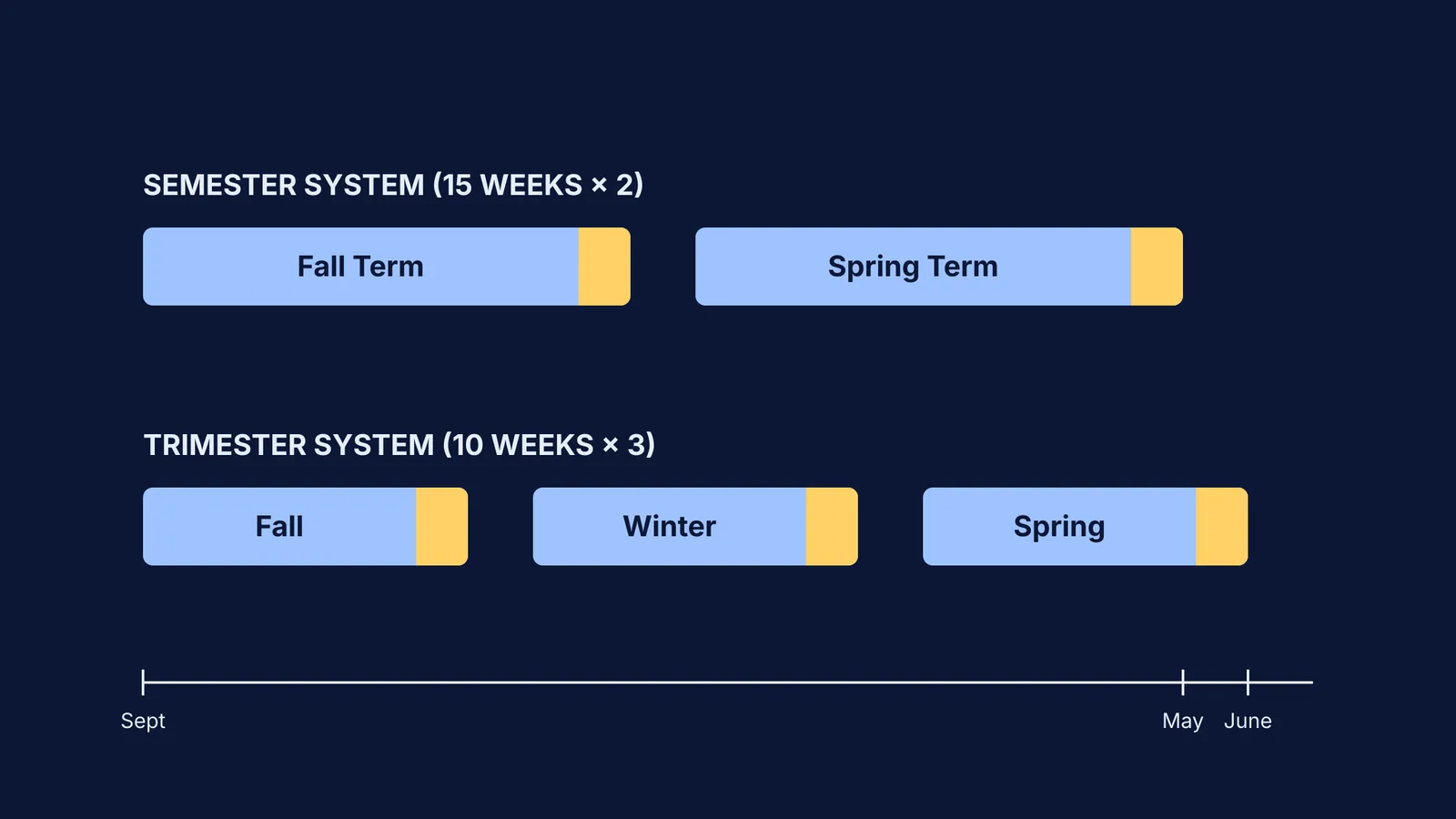
A semester system splits the year into two main terms (Fall and Spring), each lasting between 14 and 20 weeks, with an average of 15 weeks [[1]](https://www.niche.com/blog/quarter-vs-semester-which-is-right-for-you/). Students typically juggle 4 to 6 classes simultaneously, earning around 15 credits per term.
A trimester system divides the year into three equal terms (often Fall, Winter, and Spring), each lasting 10 to 12 weeks [[1]](https://www.niche.com/blog/quarter-vs-semester-which-is-right-for-you/). Students usually take 3 to 4 classes per term, earning 9 to 12 credits.
A quarter system includes four 10-week terms (often including a mandatory summer term), functioning similarly to trimesters in pace and intensity.
Because the trimester term is significantly shorter, college mid-semester exams arrive in the fourth or fifth week, leaving almost no ramp-up time at the start of the year.
Does calendar length impact student performance?
It is natural to assume that the longer you have to study a subject, the better you will perform. However, recent data suggests the opposite. A 2022 study published in the *American Economic Journal: Economic Policy* by Bostwick, Fischer, and Lang found that when universities switched from a quarter system to a semester system, on-time graduation rates dropped by 3.7 percentage points [[2]](https://www.aeaweb.org/articles?id=10.1257/pol.20190589). The transition also led to lower first-year grades.
The researchers found that shifting to a semester system decreases the likelihood of a student taking a full course load. In a semester system, students must divide their attention across five or more subjects for 15 weeks. In a trimester or quarter system, they focus intensely on just three or four. Juggling fewer subjects simultaneously reduces the risk of falling behind in one.
How do calendars affect internships and summer breaks?
Beyond the classroom, the academic calendar dictates your summer schedule and internship opportunities. The standard semester system ends in early May, aligning perfectly with the summer internship cycles of most major companies. Because approximately 90% of US colleges use semesters [[1]](https://www.niche.com/blog/quarter-vs-semester-which-is-right-for-you/), corporate recruitment is heavily built around this 15-week rhythm.
Trimester and quarter systems often push the end of the academic year into mid-June. This late finish can cause scheduling conflicts for students pursuing competitive summer internships that begin in May. However, the trimester system offers a unique advantage for students who want to graduate early. By treating the summer as an optional fourth term, highly motivated students can take a full load of classes year-round, potentially completing a four-year degree in just three years.
Does a faster pace mean more exam stress?
While taking fewer classes improves graduation odds, the 10-week trimester comes with its own challenge: frequent finals. When exams happen three times a year, the academic pressure feels acute rather than sustained.
This intense pace leaves no room for the mid-term slump. If you are struggling with a concept in week two, you cannot wait until week six to figure it out. Fermi's AI tutor can work out what you already know and build a plan for the session, so you sit down to a clear next step instead of a blank page. Instead of flipping through textbook pages, the tutor teaches rather than answers, holding a line of reasoning to help you understand where you went wrong.
For students in a 15-week semester, the stress profile is different. The pacing is slower, allowing for deeper research and longer papers, but the pressure is sustained over four months. Falling behind late in a semester can create a hole that is mathematically difficult to climb out of before finals.
How can you adjust to your college calendar?
Whether your college uses semesters or trimesters, you must align your study habits with the calendar's rhythm. Use this simple planning framework to stay on track:
Map the timeline early: In a trimester, you have one-third less time per course. Plot your syllabus on a calendar in week one and mark the point of no return for dropping a class or asking for an extension.
Shift to weekly milestones: Do not study for the mid-term; study for the Friday milestone. Break 10- or 15-week syllabuses into single-week concepts. If you miss a week, fix it that weekend.
Run a readiness check: Before an exam window opens, run a readiness checklist to test your recall without notes.
Use step-by-step solvers for blocks: When a specific problem type halts your progress, do not waste days on it. The Fermi Problem Library offers a step-by-step solver that explains the reasoning behind each step, letting you clear the hurdle and stay on pace.
Choosing how to study is just as important as what you study. By respecting the tempo of your college calendar, you can manage your coursework load and approach finals with confidence.


