

On this page
A zoo is an overwhelming sensory environment for a child. With dozens of exhibits competing for attention, most families move from enclosure to enclosure at a brisk pace, glancing at an animal for a few seconds before rushing to the next.
But with a few structural changes, a zoo can be one of the most effective outdoor classrooms available. A 2019 study published in the *Journal of Experimental Child Psychology* by Layla Unger and Anna V. Fisher investigated how a short, real-world learning experience affected the way children understand biology. They found that children aged 4 to 9 who attended a four-day zoo program showed a 64% increase in tests measuring how they organise their knowledge of animals (https://doi.org/10.1016/j.jecp.2018.10.007). The children did not just memorise isolated facts; they learned how different species relate to one another. This advanced cognitive skill, known as semantic organisation, was previously thought to take months or years of formal schooling to develop.
The difference between a frantic day out and a day of deep biological learning is active observation. You do not need to be a wildlife expert to provide this structure for your family.
How can you make a zoo visit educational for kids?
The first step is slowing down. You will learn more by spending more time at fewer enclosures than by rushing from one to the next. If you try to see everything, your child is likely to become exhausted and stop absorbing information, a common problem families also face during science museum visits.
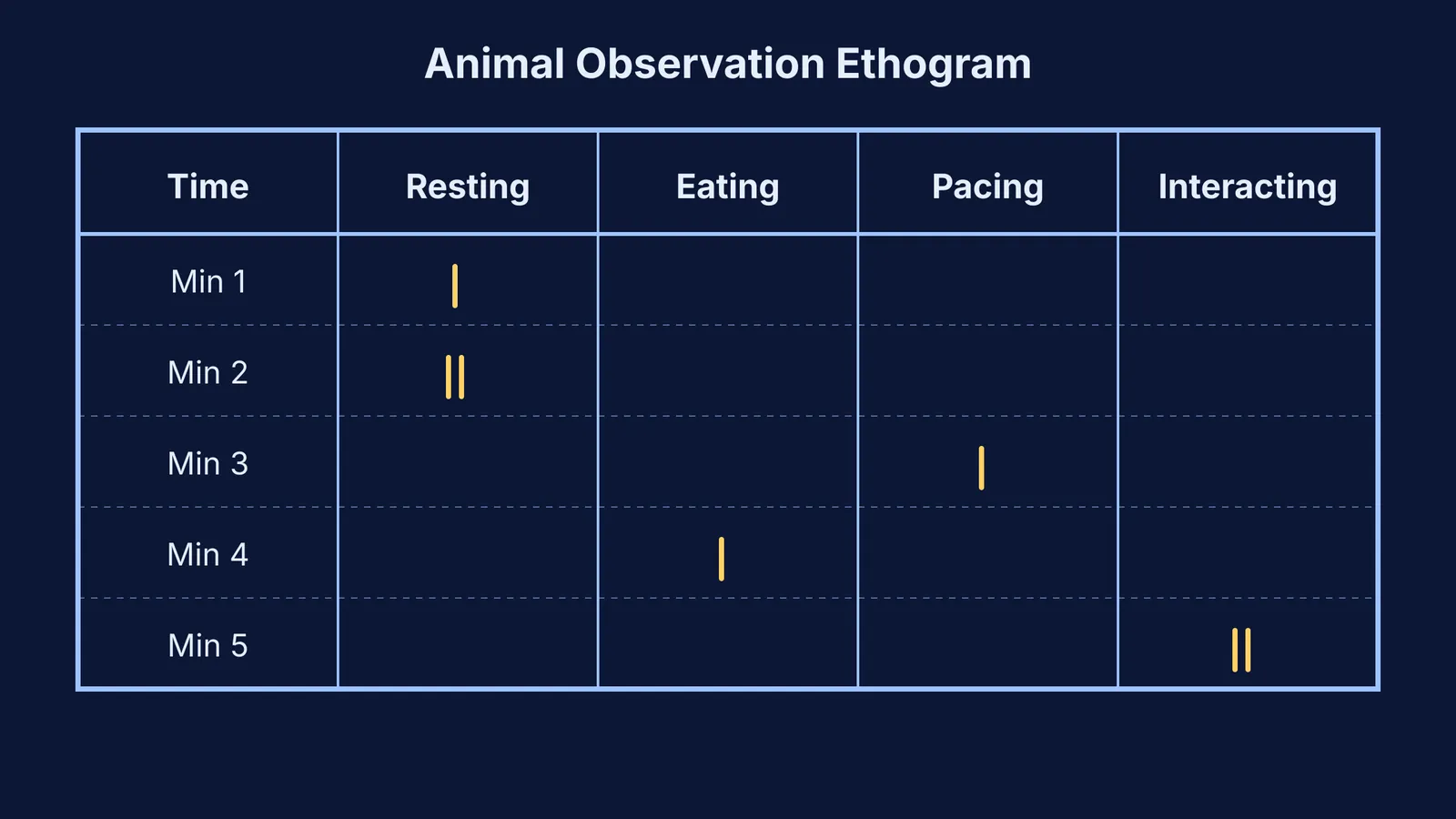
Before you arrive, pick a handful of animals to focus on. When you reach the enclosure, introduce an 'ethogram'—a tool that real biologists use to record animal behaviour in the field.
Give your child a clipboard with a simple table. Ask them to make a tally mark at regular intervals for what the animal is doing: resting, eating, pacing, or interacting with others. This simple task forces them to stand still and observe carefully. It moves them from merely identifying an animal to studying its daily life and noticing patterns that they would have missed in a quick glance.
What should children observe at the zoo?
An unguided zoo visit often consists of a parent reading the name on a plaque and the child looking for the animal. While fun, this does not always lead to learning. A 2014 study in *Conservation Biology* by Eric Jensen evaluated children aged 7 to 15 at the London Zoo. It found that 41% of educator-guided visits resulted in measurable conservation biology learning, compared to just 34% of unguided visits (https://doi.org/10.1111/cobi.12263).
You can act as that guide by shifting the focus from names to 'how' and 'why' questions. When your child spots an animal, prompt them with inquiry-based questions:
"How does its body help it survive in this environment?"
"Why do you think it spends so much time in the shade instead of the sun?"
"If you were designing a home for this animal, what would you need to include?"
If a complex question comes up during these discussions—like how a heavy bird manages to fly, or how an elephant's trunk works as a lever—you can bring it to Fermi's AI tutor at home. The tutor works out what the student knows and builds a plan for the session, holding a line of reasoning to explain the underlying biology or physics rather than just printing an answer.
Why does drawing help children learn?
Smartphones have made it easy to snap a picture of an animal and walk away. But taking a photo outsources the observation to the camera, allowing the child to disengage almost immediately. Drawing, on the other hand, requires the child to do the cognitive work.
In Jensen's 2014 study, researchers used annotated drawings before and after the visit to measure what the children had learned. The post-visit drawings often showed a dramatic improvement in accuracy—shifting from cartoonish depictions to realistic representations with correct habitats. Drawing forces a child to look at the specific details they usually ignore: the curve of a beak, the texture of a shell, or the exact layout of a habitat.
Instead of a camera, hand your child a sketchbook. You do not need to judge the artistic quality of the result; the goal is the process of looking. Ask them to sketch the animal's enclosure rather than just the animal itself. Prompt them to label where the animal hides, where it finds water, and what kind of terrain it navigates. This exercise builds a stronger mental model of ecosystems and biological adaptations. Much like doing hands-on kitchen science experiments, sketching turns a passive viewer into an active participant, making the scientific principles stick long after the trip is over.


