

On this page
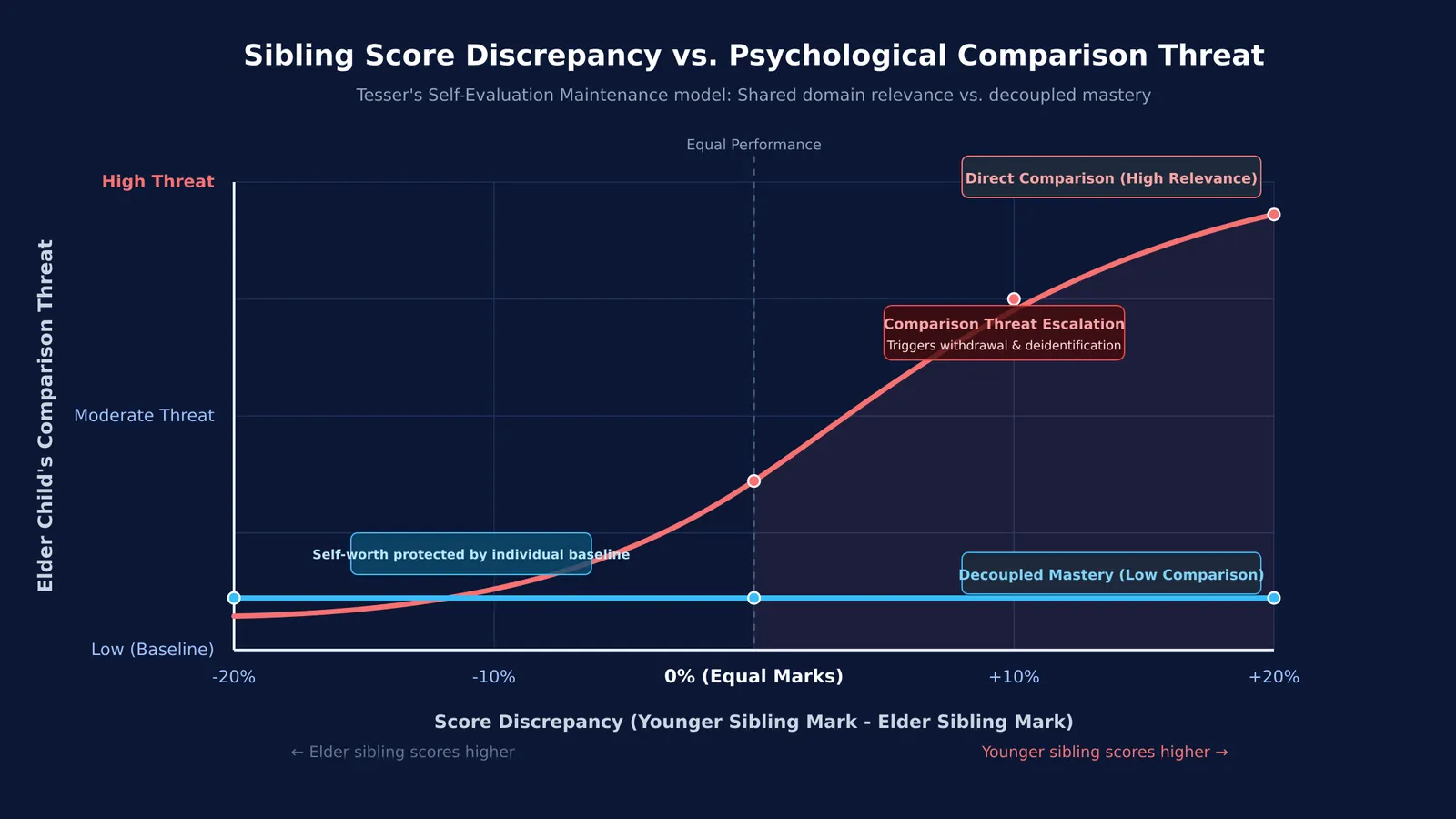
When report cards or test results arrive, a younger child outscoring an older sibling disrupts the unwritten household hierarchy. For years, the elder child occupied the role of the academic pioneer—reading first, tackling board exam syllabi first, and carrying parental expectations. When a younger sibling achieves higher marks or percentiles in similar subjects, it creates what psychologist Abraham Tesser identified as a comparison threat in his Self-Evaluation Maintenance model. Under this framework, when someone close to you outperforms you in a domain central to your self-worth, your self-esteem drops, leading to increased friction or defensive withdrawal.
In families, this dynamic often triggers sibling deidentification. As researchers Shawn Whiteman, Susan McHale, and Ann Crouter documented across 171 families in Social Development, adolescents actively differentiate themselves from their brothers and sisters to shield their self-esteem. When an older child feels they cannot maintain their academic standing against a younger sibling, they may quietly disengage from schoolwork altogether, adopting a protective stance: "They are the bookworm, so I do not care about marks."
How do parental expectations magnify sibling grade gaps?
The damage rarely stems from the score itself; it stems from how parents react to it. In a three-year longitudinal study of 388 families published in the Journal of Family Psychology, Alexander Jensen and Susan McHale tracked firstborn teenagers (mean age 15.71) and secondborn teenagers (mean age 13.18). After controlling for prior school performance and individual ability, the researchers discovered that parents' beliefs about sibling competence acted as self-fulfilling prophecies. The sibling whom parents perceived as more academically capable earned higher grades the following year, while the sibling viewed as less capable fell further behind.
Crucially, Jensen and McHale found that sibling differences in grade point average subsequently drove differences in academic interest. The child who earned lower grades than their sibling reported a sharp drop in their academic interests by the next year. Casual household remarks—such as asking an elder child why they cannot solve a problem as quickly as their younger brother, or praising a younger sister's study discipline in front of the family—cement these roles. Understanding why comparing siblings backfires is the first step toward breaking this cycle.
How can families celebrate results without damaging sibling bonds?
Preserving both children's motivation requires strict operational boundaries on results day. When marks arrive, never unpack them in a common living area or on extended family WhatsApp groups. Public comparisons, even well-intentioned ones, force the older child to manage acute public humiliation while trying to process their own academic performance.
To build a healthy home environment, establish three non-negotiable family habits:
Never disclose marks across siblings: Keep each child's percentage, percentile, or rank confidential between that student and the parents.
Separate celebration rituals: Acknowledge the younger child's milestone on its own terms, such as a favourite meal or outing, rather than staging an all-family trophy showcase that isolates the elder.
Focus on personal mastery curves: Measure each child solely against their own previous baseline. Research on praising effort rather than innate ability demonstrates that framing growth around strategy and persistence protects self-worth far better than competitive rankings.
What should parents say when marks arrive?
Having clear scripts prevents emotional, reactive conversations. Use distinct language tailored for each child in one-on-one discussions:
To the younger sibling in private: "You worked consistently on your revision and your problem practice paid off. We are proud of your dedication. Remember that everyone in this house has their own academic journey, so we do not discuss marks or boast about scores at the dinner table."
To the elder sibling in private: "A test score is a diagnostic snapshot of specific topics on one morning, not a verdict on your intellect. Your sibling's performance does not change your goals or our belief in you. Let us look at the test paper together, identify where the marks were lost, and build a concrete fix."
To inquisitive relatives and neighbours: "Both children are working hard on their individual curricula and personal strengths. We do not compare their marks."
Learning what parents should say on results day ensures that external societal scrutiny does not bleed into sibling relationships.
How can the older child rebuild independent academic momentum?
Once the immediate shock of results subsides, help the older child reclaim ownership of their learning away from the family spotlight. When an adolescent feels monitored or overshadowed at home, shared study tables often intensify tension. Creating an independent workspace allows them to work without the constant anxiety of being evaluated against their sibling.
When an older child loses confidence and needs a fresh start, self-directed learning tools offer a low-stakes environment to rebuild competence. Fermi's AI tutor works out what a student already knows and builds a plan for the session, letting them work through concepts and practice problems step by step without fear of judgment.
If an older child exhibits persistent signs of despair, severe withdrawal, or anxiety following academic setbacks, seek professional guidance. In India, students and parents can contact the national Tele MANAS helpline at 14416 (toll-free, 24/7) for confidential, qualified mental health support. Academic success is a long marathon, and protecting an older child's self-belief matters far more than any single exam report.


