On this page
When an older child enters Class 11 to prepare for competitive examinations like JEE or NEET, the entire household routine shifts around them. Study schedules, coaching drop-offs, and towers of reference books become familiar fixtures in the living room. Two years later, when the younger sibling completes Class 10, their response to the subject-choice form often seems automatic: they want the exact same stream.
For parents, this announcement brings an immediate sense of relief. The books are already on the shelf, the coaching landscape is understood, and the academic roadmap feels tried and tested. Yet choosing a stream is a consequential turning point in senior school, and picking a path simply because an older brother or sister walked it carries hidden hazards. Families navigating this transition can review our guide to choosing a stream after Class 10 to explore the broader subject options.
Why does a younger child want the same stream as their elder sibling?
The impulse to mirror an elder sibling is rooted in powerful social and developmental dynamics within the home.
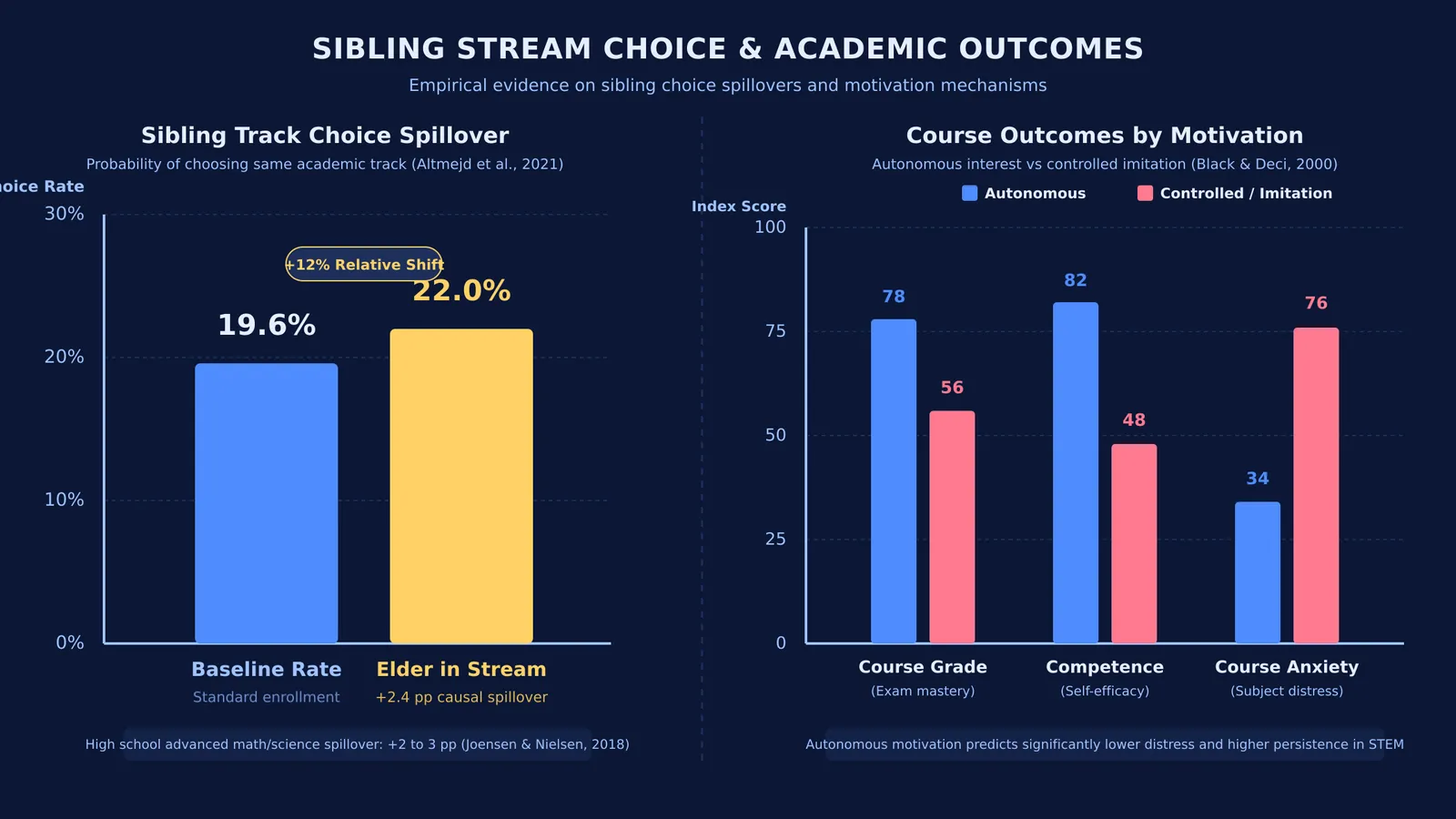
First, older siblings provide what economists call a salient information channel. In a four-country study published in *The Quarterly Journal of Economics*, Altmejd and colleagues (2021) examined within-family educational spillovers and found that a younger sibling is 2.4 percentage points more likely to choose the exact same major as their older sibling. Across the sample, this represents a 12 percent increase over the baseline rate of 19.6 percent. The authors showed that this effect is driven by personal information transmission: watching an older sibling navigate a field demystifies the syllabus and makes the track feel approachable.
Second, younger children naturally model older siblings whom they admire. Investigating 171 families with adolescent sibling pairs, developmental psychologists Whiteman, McHale, and Crouter (2007) found that observational learning (modeling) is a primary mechanism shaping adolescent choices. Younger siblings frequently borrow the academic identities of their older brothers or sisters to gain confidence or family approval.
Finally, household culture plays an unspoken role. If the family spent years celebrating an elder child's performance in science or maths, a younger child may internalise the belief that only that specific stream earns true parental respect. Exploring why comparing siblings backfires highlights how subtle family cues push children toward identical goals.
What are the hidden risks of copying an older sibling's stream?
Sibling spillovers also appear in secondary school course selection. Analysing high school choices, Joensen and Nielsen (2018) showed that younger siblings are 2 to 3 percentage points more likely to choose advanced mathematics and science courses when their older sibling did so.
However, when a teenager chooses advanced coursework out of imitation rather than genuine interest, academic difficulties compound. Educational researchers distinguish between autonomous motivation, where a student pursues a subject out of inherent interest or personal value, and controlled motivation, which is driven by external approval, guilt, or emulation.
In an empirical investigation of 137 science students, Black and Deci (2000)84:6<740::AID-SCE4>3.0.CO;2-3) found that autonomous motivation predicted higher course performance, greater perceived competence, and significantly lower anxiety. Students driven by autonomous motivation persisted through challenging concepts, whereas those relying on external factors experienced higher distress.
When the senior secondary syllabus deepens, an imitative student lacks the intrinsic curiosity required to solve demanding numericals or read complex chapters independently. Furthermore, academic struggle invites immediate self-comparison with the older sibling's past report cards. Developing autonomy-supportive parenting practices helps teenagers build internal motivation instead of relying on external validation.
How can parents test if the stream choice is genuine?
Before signing school registration forms, parents can use a four-question diagnostic to test whether their child's enthusiasm reflects authentic interest:
The Independent Content Test: Can your child spend quiet time working through an introductory Class 11 chapter without discussing what their sibling scored in it?
The Intrinsic Motivation Test: Can they identify specific subjects or skills they are genuinely curious to learn, separate from career prestige?
The Sibling Removal Test: If their elder sibling had chosen Commerce or Humanities, would they still choose this stream today?
The Daily Grind Test: Do they look forward to the day-to-day work of the stream—such as problem sets, reading, or lab work—or are they only focused on the final degree?
To let a younger student test their own appetite for senior subjects without the pressure of an elder sibling's coaching notes, the Fermi Concept Library offers lessons across physics, chemistry, biology, mathematics and computing, each with its own lesson and its place in the map. A student can also try worked exercises in the Fermi Problem Library, which uses a step-by-step solver that explains the reasoning rather than printing an answer.
What should parents say to open the conversation?
Separating a child's genuine aspirations from sibling modeling requires a gentle, open conversation that lowers family pressure. Accusing a child of copying will only make them defensive. Instead, reassuring them that every track is valued equally—and learning how to help children learn without adding pressure—creates the psychological safety teenagers need to articulate what they truly want:
"We loved supporting your sister through her science studies, and we are just as excited to support you in whatever stream fits your strengths best."
"You do not need to repeat anyone else's journey to make us proud. This choice belongs completely to you."
"Let us explore all three streams as if nobody in our family has ever chosen one before."
Give your younger teenager the space to discover their own intellectual identity. When a student chooses a stream for their own reasons, they bring the genuine curiosity and internal resilience needed to succeed.