

On this page
If your child already types with two fingers, you may wonder when to teach them properly. Start once handwriting is settled, usually around Class 3 or 4, and practise a little every day.
When should a child start learning typing on a keyboard?
Letting a young child press keys and type their name is fine at any age. Proper touch typing, where fingers rest on the home row and the eyes stay on the screen, is easier to learn once your child can already form letters by hand without thinking about it.
The US Common Core writing standards give a useful yardstick. By Grade 4 they expect children to type at least one page in a single sitting. By Grade 5 it is two pages, and by Grade 6 it is three pages. These are US benchmarks rather than Indian board rules, but those grades line up roughly with Classes 4 to 6, which is a sensible window for regular practice.
Do not swap the pen for the keyboard, though. In a 2009 study that included typically developing children in grades 2, 4 and 6, Virginia Berninger and colleagues at the University of Washington found that the children wrote longer essays, and produced words faster, with a pen than with a keyboard. Berninger's advice, as reported by her university, was to help children "become bilingual writers so they can write by both the pen and the computer."
That study is by Van der Weel and Van der Meer in Frontiers in Psychology. If your child is still struggling to form letters, work on that first. Our guide on why a Class 1 child refuses to write can help.
Why does typing matter for school projects and computer-based exams?
From middle school on, project reports, slides and coding exercises move onto a computer. A two-finger typist spends their energy hunting for keys instead of thinking. Typing doesn't replace understanding, though. If a science project is stuck because the idea itself is unclear, the Fermi Concept Library has a lesson for every concept in physics, chemistry, biology, mathematics and computing.
Entrance exams are moving onto screens as well. JEE Main, run by the National Testing Agency, has been a computer-based test since 2019. Since JEE Main is a maths and science paper rather than a writing test, typing speed itself will not add marks. For what to do if something goes wrong on exam day, read what happens if your computer freezes in JEE Main. Always check the current NTA information bulletin for the rules of each year's exam.
How much should a child practise typing each day?
Little and often. In a classic 1978 study, A. D. Baddeley and D. J. A. Longman trained postal workers to type on a mail-sorting machine keyboard, and the group that practised one hour once a day learned in fewer hours than the group that practised two hours twice a day. The once-a-day group also ended up typing more correct keystrokes per minute. Those were adults. For a child in Classes 3 to 6, scale it down to a short session every day instead of a long Sunday marathon.
A four-week typing plan for Classes 3 to 6
This is our suggested routine, built on the little-and-often finding above: 10 to 15 minutes a day, five days a week, on any free typing-practice website or a plain document.
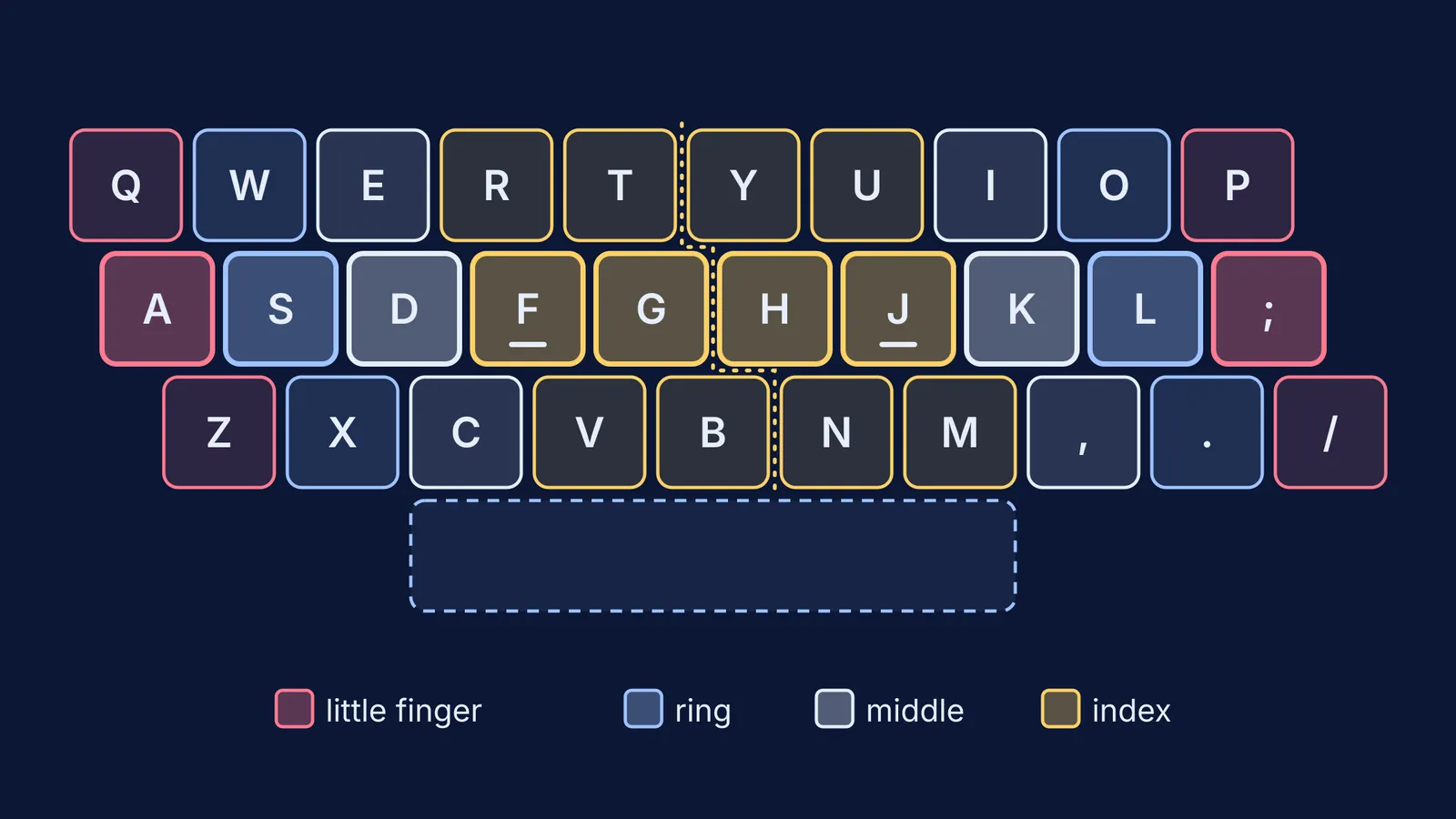
Week 1, home row only. Fingers rest on A S D F and J K L ;, with thumbs on the space bar. Find the small bumps on F and J without looking. Type simple words like "sad", "lad" and "flask".
Week 2, add the top row. Each finger reaches up from its home key and comes back. Keep it slow, because accuracy matters more than speed.
Week 3, add the bottom row and capital letters with the Shift key. Type short sentences from a school textbook.
Week 4, type for real. Your child types a paragraph they wrote by hand earlier in the week, such as a diary entry or a science summary.
Here is what you can say when they get frustrated: "Fast will come later. Today we're just teaching your fingers where to live." If they keep looking down, drape a light cloth over their hands for a minute.
How do you know your child's typing is improving?
They type with all ten fingers and return to the home row without looking.
They sit upright, wrists level, screen at about eye height.
By Class 5 or 6, they can type a page or two of their own writing in one sitting, which matches the Common Core benchmarks above.
They still write comfortably by hand for school tests.
Older students who want to catch up fast can follow our two-week touch typing plan for students. If writing of any kind stays unusually hard, talk to your child's teacher, who can suggest whether a specialist assessment would help.
Start this week with ten minutes on the home row.


