

On this page
The introduction of the National Curriculum Framework for School Education (NCF-SE 2023) brings a major shift for students entering Class 6. The framework enforces a revised Three-Language Formula for the Middle Stage (Classes 6 to 8) that requires students to study at least two languages native to India.
For most families, this means changing how they approach their child's third language.
What is the new Three-Language Formula?
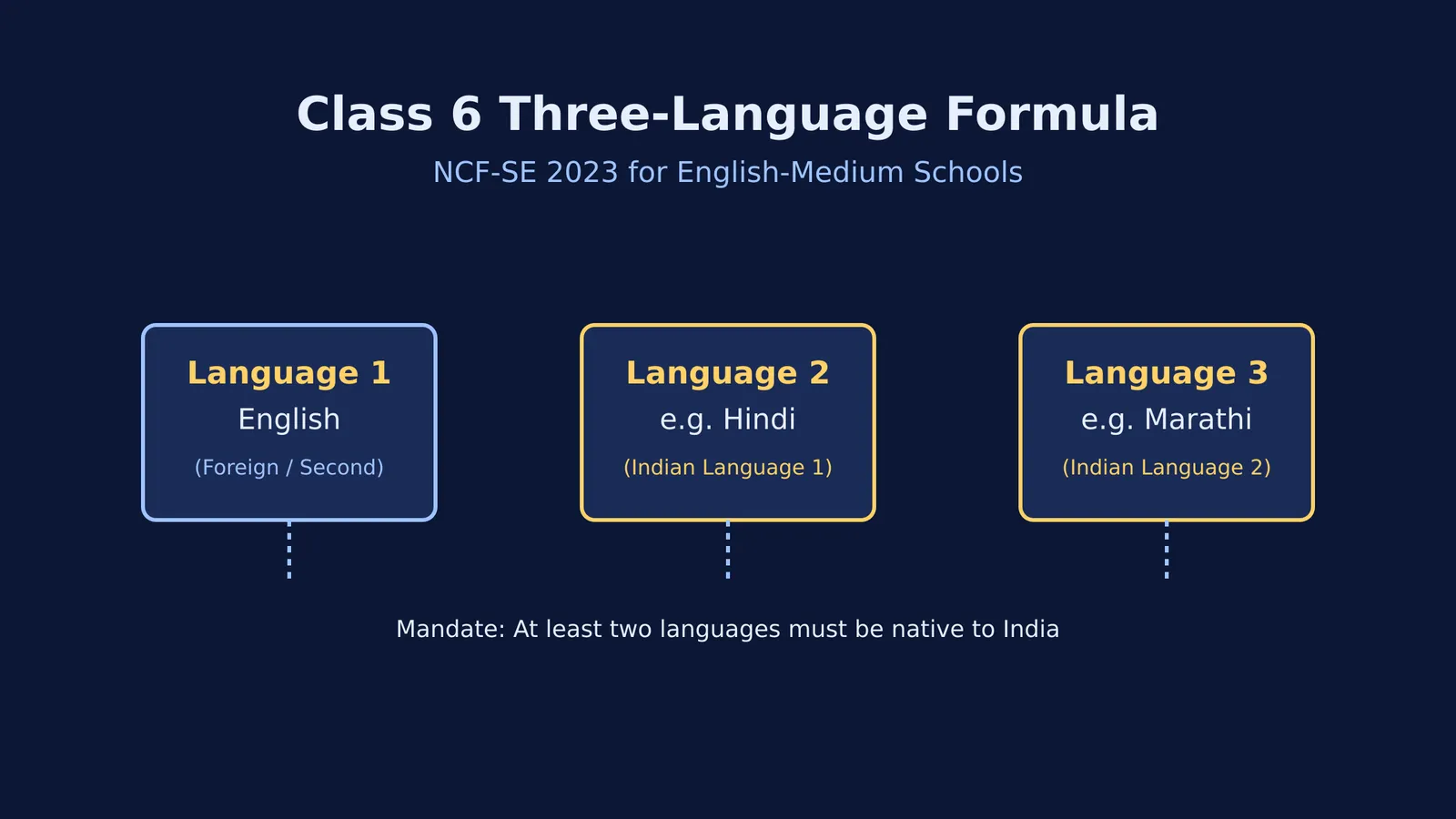
Starting with the Class 6 batch of the 2026-27 academic session, every student must study three academic languages (categorised as R1, R2, and R3). The crucial mandate is that two of these three must be "Bhartiya Bhashas"—languages native to India.
Under this system, English does not count as an Indian language. If your child attends an English-medium school where English takes up one language slot, the remaining two slots *must* be filled by Indian languages, such as Hindi and a regional language (like Marathi or Kannada), or Hindi and Sanskrit.
Students starting Class 6 under this new framework will eventually face a Board Exam for their third language when they reach Class 10. This aligns with broader testing shifts across the country, such as the introduction of CBSE Class 10 two board exams from 2026.
What about French and German?
Previously, many students chose English and a European language like French or German as their primary language electives. Under the NCF-SE 2023 rules, this combination is effectively blocked for the core curriculum.
If a student in an English-medium school picks French as their third language, they are studying two non-Indian languages (English and French) and only one Indian language. Because this violates the mandate, most schools are moving European languages out of the core academic timetable. Instead, French, German, and Spanish will likely be offered only as optional extracurricular clubs or fourth-language electives, meaning they will not count toward the mandatory CBSE language requirements.
Will a third language overload their schedule?
Parents often worry that adding a third academic language will overwhelm their child and steal focus from core subjects. However, research suggests the brain is well-equipped for this challenge.
A 2010 study published in the Bilingual Research Journal found that bilingual students find it significantly easier to learn a third language than monolinguals do to learn a second, as their brains are already adapted to managing multiple linguistic systems and switching between vocabularies. Because students in India are inherently exposed to multiple languages, this "scaffolding" effect works in their favour.
The NCF-SE 2023 also acknowledges the learning curve by recommending more instructional time for the newly introduced third language in the Middle Stage. Still, time management is critical. If you find your child is spending too much time wrestling with core subjects and lacking time for language practice, Fermi's AI tutor works out what they already know and builds a plan for the session, so they sit down to a clear next step instead of a blank page.
Which third language should you choose?
When deciding between the available Indian languages, consider your family's environment and the child's future use.
A Regional Language (e.g. Marathi, Tamil, Bengali): Choosing the local state language is often the most practical choice. It offers immediate real-world practice, such as reading shop signs or speaking with neighbours, and is essential if you plan to stay in the state long-term. Family support—having a parent or grandparent who speaks it—is the biggest predictor of a student's success in a new language.
Sanskrit: Sanskrit is highly structured, pattern-based, and heavily rule-driven. It is a popular option, especially if your child enjoys logical subjects and memorisation, or if they struggle with the conversational demands of modern spoken languages.
How can you support language learning at home?
To build proficiency without burnout, focus on consistency rather than cramming.
The 15-Minute Rule: Instead of a two-hour weekend session, distribute the practice. The 2013 Dunlosky learning techniques review found that distributed practice (spacing study out over time) is one of the most effective ways to retain new information. A short daily vocabulary review beats hours of Sunday cramming.
Media Immersion: Let them watch familiar cartoons or read simple comic books dubbed in the new language. Following the visual context helps them acquire grammar naturally.
Avoid the translation trap: Encourage them to associate new words directly with the object or action, rather than constantly asking, "What does this mean in English?". When testing them, point to a picture rather than saying the English word.


