

On this page
You do not need a workshop to raise a child who can fix things. A screwdriver, a spanner and a torch that has stopped working are enough to teach three things school science will ask for later: how a lever multiplies force, how a circuit must be closed, and how to stay calm when the first try fails. Match the job to the age, and keep every project away from the wall socket.
What can a child learn from a screwdriver, a spanner and a torch?
Screwdriver: the wide handle turns a thin shaft, a wheel and axle. Our explainer on how a screwdriver multiplies force as a wheel and axle has the maths.
Spanner: a lever. Where you hold it changes how hard you must push.
Torch: a complete circuit of cells, switch and lamp. NCERT's Class 7 science textbook, Curiosity, chapter 3, opens its electricity lessons with exactly this.
Patience comes free: screws strip, nuts stick and torches stay dark.
What safety rules apply at each age?
These bands are our editors' starting point, not an official standard. Move your child up when they follow the rules without reminders.
Ages 8 to 10: you hold, they watch, then they try. Use a practice plank with screws you have already started. They can take the cells out of a torch and put them back the right way round.
Ages 11 to 13: they do, you stay in the room. Tighten a loose cupboard hinge or a bicycle nut, choosing the right size of tool first.
Ages 14 and up: they plan, you check in. They repair a torch alone, then show you.
Some rules never change:
Batteries only. The NCERT chapter is blunt: "Never ever perform experiments with power supply at your home or school", and use only cells like those in torches, clocks and remotes (NCERT Curiosity, Class 7).
Safety glasses for anything that can slip or flick. About half of all eye injuries happen at home, and protective eyewear can reduce the risk of eye injury by 90 percent, according to the American Academy of Ophthalmology.
Right tool, good condition. A screwdriver is not a chisel. US construction safety rules bar using spanners whose jaws are sprung so far that they slip (29 CFR 1926.301).
Push away from your body and your other hand.
Lock away spare coin cells if there are toddlers at home. Injury from a button battery stuck in the food pipe can begin in only two hours, warns the National Capital Poison Center, which says to get help immediately if one may have been swallowed, without waiting for symptoms.
How do you teach a spanner as a lever?
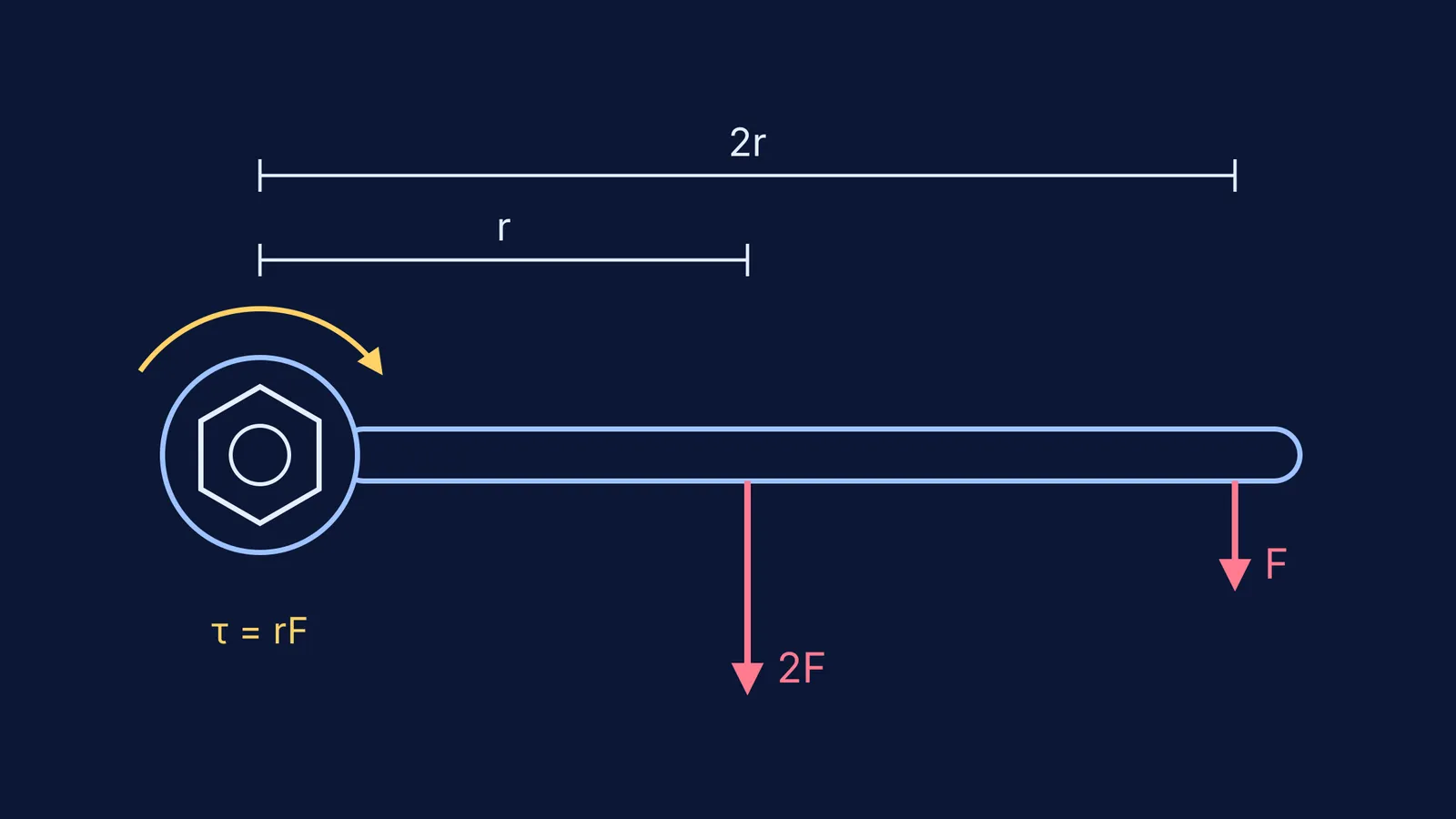
Torque, the turning effect of a force, equals the force multiplied by its perpendicular distance from the pivot, written τ = r⊥F (OpenStax College Physics).
Try this with a stuck nut:
Ask your child to grip the spanner close to the nut and turn. It feels hard.
Now grip about twice as far out. Ask: "How much less push do you need?"
Let them reason it out: doubling the distance halves the push for the same torque.
Finish with the door test: push a door near its hinges, then near the handle. OpenStax uses this example too: push too close to the hinges and the door opens slowly, if at all.
How do you repair a torch with your child?
A dead torch is a fault-finding puzzle. A lamp glows only when current has a complete path, cells sit positive terminal to negative terminal, and a filament lamp "fuses" when its thin wire breaks (NCERT Curiosity, chapter 3).
Change one thing at a time:
Slide the switch on and off and note what happens.
Open the torch and check which way each cell faces.
Swap in fresh cells.
Wipe rust or dirt off the spring and contacts with a dry cloth.
Check the lamp: an old filament bulb may show a broken wire; an LED has a longer positive leg, so the way round matters.
Check that the switch closes the gap.
Before each step, ask for a prediction: "If this is the fault, what will happen when we fix it?" That habit is the science lesson. Next, try why all bulbs go off when one fuses in series. For ideas that are easier to see than to read, the Fermi Simulation Lab has interactive simulations you can explore together.
What should you say when the repair goes wrong?
A torch that still will not light is where patience is learnt, so have the words ready:
"Tools down. What did you expect to happen?"
"What is one thing we can check next?"
"Good, that rules something out."
"Let's get a glass of water and come back."
Don't take the tool from their hand unless safety needs it; fixing it for them teaches that they cannot. Praise the checking, not just the glowing torch.
When your teenager outgrows the torch, learning electronics and soldering is a good next step, still on batteries.


