

On this page
Have you ever tried to turn a stubborn screw using a screwdriver with a very thin handle? It is nearly impossible. But if you switch to a screwdriver with a thick, rubbery grip, the screw turns easily. You are using the exact same amount of hand strength, so where does the extra turning force come from?
The secret is a simple machine called the wheel and axle.
What is the mechanical advantage of a wheel and axle?
A wheel and axle consists of a large wheel attached to a smaller central shaft (the axle) so that they rotate together. According to OpenStax *College Physics*, it functions as a lever that can rotate in a complete circle around a fulcrum (OpenStax).
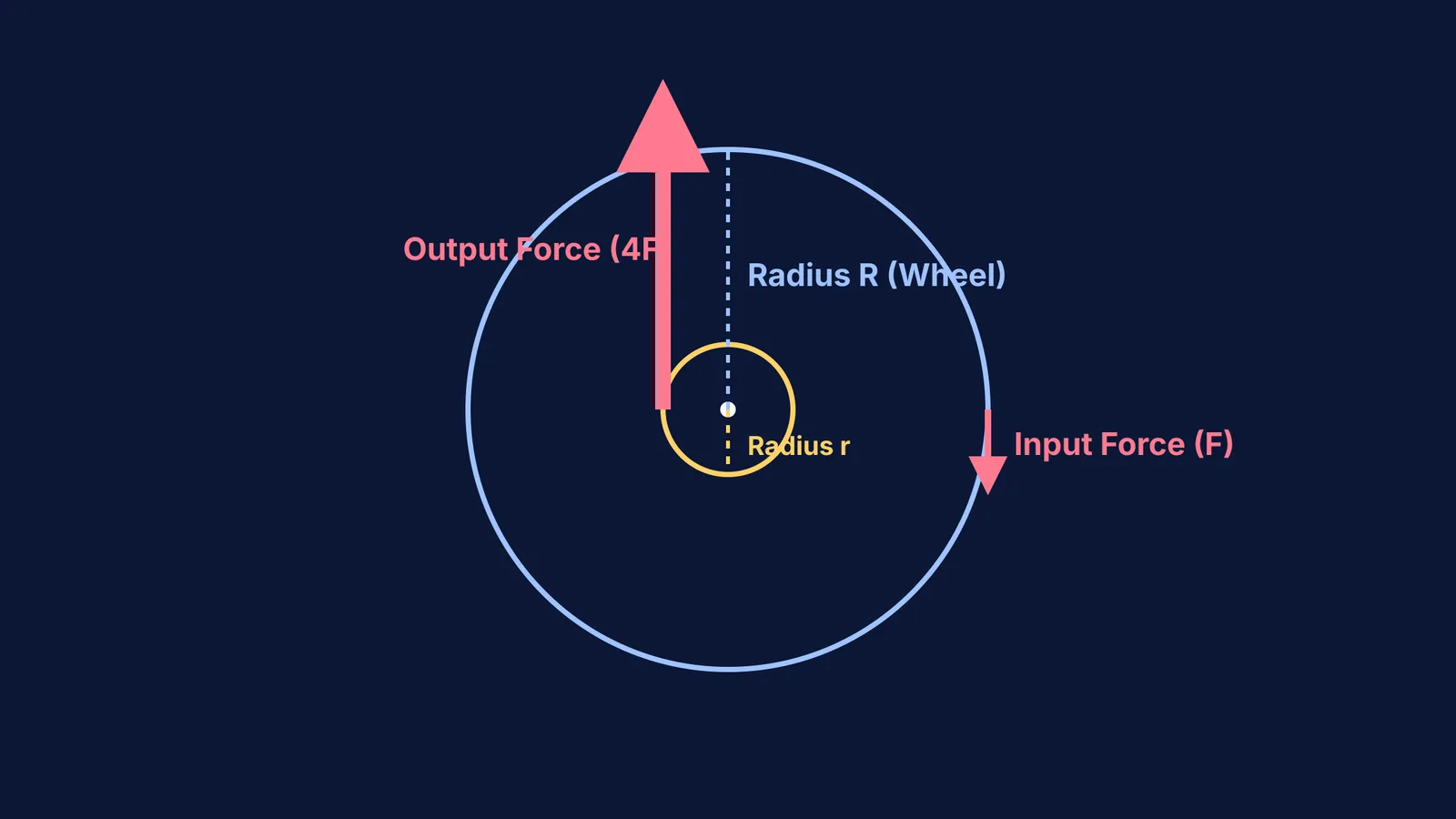
The ideal mechanical advantage (IMA) of this simple machine is calculated by dividing the input radius by the output radius. When force is applied to the wheel, this is the radius of the wheel (R) divided by the radius of the axle (r):
IMA = R / r
When you apply an input force to the outer edge of the wheel, the machine multiplies that force at the axle. Because the wheel's radius is much larger than the axle's radius, the mechanical advantage is always greater than 1. You trade distance for force: your hand moves a long way around the outside of the wheel, while the axle moves a short distance but with a much greater output force.
If you are learning about these trade-offs, the wheel and axle is one of the most common applications of the principle of moments. Because both parts rotate together, the input torque (force × radius) must equal the output torque in a frictionless system. You can explore how these forces are calculated by finding torque about a point with vectors.
How does a screwdriver act as a wheel and axle?
A screwdriver does not look like a traditional wheel, but the physics are identical. The handle you grip is the "wheel," and the metal shaft that slots into the screw is the "axle."
If you cannot loosen a stuck screw, the physics solution is not necessarily to push harder. Instead, you need a screwdriver with a wider handle to increase R, which instantly increases your mechanical advantage and the torque applied to the screw.
Here is a worked example to show exactly how much force you gain using the ratio R/r:
Imagine a screwdriver where the handle's radius R is larger than the shaft's radius r, such that R = 5r.
Calculate the ideal mechanical advantage: IMA = 5r / r = 5.
If your hand applies an input force F to the outside of the handle, the shaft applies a rotational force of 5F to the screw.
This means that the tool multiplies your input turning force. The trade-off is that you must turn the handle a full revolution just to turn the tiny shaft the same revolution.
If you are struggling to map these physical tools to their mathematical formulas, the Fermi Concept Library has a lesson for every simple machine.
Why is a steering wheel considered a wheel and axle?
The steering wheel of a car is another classic example of a wheel and axle designed to multiply force. Because the steering wheel has a much larger radius than the steering column (the axle) it turns, it produces a large mechanical advantage. When you apply a light force to the outside of the steering wheel, the steering column exerts a much greater force to turn the car's heavy linkage.
Just like finding the balance point using the principle of moments on a metre scale, the steering wheel relies on a large radius to amplify your effort.
In real-world applications, friction slightly reduces this ideal advantage, giving you an actual mechanical advantage (AMA) that is slightly lower. This is why a rusty screw might still resist even the thickest screwdriver. However, the core principle remains the same: a larger wheel makes the work feel easier.
A practical checklist for solving wheel and axle problems
When you encounter simple machine problems in your exams, use this checklist to ensure you do not make a careless mistake:
Identify the input and output: Is the force applied to the large wheel or the small axle?
Check the units: Ensure both radii are in the same unit before dividing.
Calculate the IMA: If the input is on the wheel, IMA = R / r. If the input is on the axle, IMA = r / R.
Account for efficiency: If the problem provides an efficiency percentage, multiply the IMA by the efficiency to find the Actual Mechanical Advantage (AMA).
Remember the trade-off: If force is multiplied, distance must be divided. Work (force × distance) is always conserved in an ideal machine.


