

On this page
It is easy to remind your child to say "thank you" when they receive a gift from a relative or extra help from a teacher. Most parents successfully instil this basic level of politeness early on. However, spoken gratitude often becomes an automatic reflex rather than a genuine feeling. Taking the time to sit down and write a thank-you note requires a child to pause, reflect, and articulate exactly why they appreciate what someone else has done for them.
Researchers who study child development have found that this simple practice of writing gratitude letters does much more than teach good manners. It actively rewires a child's thinking, shifting their focus away from what they lack and toward the people who support them in their daily lives.
Are children today lacking gratitude?
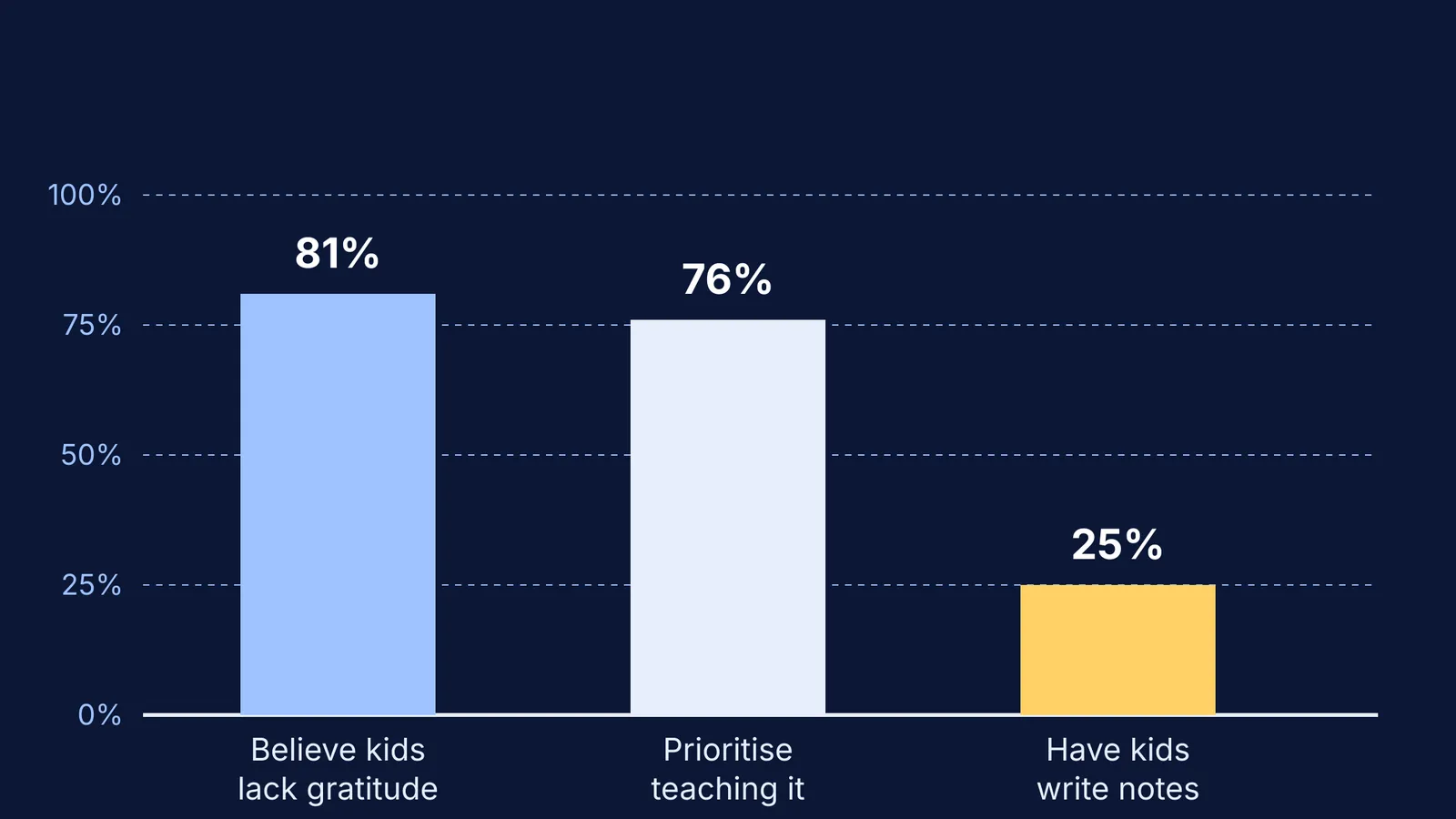
Many parents feel that modern children take their advantages for granted, especially in an era of instant gratification. According to a 2021 C.S. Mott Children's Hospital National Poll on Children's Health, 81% of parents agree that children today are not grateful for what they have.
However, the same poll revealed a significant gap between what parents value and the habits they actively practice at home. While 76% of parents rated teaching gratitude as a "high priority," and 88% regularly prompted their children to say "please" and "thank you," far fewer engaged in structured gratitude practices. Only 25% of parents reported that they regularly have their child write or make thank-you cards for gifts. Relying solely on verbal politeness may cause children to miss out on the deeper psychological benefits of written reflection.
What does writing a thank-you note teach a child?
Expressing gratitude in writing forces a child to engage in a psychological process called "benefit appraisal." Instead of simply enjoying a new toy or a higher test score, the child must think about the cost the giver incurred—whether in time, effort, or money—and the value of the benefit they received.
This reflection pays immediate and lasting dividends for the child's own emotional well-being. A 2009 study published in *The Journal of Positive Psychology* by Dr. Jeffrey Froh and his colleagues tested the effects of writing and delivering a gratitude letter. They found that children and adolescents who completed the letter-writing exercise experienced a significant increase in positive affect (emotions like joy, pride, and enthusiasm) as well as overall gratitude.
Crucially, the researchers noted that these benefits were strongest for youth who initially started the study with lower levels of positive emotions. For these students, the emotional boost provided by the gratitude letter lasted for up to two months after the intervention ended.
How do you help a child write a thank-you note?
Generic notes like "Thank you for the book, I like it" are less effective for building this mindset than highly specific ones. To help your child move beyond the basics, you can guide them using a simple "three questions" framework when they sit down to write their letters:
Intent: Why do you think your aunt or teacher did this for you? Did they notice you needed help, or did they want to make you smile on your birthday?
Cost: What did it cost them to provide this? Did it take their free time on a weekend, their physical effort, or their money?
Value: How does this gift or act of help make your life better or easier?
A thank-you letter based on this framework might look like: *"Dear Mr. Sharma, thank you for staying after school on Tuesday to explain the physics chapter. I know you were busy marking papers and it cost you your free time, but you saw that I was completely confused. Your extra help made me feel much more confident about tomorrow's exam."* This level of detail ensures the child is internalising the kindness they received.
How do you build the habit without forcing it?
While the benefits of writing thank-you notes are clear, developmental psychologists warn against turning gratitude into a forced chore. If children feel they are only writing letters to avoid punishment or to earn a bribe, the exercise loses its internal value. Research on rewards and motivation consistently shows that external bribes can undermine a child's intrinsic desire to engage in a positive habit.
Instead of forcing it, try modeling the behaviour yourself. When your child sees you writing a quick note of appreciation to a colleague, a neighbour, or a relative, they learn that expressing gratitude is a normal, healthy part of adult life. You can also build a routine where the whole household sits down to write, read, or reflect. Setting up a family quiet hour on a Sunday afternoon provides a calm, distraction-free environment where your child can practice writing their notes while you catch up on your own reading or correspondence.
This habit of slowing down and reflecting is a skill that extends far beyond writing letters. Just as writing out a specific thank-you note helps a child reflect on what they value, writing out the steps of a difficult mathematics or science problem helps them learn the underlying reasoning. When your child struggles to put their methods into words or cannot find where they went wrong, the Fermi Problem Library provides worked problems with a step-by-step solver that explains the reasoning rather than printing an answer. By practicing reflection—whether in gratitude or in physics—children learn to think deeply and appreciate the process.


