

On this page
When children sit down to research a school project, they typically type a question into Google, click the first link that looks professional, and start reading. If they find a sentence that fits, they might just copy it. It is a process built on speed, not understanding.
Research shows that simply growing up with technology does not make students skilled at evaluating it. A landmark 2019 study by the Stanford History Education Group involving 3,446 high school students found that 96% of students failed to consider how a website's funding might affect its credibility on climate change (Stanford COR, 2019). Instead of investigating the source, students trusted superficial markers like a polished design or a ".org" domain.
Why do students copy from the internet?
Copying and pasting is widespread. Surveys indicate that 95% of high school students report participating in some form of cheating, such as copying homework, and roughly one in three admit to using the internet to plagiarize an assignment (Plagiarism.org, 2014).
Students often copy because they feel pressured for time, fear poor grades, or simply because they do not understand the underlying material. When they hit a wall—whether they are trying to grasp naming carbon compounds or figuring out concave mirror positions—the internet offers an immediate, effortless answer.
The rise of generative AI has made this even easier. A chatbot can write a full essay or solve an equation in seconds. However, copying bypasses the productive struggle where actual learning happens. If a student simply pastes an answer into a document, they have not formed the neural connections required to recall that information during a closed-book exam.
What is lateral reading and why does it matter?
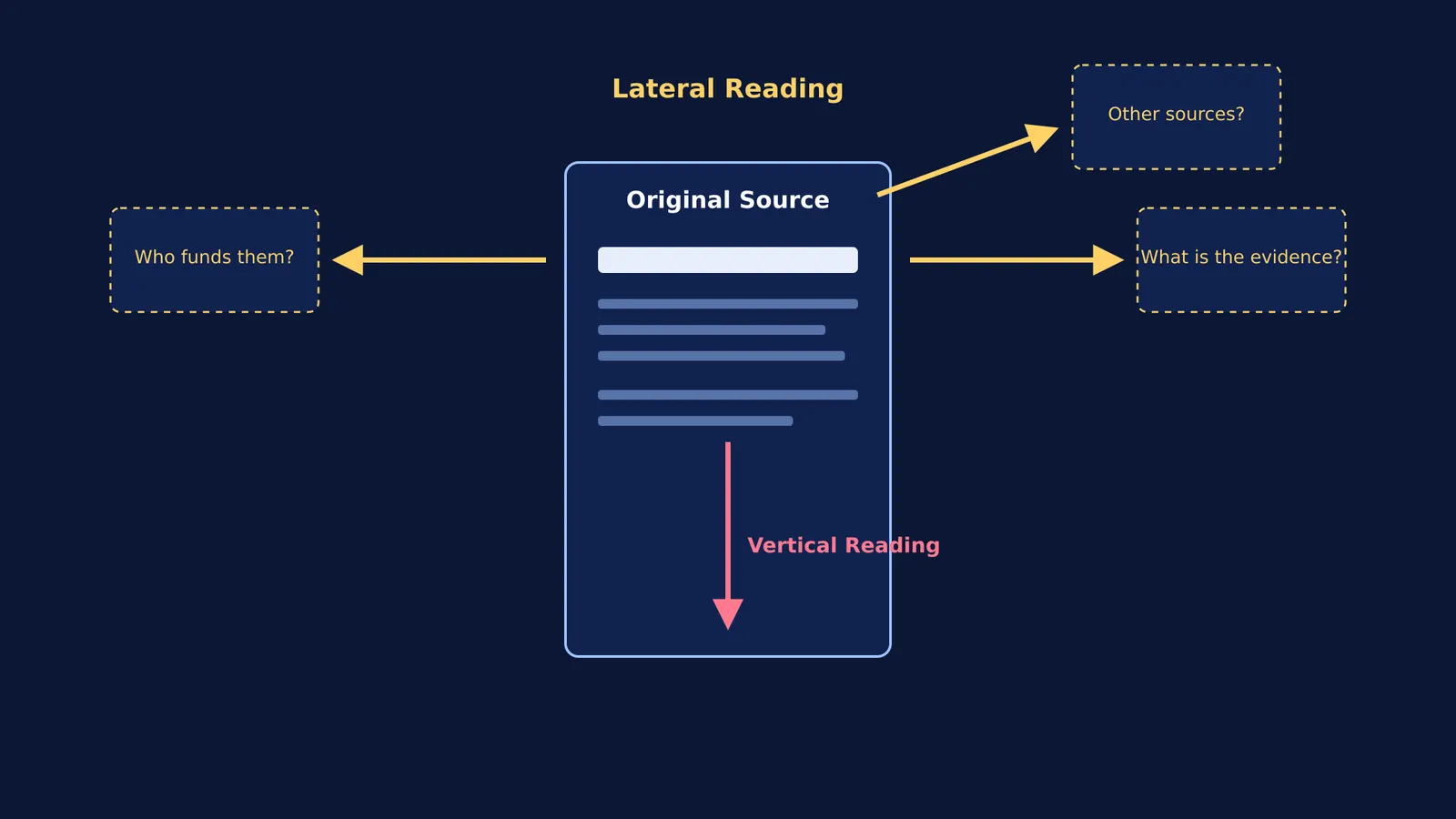
Most students read "vertically": they stay on a single webpage and scroll down, looking at its "About" page, its top-level domain, and its professional logos to decide if it is trustworthy. Professional fact-checkers do the opposite. They read "laterally", meaning they immediately leave the site and open new tabs to see what other independent sources say about the original author.
The vertical reading habit is dangerous because bad actors can easily make a website look authoritative. A 2022 study in the *Journal of Educational Psychology* found that students who received just six 50-minute lessons in lateral reading were significantly more likely to correctly identify questionable websites compared to a control group (Wineburg et al., 2022).
How to teach your child to evaluate sources?
You can teach your child this habit by asking them to pause on the search results page and ask three specific questions before they commit to using a source for their homework:
Who is behind the information? Do not trust a website's own "About" page to tell the truth. Ask your child to search for the organisation's name in a new tab to see who funds them and whether they have a clear bias.
What is the evidence? Does the site link to primary sources, such as official government data or peer-reviewed journals, or does it make claims without backing them up?
What do other sources say? If a site makes a surprising or controversial claim, see if reputable news organisations or established educational institutions report the same thing.
Another key skill is "click restraint". Teach your child not to click the very first search result automatically. Fact-checkers scan the snippets of multiple search results to decide which source is most likely to provide an independent perspective.
How to help them build better study habits?
When your child asks you for help with a difficult concept, resist the urge to just give them the final answer or point them to the quickest Google result. Instead, focus on the process of discovery. Ask them where they have looked so far and what they think is missing.
If they are struggling to start or if they have concept gaps, Fermi's AI tutor can help. Rather than just printing an answer for them to copy, Fermi works out what they already know and builds a plan for the session. The AI tutor notices where a student is stuck and decides whether to explain, ask, or show.
If they need to see the steps of a calculation to understand how a problem is solved, the Fermi Problem Library provides worked problems with a step-by-step solver that explains the reasoning. This ensures they learn the underlying method, so they can apply it themselves in the exam hall without relying on a search engine.
By teaching them to question online sources and value the problem-solving process over the final answer, you equip them with critical thinking skills that outlast any single homework assignment.


