On this page
When a child sits quietly through lessons, their silence is frequently misinterpreted as confusion, daydreaming, or disinterest. In a typical crowded classroom, a child who never raises their hand rarely causes trouble, but they risk fading into the background.
Opening a conversation with your child's class teacher ensures that their observational nature is not mistaken for a learning gap, while creating structured, gentle avenues for them to participate.
Why does classroom shyness get misunderstood?
Teachers naturally rely on oral participation as a quick barometer of understanding. However, research demonstrates that verbal hesitation does not reflect academic capability.
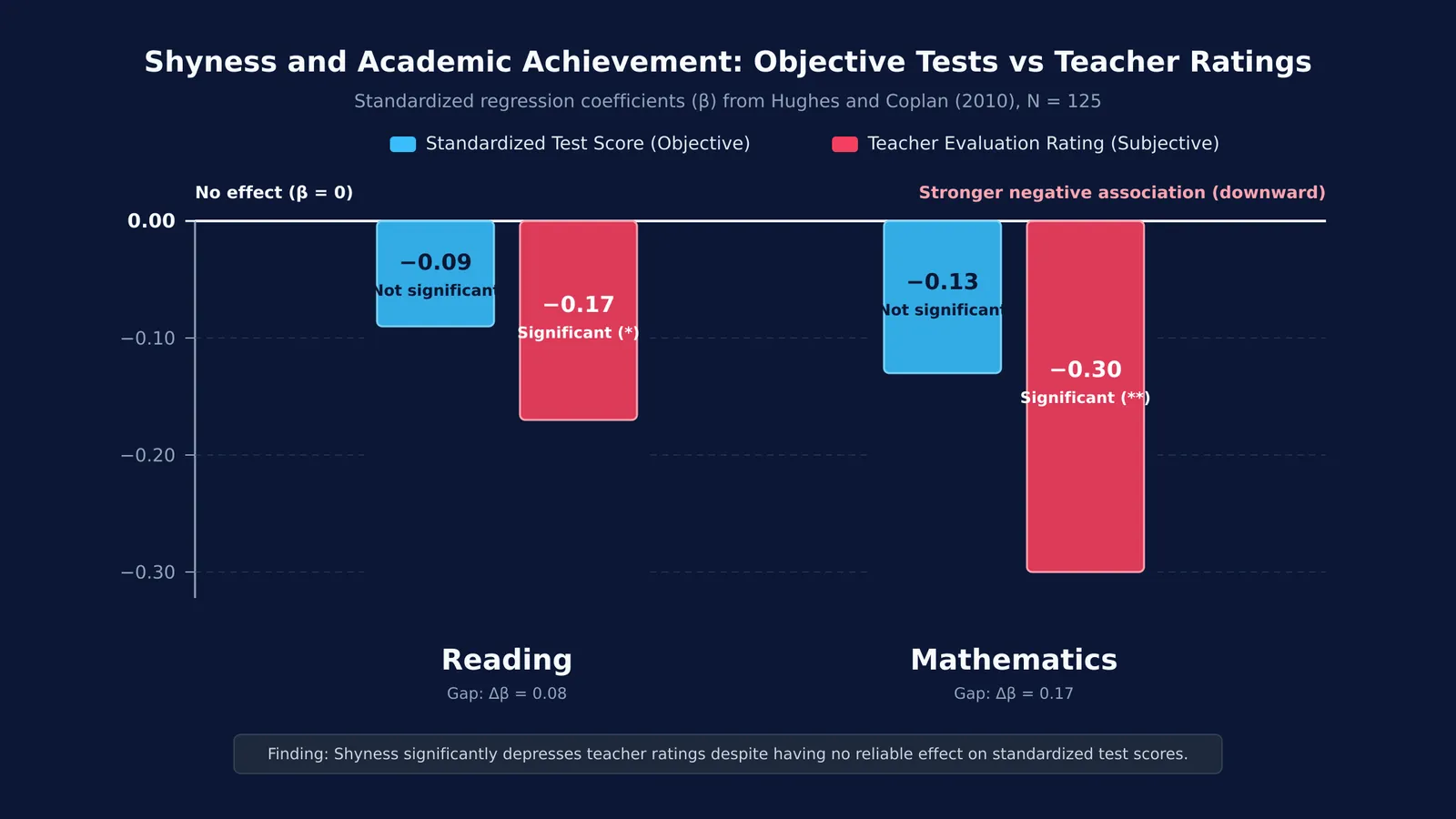
A landmark study by Kathleen Hughes and Robert J. Coplan in School Psychology Quarterly examined 125 students aged 9 to 13 to explore how shyness affects classroom performance. When comparing objective standardised test results with subjective teacher ratings, the researchers uncovered a striking divide. Shyness negatively predicted teacher-rated achievement in reading (β = −0.17) and mathematics (β = −0.30), yet it showed no statistically significant relationship with actual standardised test scores (−0.09 for reading, −0.13 for maths). Teachers evaluated shy children as less academically capable simply because their lack of hand-raising looked like confusion.
This perceptual gap is compounded by how shy children interact with adults. Research by Kathleen Moritz Rudasill and Sara E. Rimm-Kaufman in Early Childhood Research Quarterly following 819 students found that shyness significantly reduces child-initiated contact with teachers. Because quiet students rarely walk up to the desk to ask doubts or initiate chats, teachers perceive less emotional closeness in the relationship unless they deliberately step forward to bridge that space.
What background should you share with the teacher?
Walking into a parent-teacher meeting to announce "my child is shy" often leaves the teacher unsure of what to do differently. Instead of offering a generic label, share three concrete observations from home:
Explain their processing speed: Let the teacher know that your child often knows the answer but needs several seconds to formulate their sentence. They freeze when put on the spot, but thrive when given brief advance notice.
Share their genuine interests: Tell the teacher what topics light them up at home, whether it is solving geometry puzzles, building circuits, or reading historical biographies. This gives the teacher an easy anchor when starting a casual conversation.
Clarify their non-verbal cues: Explain what your child looks like when they are engaged versus when they are overwhelmed. For many quiet students, listening attentively with downcast eyes is active concentration, not distraction.
Framing temperament thoughtfully is part of helping your child flourish. As we highlight in our guide on how to help children learn without pressure, children develop genuine academic confidence when adults respect their pacing rather than forcing extroverted compliance.
How can teachers offer low-stakes chances to speak?
In an educational psychology review published in Translational Issues in Psychological Science, Irina Kalutskaya and colleagues noted that children experiencing classroom speech reticence benefit most when educators scaffold low-stakes communicative opportunities into regular lessons. When you speak with the teacher, suggest two or three manageable strategies:
The gentle heads-up: Ask the teacher to give a private warning before class or during seatwork: "In five minutes, I will ask you to read out the third sentence on page 20." This removes the adrenaline rush of an unexpected call.
Extending the pause: In classic research published in the Journal of Teacher Education, Mary Budd Rowe demonstrated that teachers typically wait less than one second after asking a question before calling on someone else. Increasing wait time to 3 seconds or more dramatically improves response length and allows thoughtful, reticent students to contribute.
Think-pair-share routines: Suggest allowing students to discuss answers with a single bench partner before speaking in front of the whole room. Testing an idea with one peer builds the courage needed to share publicly.
When quiet students struggle with a tricky topic, they often avoid raising their hands during lectures to clarify doubts. Practising at home can rebuild their baseline certainty. Fermi's AI tutor teaches rather than answers: it works out what the student already knows, notices where they are stuck, and decides whether to explain, ask, or show. Exploring topics beforehand through the Fermi Concept Library gives quiet students the familiarity they need to raise their hands without fear.
What should you say during the parent-teacher meeting?
Keep the tone collaborative rather than critical. Frame the conversation around partnering together to help your child share their ideas. Pair your discussion with our checklist of parent-teacher meeting questions that lead to real follow-up.
Here is a simple script you can adapt for an in-person meeting or an introductory email:
"At home, Rohan really enjoys maths and often explains problems clearly to us at the dinner table. However, in a large classroom, he tends to hold back and rarely volunteers an answer. We want to support you in helping him participate. Would it be possible to give him a brief heads-up a few minutes before asking him to read or answer, or let him share ideas with his bench partner first? We find that having a moment to collect his thoughts makes a world of difference."
When your child does speak up in class, celebrate their bravery rather than the outcome. Remember to praise effort over fixed traits, focusing on the effort it took to raise their hand rather than whether the answer was flawless.
How should you follow up after the discussion?
After speaking with the teacher, resist the urge to interrogate your child every afternoon with questions like "Did you speak today?" Doing so simply relocates classroom pressure to the dinner table.
Instead, send a short check-in message to the teacher after two to three weeks:
"Thank you for trying out the advance notice strategy with Ananya over the past couple of weeks. We have noticed she seems much more relaxed when heading to school. From your side, have you seen any small shifts during discussions?"
For most children, shyness is simply a personality trait that softens with time and predictable routines. If your child's reluctance is accompanied by intense physical distress, panic, or complete avoidance of speaking across all social settings, seek professional guidance. In India, free and confidential support is accessible through the national mental health helpline Tele MANAS at 14416.
To help your child build confidence before taking questions in class, the Fermi Problem Library offers worked problems with a step-by-step solver that explains the reasoning rather than just printing an answer.