

On this page
The jump from Class 10 to Class 11 is one of the steepest in the Indian education system. It is also the first time students are formally separated by their academic choices. For many 15-year-olds, the prospect of losing their social circle is more daunting than the syllabus itself, leading them to follow the group rather than their own aptitude.
The invisible pull of the peer group
Teenagers rarely admit to choosing a path just to stay with their friends. A major study involving over 6,500 students found that more than 80% claim they choose subjects based on personal interest, arguing that conscious peer pressure is largely a myth (Cambridge Assessment).
However, experiments tell a different story. Researchers found that students are often unwittingly influenced; their stated academic preferences shifted to match their peers even when they claimed in surveys that friends had no influence on them (Behavioural Public Policy).
In India, this implicit pressure is highly visible. A 2026 survey found that 52.6% of students cited friends or peer recommendations as the single most influential factor in their final college or stream path (ANI). The fear of missing out, or of navigating a difficult new syllabus alone, drives many to take a stream simply because the rest of their group is doing it.
How can you tell if their interest is genuine?
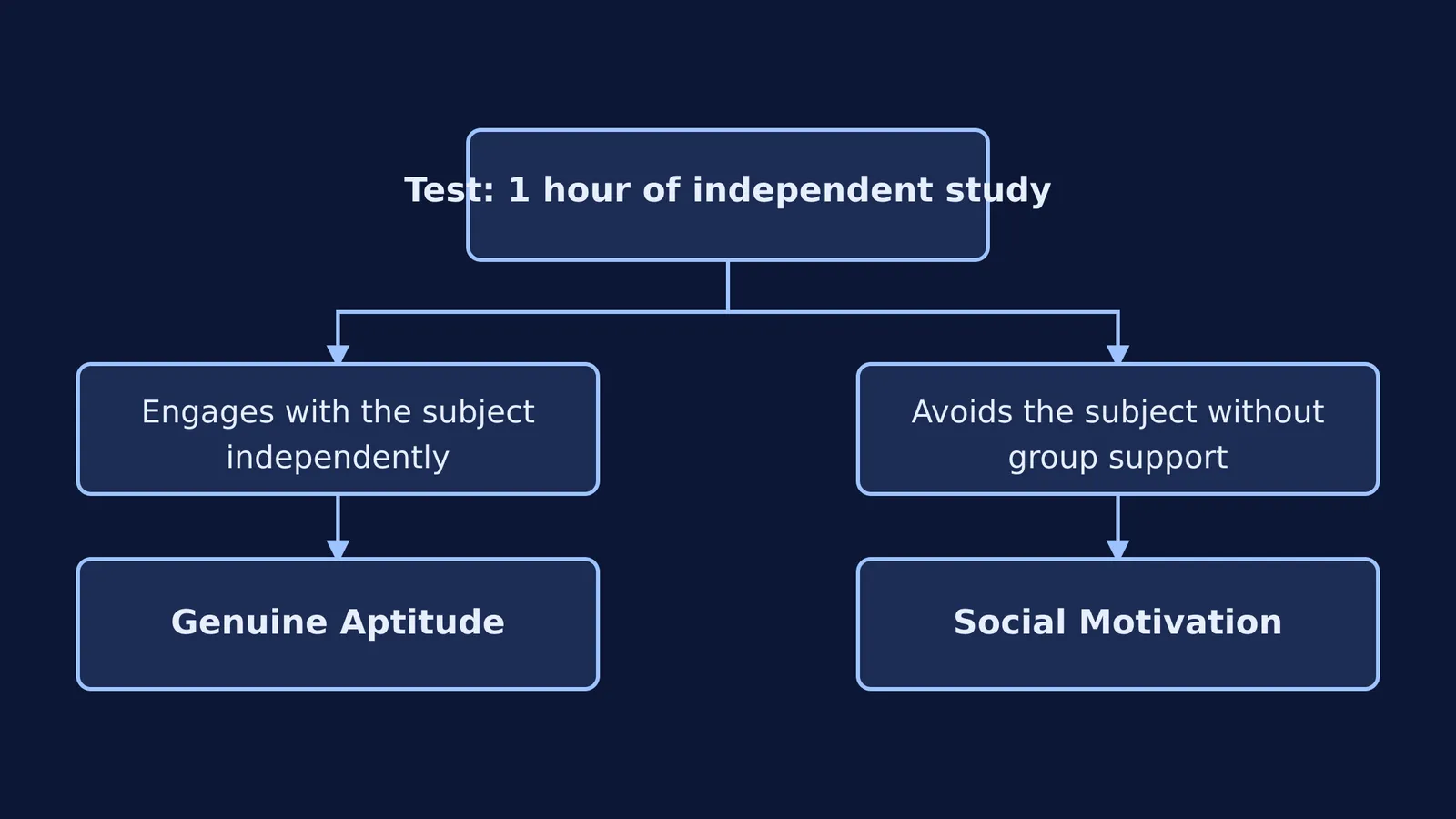
If your child insists they want to study physics or mathematics, but you suspect they are just following their best friend, you need to separate the subject from the social context. Genuine aptitude persists when the group is absent.
One of the most effective ways to test this is through independent problem-solving. Ask them to spend an hour working through a challenging Class 11 concept entirely on their own.
You can test this independence by having them learn a new concept using Fermi's AI tutor. Fermi works out what they already know, builds a plan for the session, and teaches through it — writing on a board, drawing the figure, running the simulation, and checking understanding as it goes. Because the AI asks questions and explains the reasoning directly to the student, it requires their full, undivided attention.
If they persist with the tutor, work through the friction of a new concept, and feel satisfied when they solve it alone, their interest in the subject is real. If they give up quickly and only want to study when their friends are on a group call, they may be confusing social comfort with academic aptitude.
A practical script for parents
Directly asking, "Are you just copying Rahul?" will usually trigger a defensive response. Instead, frame your questions around the daily reality of the stream.
Try these conversation starters:
"What did you enjoy most about the last science chapter you studied alone?"
"If Rahul decided to take Humanities tomorrow, how would that change your plan?"
"Let us look at a Class 11 physics paper together. Which parts of these problems make you want to learn more?"
These questions shift the focus from the social group to the actual work required in the stream. For more advice on navigating these conversations, see our guide to choosing a stream after Class 10.
What to do if they still want the same stream?
If your child is determined to stick with their friends, forcing them into a different stream might cause resentment. However, you can agree on a trial period with clear boundaries.
Allow them to start the stream, but set the expectation that they must build a study routine that lasts independently of their friends. Agree that if they struggle significantly in the first term, they will be open to discussing a change. This compromise respects their social needs while keeping academic reality in focus.
You can also help children learn without adding pressure by ensuring they have academic support outside their peer group. When a student knows they have a safety net at home, they are much more likely to admit when a stream is not the right fit for them, rather than hiding their struggles to save face in front of their friends. Regular check-ins during the first few months of Class 11 can catch these issues before they become permanent roadblocks.


